DC vs AC Power: The Complete Guide (2026)
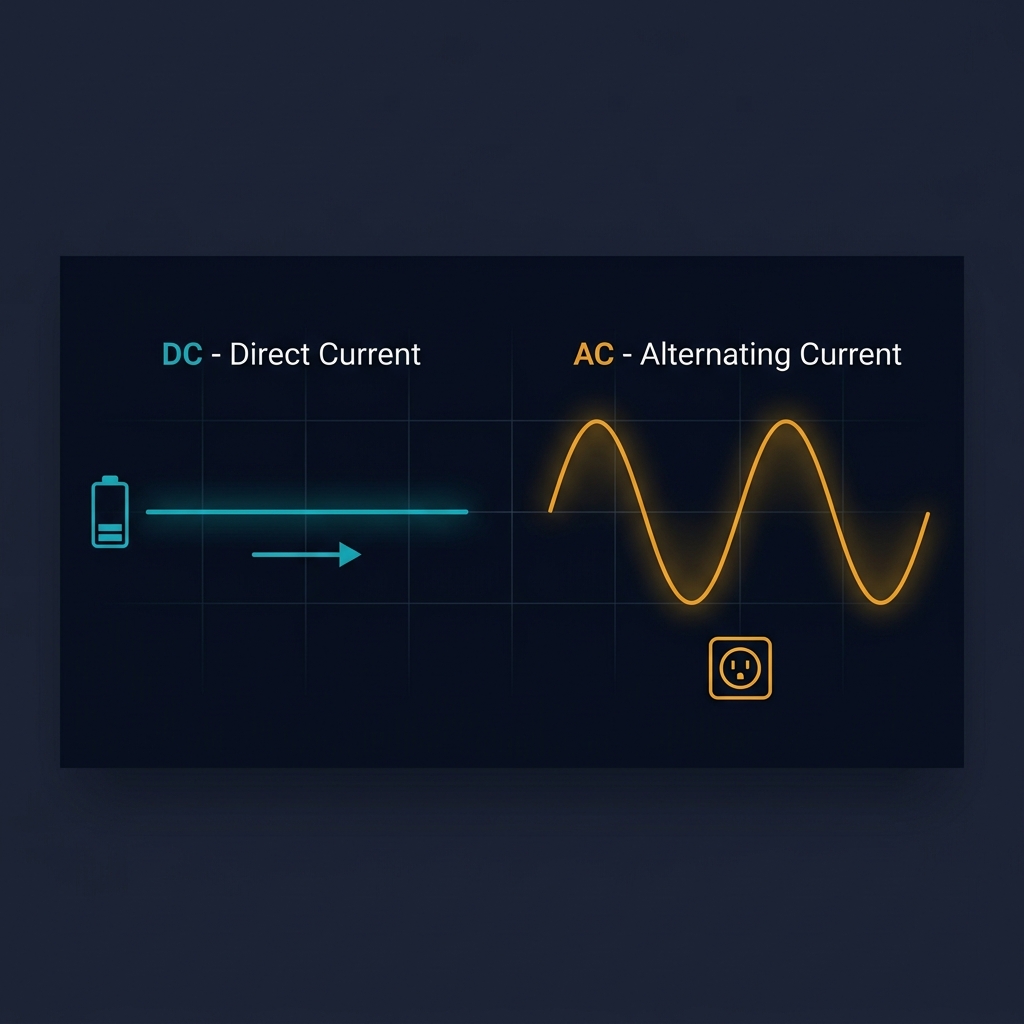
DC vs AC power comes down to one core difference: direct current (DC) flows in a single, steady direction, while alternating current (AC) reverses direction many times per second — typically 60 times in North America. Your home’s wall outlets deliver AC because it’s cheap and efficient to transmit over long distances using transformers. But your phone, laptop, LED lights, solar panels, and EV battery all run on DC — which is why chargers and inverters exist to convert between the two. Neither type is “better.” Each solves a different engineering problem, and modern life depends on both working together.
DC (Direct Current) = electrons flow in one steady direction → batteries, solar panels, phones, laptops, EVs.
AC (Alternating Current) = electrons reverse direction 50–60 times per second → wall outlets, power grid, appliances.
Your home receives AC from the grid. Most of your electronics convert it to DC internally.
That’s the snapshot. But if you’re trying to understand why your solar panels need an inverter, why your EV charger comes in “AC” and “DC” flavors, or what actually happened in the famous Edison vs. Tesla feud — keep reading. This guide covers the real-world differences, the physics behind each, and where DC power is making a surprising comeback in 2026.
What Is the Difference Between DC and AC Power?
Electric current is the flow of charged particles (usually electrons) through a conductor like copper wire. The difference between DC and AC is simply the direction those electrons travel.
DC Power — One Direction, Constant Flow
Direct current flows in a single direction, all the time. Electrons leave the negative terminal, travel through the circuit, and arrive at the positive terminal. No reversals. No oscillation. Just steady, one-way traffic.
Think of it like a garden hose. Turn on the faucet, and water flows one direction — from the spigot to the nozzle. That’s DC. The “pressure” (voltage) stays constant, and the flow doesn’t reverse itself.
Every battery you’ve ever used produces DC. So does every solar panel. Your phone, laptop, TV’s internal circuitry, LED light strips, and the battery pack in an electric vehicle — all DC.
AC Power — Reversing Direction, Sine Wave Pattern
Alternating current does something completely different. The electrons don’t just flow forward — they reverse direction dozens of times per second, pushing forward then pulling back in a rhythmic cycle. In North America, this happens 60 complete cycles every second (60 Hz). In most of Europe, it’s 50 cycles per second (50 Hz).
If DC is a garden hose, AC is more like a tide. The water surges in, then pulls back out, then surges in again — over and over. And if you graph the voltage of AC over time, it traces a smooth sine wave — a pattern discovered by plotting rotating generators in the 1800s.
Here’s what trips people up: even though the electrons are sloshing back and forth, they still deliver energy. The electrical energy moves forward through the wire regardless of which way individual electrons are moving at any given instant. It’s the wave that carries the power, not the electrons themselves traveling from point A to point B.
Quick Comparison Table — AC vs DC at a Glance
| Feature | AC (Alternating Current) | DC (Direct Current) |
|---|---|---|
| Direction of Flow | Reverses periodically | One direction only |
| Waveform | Sine wave | Flat line (constant) |
| Frequency | 50 Hz or 60 Hz | 0 Hz (no frequency) |
| Voltage Behavior | Oscillates (peaks and zero-crossings) | Steady and constant |
| Easy to Transform Voltage? | Yes (transformers) | No (needs electronic converters) |
| Long-Distance Transmission | Excellent (standard grid) | Growing (HVDC lines) |
| Energy Storage | Can’t be stored directly | Stored in batteries |
| Common Sources | Power plants, generators, wind turbines | Batteries, solar panels, fuel cells |
| Common Devices | Refrigerator, washer, HVAC, power tools | Phones, laptops, LEDs, EVs |
| Polarity | Changes every half-cycle | Fixed (positive and negative) |
| Historical Champion | Tesla & Westinghouse | Thomas Edison |
| 2026 Trend | Still dominates grid distribution | Surging in data centers, EVs, and solar |
How Alternating Current (AC) Actually Works
Sine Waves, Frequency, and What “60 Hz” Actually Means
AC voltage doesn’t just toggle between “on” and “off.” It follows a smooth, continuous curve — the sine wave. At any given instant, the voltage is somewhere between its positive peak (+170V for a 120V circuit) and its negative peak (−170V). It passes through zero in between, twice per cycle.
That “120V” on your wall outlet? It’s actually the RMS (root mean square) value — a kind of useful average. The actual voltage peak is about 170V, but the heating effect of the AC wave is equivalent to a steady 120V DC. That’s why the numbers match for practical purposes.
Frequency measures how many of these complete cycles happen per second. In North America, the grid runs at 60 Hz — 60 full sine wave cycles every second. In Europe, Asia, and most of Africa, it’s 50 Hz. The difference is historical, not a matter of one being better than the other.
Here’s a question that bugs people: if AC reverses 60 times per second, why don’t your lights flicker? Two reasons. First, incandescent bulbs have thermal inertia — the filament stays hot between cycles. Second, LED drivers and fluorescent ballasts convert the AC to DC internally, so the light source never actually sees the oscillation.
Why AC Is a Natural Output of Spinning Generators
Every coal plant, gas turbine, nuclear reactor, hydroelectric dam, and wind turbine generates AC. Not by choice — by physics.
A generator works through electromagnetic induction, a principle Michael Faraday discovered in 1831. Spin a magnet inside a coil of wire (or spin the coil near a magnet — same result), and the changing magnetic field pushes electrons through the conductor. As the magnet rotates, it pushes electrons one direction on the upswing, then reverses them on the downswing.
The output is naturally AC. You’d have to add extra components (a commutator or electronic rectifier) to convert it to DC — which adds cost, complexity, and energy loss. The grid skips that step entirely and transmits what the generator produces: alternating current.
How Direct Current (DC) Actually Works
Why Batteries and Solar Cells Produce DC
Batteries produce DC because of chemistry. Inside a battery, a chemical reaction strips electrons from one material (the anode) and pushes them toward another (the cathode). The reaction only works in one direction, so the current only flows in one direction. That’s DC by nature.
Solar cells work the same way — conceptually. When photons from sunlight hit a silicon photovoltaic cell, they knock electrons loose. The cell’s internal electric field (created by doping silicon with phosphorus and boron) pushes those free electrons in one specific direction. Again, one direction. DC.
There’s no spinning involved, no oscillation, no sine waves. Batteries and solar panels are inherently DC devices.
Where You’ll Find DC Power in Everyday Life
DC is everywhere, hiding behind AC adapters and charging bricks:
- Your phone and laptop — the charger converts AC from the wall into DC (typically 5V, 9V, or 20V via USB-C Power Delivery)
- LED light bulbs — the driver circuit inside converts AC to low-voltage DC
- Your car’s electrical system — the 12V battery runs everything from headlights to the stereo
- Game consoles, routers, modems — all powered by external DC adapters
- Flashlights, power banks, wireless earbuds — anything with a battery runs on DC
- Electric vehicles — 400V or 800V DC battery packs power the drivetrain
If it has a battery or a charging cable, it runs on DC. Period.
Why the Power Grid Uses AC (And Why That Matters)
This is the section that answers the question most people actually have: if all my devices use DC, why doesn’t the grid just deliver DC?
Transformers — The Reason AC Won
One device changed the course of electrical history: the transformer. A transformer can step AC voltage up or down with almost no energy loss — and it does it with nothing but two coils of copper wire wrapped around an iron core. No moving parts. No electronics. No maintenance.
Here’s why that matters: energy loss in transmission lines follows the formula P = I²R. Power lost as heat equals the current squared times the wire’s resistance. Double the current, quadruple the heat loss. That’s Ohm’s Law at work, and it’s ruthless.
The solution? Crank up the voltage. Higher voltage means lower current for the same amount of power (because P = V × I). Lower current means dramatically less heat loss in the wires. A transformer can step 20,000 volts up to 345,000 volts for cross-country transmission, then step it back down to 240V at the neighborhood substation.
This trick only works with AC. A traditional transformer relies on a changing magnetic field — and DC, by definition, doesn’t change. It’s constant. A DC-fed transformer is just a paperweight.
From Power Plant to Your Outlet — The Journey
Here’s how AC power reaches you:
- Power plant — A generator produces AC at roughly 11,000–25,000 volts
- Step-up transformer — Voltage jumps to 115,000–765,000 volts for long-distance transmission
- High-voltage transmission lines — Power travels hundreds of miles with minimal loss
- Step-down substation — Voltage drops to 4,000–35,000 volts for local distribution
- Neighborhood transformer — Voltage drops again to 240V (split into two 120V legs in North America)
- Your electrical panel — Distributes power to every outlet and appliance in your home
The whole system works because transformers make each voltage change nearly free. That’s why AC dominates every power grid on Earth.
High Voltage, Low Current — The Efficiency Trick
Think of it like a water system. You can deliver the same amount of water (energy) through a pipe by either using high pressure (voltage) with a thin stream (low current), or low pressure with a fire-hose blast (high current). The thin stream causes less friction in the pipe. The fire-hose approach wastes a ton of energy fighting resistance.
According to the EIA, about 5% of all electricity generated in the United States is lost during transmission and distribution. Without high-voltage AC transmission, that number would be catastrophically higher — potentially 30%+ over long distances. Transformers are the reason your electricity bill isn’t triple what it is now.
The War of Currents — Edison vs Tesla vs Westinghouse
The rivalry between AC and DC isn’t just a physics topic. It’s one of the greatest business battles in American history.
Edison’s DC Empire and the Problem of Distance
Thomas Edison launched the world’s first commercial electrical system in 1882 — the Pearl Street Station in lower Manhattan. It delivered 110V DC power to 85 customers within a one-mile radius. And that radius was the problem.
DC couldn’t travel far. Without an easy way to step voltage up for transmission (remember — transformers don’t work with DC), Edison had to build power stations every mile or so. That worked in dense cities. It was completely impractical for suburbs, towns, or rural areas.
Edison knew AC was a competitive threat. His response wasn’t to improve DC — it was to attack AC.
Tesla’s AC Motor and Westinghouse’s Gamble
Nikola Tesla had designed something Edison couldn’t match: a polyphase AC induction motor, plus an entire system for generating, transmitting, and using AC power. George Westinghouse, a savvy industrialist, licensed Tesla’s patents and built the infrastructure to commercialize them.
Edison’s counter-campaign got ugly. He funded public demonstrations that electrocuted animals with AC to “prove” it was lethal. He lobbied for AC to be used in the first electric chair — hoping the public would associate alternating current with death. It’s one of the darker chapters in the history of American innovation.
The 1893 World’s Fair — Where AC Won
The turning point came at the 1893 World’s Columbian Exposition in Chicago. Westinghouse won the contract to light the entire fairgrounds using Tesla’s AC system. The result was spectacular — a dazzling “White City” illuminated by AC power that millions of visitors experienced firsthand.
Two years later, Westinghouse won an even bigger prize: the contract to build the Niagara Falls hydroelectric power plant. AC generated at Niagara was transmitted 26 miles to Buffalo, New York — a distance Edison’s DC couldn’t touch.
The war was over. AC became the global standard for power distribution.
And here’s the irony: Edison’s own company eventually merged into General Electric — which began manufacturing AC equipment. Even Edison’s legacy conceded the point.
How Devices Convert Between AC and DC
Your wall outlets deliver AC. Your devices need DC. Something has to bridge that gap, and two technologies handle it: rectifiers (AC → DC) and inverters (DC → AC).
Rectifiers — Turning AC into DC (Your Phone Charger)
A rectifier converts AC into DC. The key component is the diode — a semiconductor that acts like a one-way valve. It lets current flow in one direction and blocks it in the other.
The simplest version uses a single diode that chops the AC sine wave in half, passing only the positive portions. That gives you pulsing DC — better than raw AC, but still bumpy. A bridge rectifier uses four diodes arranged in a diamond pattern to flip the negative halves of the wave upward, capturing the full cycle’s energy. Add a smoothing capacitor to fill in the gaps, and you’ve got reasonably clean DC.
Every phone charger, laptop adapter, and USB cable is a rectifier in disguise. That warm brick on your MacBook charger? That’s the heat generated by AC-to-DC conversion.
Inverters — Turning DC into AC (Your Solar System)
An inverter does the reverse — it converts DC into AC. This is how your solar panels feed power into a grid that runs on alternating current.
The core principle is electronic switching. Transistors (usually MOSFETs or IGBTs) rapidly flip the DC current back and forth — 60 times per second in North America — to simulate the alternating pattern of AC. Advanced inverters use a technique called pulse width modulation (PWM) to sculpt these rapid switches into a smooth sine wave that matches grid-quality AC power.
Solar panels generate DC power, which is why every home solar system needs an inverter — and if you’re curious about what power factor means for AC circuit efficiency, that’s the other half of the AC conversion equation.
Why Modern Chargers Are “Switching” Power Supplies
Old-school chargers used bulky transformers to step down voltage (that’s why vintage laptop chargers weighed two pounds). Modern chargers use a switching power supply instead — they rectify the AC to DC, chop the DC into high-frequency pulses (50,000–100,000 Hz), run those pulses through a tiny transformer, then rectify again.
The result? A charger that fits in your palm, wastes less energy as heat, and can negotiate different voltages (USB-C Power Delivery can output 5V, 9V, 15V, or 20V depending on what the device requests). It’s an elegant piece of engineering that most people never think about.
AC vs DC in Solar Energy Systems
The Solar Power Chain — From Panel to Plug
Solar panels produce DC electricity through the photovoltaic effect. Sunlight hits silicon cells, knocks electrons loose, and the cell’s internal structure pushes them in one direction. That’s DC — straight from physics.
But your home runs on AC. Your appliances expect AC. The grid is AC. So the DC from your panels has to be converted before it’s useful.
Here’s the full chain:
- Solar panels produce DC (typically 30–50V per panel)
- Panels wired in series push total voltage to 300–600V DC
- Inverter converts that high-voltage DC to 240V AC (split-phase, matching the grid)
- Your electrical panel distributes the AC to outlets and appliances
- Excess power flows back through the utility meter, spinning it backward (net metering)
Every step between the panel and your toaster involves managing the relationship between DC and AC.
DC-Coupled vs AC-Coupled Battery Systems
If you’re adding battery storage to a solar system, you’ll encounter two architectures — and the difference matters for efficiency.
In a DC-coupled system, solar DC goes straight to the battery through a charge controller — no unnecessary AC conversion along the way. The inverter only kicks in when you actually use the power. Fewer conversion steps means less energy lost as heat.
In an AC-coupled system, the solar inverter converts DC to AC first, then a separate battery inverter converts it back to DC for storage. When you use the stored power, it converts back to AC again. That’s three conversions instead of one, and each one shaves off 2–5% efficiency.
DC-coupled is more efficient. AC-coupled is easier to add to an existing solar installation. Most hybrid inverters in 2026 handle both.
String Inverters vs Microinverters — Quick Comparison
String inverters convert the combined DC output of an entire string of panels (6–12 panels wired together) into AC. One inverter for the whole array. Cheaper, simpler, but if one panel is shaded, the whole string’s output drops.
Microinverters sit behind each individual panel and convert DC to AC right at the source. More expensive upfront, but each panel operates independently — shading on one panel doesn’t affect the others. Panel-level monitoring is a bonus.
Both technologies handle the same fundamental job: turning solar DC into usable AC.
AC vs DC in Electric Vehicles
Electric vehicles are a perfect case study for understanding the interplay between AC and DC power — because an EV uses both, constantly.
Your EV Battery Is DC, Your Motor Runs on AC
The battery pack in a Tesla, Ford, Rivian, or Hyundai EV stores energy as DC — typically at 400 volts, or 800 volts in newer platforms like the Porsche Taycan, Kia EV6, and Hyundai Ioniq 5. Batteries can only store DC. That’s chemistry.
But most EV drive motors are AC induction motors or permanent-magnet AC synchronous motors. The car’s onboard inverter converts the battery’s DC into three-phase AC to spin the motor. The inverter adjusts frequency and voltage in real time to control speed and torque.
When you hit the brakes, the process reverses. The motor becomes a generator through regenerative braking, producing AC that the inverter converts back to DC and feeds into the battery. The car recaptures energy that would otherwise be wasted as heat in brake pads.
Level 1, Level 2, and DC Fast Charging Explained
The charging speed difference between AC and DC charging is enormous — and it all comes down to where the conversion happens.
Level 1 and Level 2 chargers deliver AC power to the car. The vehicle’s onboard charger (a built-in rectifier) converts that AC to DC for the battery. This onboard charger has a limited capacity — typically 7–11 kW — which caps how fast AC charging can go.
DC fast chargers bypass the onboard charger entirely. They perform the AC-to-DC conversion in a massive cabinet at the charging station, then send high-voltage DC straight into the battery. No bottleneck. That’s why DC fast charging can hit 350 kW while your home Level 2 charger tops out at 19 kW.
Level 2 EV chargers run on 240V AC — the same voltage your dryer uses — and the charging speed difference between 120V and 240V circuits is the single biggest factor in how fast you can charge at home.
Why 800V DC Platforms Are the Future of Fast Charging
Most EVs today use 400V battery packs. Newer models are moving to 800V — and the benefits mirror the exact same physics lesson from AC grid transmission.
Higher voltage = lower current for the same power. Lower current = thinner cables, less heat, faster charging speeds. An 800V EV can accept a 350 kW DC fast charge through a cable that’s thin enough to handle comfortably. A 400V car pulling the same power would need cables as thick as a fire hose.
Porsche, Hyundai, Kia, Genesis, and Lucid already ship 800V platforms. Most major automakers plan to follow by 2027.
Is AC or DC More Dangerous?
Let’s be direct: both can kill you. Neither is “safe” to touch when energized. But they’re dangerous in different ways.
AC’s Muscle Lock Problem (The Let-Go Threshold)
AC at 50–60 Hz hits a biological worst-case scenario. At currents as low as 10–20 milliamps, alternating current causes involuntary muscle contraction — your hand clamps onto the wire, and you physically can’t release it. Electricians call this the “let-go threshold,” and it’s the single most dangerous aspect of AC.
Why does this happen? Because 60 Hz is close to the frequency at which muscle fibers respond to electrical stimulation. The alternating signal triggers contraction, then re-triggers it before the muscle can relax. The result is sustained grip. You can’t let go even though every part of your brain is screaming at your hand to open.
DC doesn’t cause this sustained contraction. A DC shock typically produces a single convulsive jerk that throws you away from the source. That sounds violent — and it is — but it often saves your life by breaking contact.
DC Arcs — Harder to Extinguish Than AC
AC has one safety advantage that DC doesn’t: zero-crossings. Sixty times per second, AC voltage passes through zero. That natural interruption helps extinguish arcs — the plasma bridges that form when electricity jumps through air. AC arcs tend to self-extinguish at these zero-crossings.
DC has no zero-crossings. A DC arc, once started, sustains itself until something physically interrupts it. That’s why DC circuit breakers are more complex and expensive than AC breakers — they need arc chutes, magnetic blowouts, or other mechanisms to force the arc out.
This matters for solar installations and battery storage systems, which operate on high-voltage DC. NEC Article 690 includes specific requirements for DC arc-fault protection in solar systems precisely because DC arcs don’t self-extinguish.
Safety Rules That Apply to Both
The lethal threshold for either type is roughly 100–200 milliamps through the chest. Wet skin drops your body’s resistance from ~100,000 ohms to as low as ~1,000 ohms — turning even 120V into a potentially deadly current source.
Always turn off the breaker before working on any circuit. Use a voltage tester to confirm the circuit is dead. Don’t trust labels, don’t trust switches, and don’t trust that someone else turned it off. Verify it yourself.
This article provides general educational information about electrical systems. For any electrical installation, wiring, or work involving AC or DC circuits, always hire a licensed electrician. All electrical work must comply with the National Electrical Code (NEC/NFPA 70) and your local building codes. Never work on live circuits.
AC vs DC Efficiency — Which Wastes More Energy?
I²R Losses — The Universal Energy Tax
Both AC and DC suffer from the same fundamental loss: current flowing through a wire generates heat. The formula is P = I²R — power lost equals current squared times resistance. Double the current, and you quadruple the waste heat. This applies equally to AC and DC.
But that’s where the similarity ends.
AC’s Extra Overhead: Skin Effect and Reactive Power
AC has two additional loss mechanisms that DC avoids entirely.
Skin effect: AC current concentrates near the surface of a conductor rather than flowing uniformly through the entire cross-section. At 60 Hz, this effect is small but measurable — it effectively reduces the usable area of the wire, increasing resistance. At higher frequencies, the effect is more pronounced.
Reactive power: AC circuits with inductive loads (motors, transformers, fluorescent ballasts) draw extra current to sustain magnetic fields. This reactive current flows back and forth through the wires without doing useful work — but it still generates I²R losses in the conductors. Power factor measures this inefficiency: a power factor of 0.80 means 20% of the current is “wasted” on magnetic field maintenance.
DC circuits have neither problem. No skin effect (DC uses the full conductor cross-section), and no reactive power (no oscillation means no magnetic field cycling). On a wire-to-wire basis, DC is inherently more efficient.
Why Data Centers Are Switching to DC
Data centers are the proving ground for DC’s efficiency advantage. Traditional data centers receive AC from the grid, convert it to DC for the UPS battery backup, convert it back to AC for distribution, then convert it to DC again at each server’s power supply. That’s three AC↔DC conversions, and each one wastes 2–5% of the energy as heat.
The fix? Skip the middle steps. Major data center operators are piloting high-voltage DC distribution — typically 380V or 800V DC — that delivers power directly to server racks with fewer conversion stages.
The numbers make the case: a traditional AC UPS system runs at roughly 88% efficiency. An HVDC distribution chain can hit 92%. That 4-percentage-point gap translates to millions of dollars in annual electricity savings for a hyperscale facility. Google has used 48V DC rack-level distribution for years. In 2026, 800V DC distribution is gaining traction as AI workloads push rack power density from 9 kW to over 100 kW per cabinet.
The Future of DC Power — HVDC, Data Centers, and Microgrids
The War of Currents ended with AC’s victory in the 1890s. But 130 years later, DC is staging a quiet comeback.
HVDC Transmission Lines — DC’s Comeback Story
High-voltage direct current (HVDC) transmission is growing worldwide for one simple reason: it beats AC over very long distances.
HVDC lines lose roughly 3% of their power per 1,000 kilometers — about 40% less than equivalent AC lines over the same distance. HVDC doesn’t suffer from reactive power losses, capacitive charging, or skin effect. And for submarine cables — where capacitive effects make AC impractical beyond about 50 km — HVDC is the only viable option.
ABB, Siemens Energy, and Hitachi Energy have installed HVDC links across the North Sea, under the English Channel, and between Scandinavia and mainland Europe. China has built 1,100 kV HVDC lines spanning thousands of kilometers to carry hydroelectric power from western provinces to eastern cities. The technology that Edison couldn’t make work in the 1880s is now carrying gigawatts across continents.
800V DC in Data Centers — Powering the AI Era
AI training requires enormous computing power, and computing power requires enormous electrical power. A single AI training cluster can draw more electricity than a small town. Traditional AC distribution can’t keep up.
The industry’s response is moving to 800V DC distribution inside data centers. The benefits stack up:
- 4% efficiency gain over traditional AC UPS systems
- 75% reduction in copper cabling within racks (higher voltage = thinner wires)
- Less heat means less cooling demand, lowering the facility’s total energy consumption
- Simpler architecture with fewer AC↔DC conversion stages
The Open Compute Project (OCP) is coordinating standards development. UL, IEEE, and NFPA are updating safety standards to accommodate DC power architectures. Widespread deployment of 800V DC data centers is expected between late 2027 and 2028.
DC Microgrids — Off-Grid Homes, RVs, and Boats
At the opposite end of the scale, DC microgrids are powering off-grid lifestyles. Solar panels produce DC. Batteries store DC. LED lights and USB-charged devices run on DC. Why convert to AC at all?
In an RV, boat, or tiny home, a DC microgrid can run lighting, fans, water pumps, and device charging directly from a 12V or 48V battery bank — no inverter needed. This eliminates conversion losses entirely and simplifies the electrical system. Add a small inverter only for the few AC devices you can’t replace (like a microwave or a specific power tool).
It’s the same logic that made Edison’s original DC system appealing: simple, direct, and efficient — when the distances are short.
Global Voltage and Frequency Standards
120V/60Hz vs 230V/50Hz — How the World Split
| Region | Standard Voltage | Frequency | Plug Types |
|---|---|---|---|
| 🇺🇸 United States / Canada | 120V | 60 Hz | A, B |
| 🇪🇺 Europe | 230V | 50 Hz | C, E, F |
| 🇬🇧 United Kingdom | 230V | 50 Hz | G |
| 🇦🇺 Australia | 230V | 50 Hz | I |
| 🇯🇵 Japan | 100V | 50/60 Hz | A, B |
| 🇮🇳 India | 230V | 50 Hz | C, D, M |
The US ended up at 120V/60Hz largely because Edison’s original 110V DC system set the standard early, and the infrastructure built around it was too expensive to change. Europe electrified later and chose 220–240V from the start — higher voltage meant thinner copper wires and cheaper installation across entire nations. Japan is the oddball: 100V nationwide, but 50 Hz in eastern Japan (Tokyo region, influenced by German equipment) and 60 Hz in western Japan (Osaka region, influenced by American equipment).
Neither standard is inherently superior. The US system is slightly safer at the outlet level. European systems use less copper. Both work.
Travel Adapters vs Voltage Converters — What You Actually Need
A travel adapter changes only the plug shape. It doesn’t change voltage. If you plug a 120V-only hair dryer into a European 230V outlet using just an adapter, you’ll fry it instantly.
A voltage converter actually transforms the voltage from 230V down to 120V (or vice versa). Most modern electronics — laptops, phone chargers, camera chargers — are “dual voltage” (100–240V input printed on the label). These only need a plug adapter, not a converter.
Check the label. If it says “Input: 100–240V, 50/60Hz,” you’re good with just an adapter anywhere in the world.
Frequently Asked Questions
Is a battery AC or DC?
Every battery produces DC — direct current. Chemical reactions inside the battery push electrons in one direction, from the negative terminal through the circuit to the positive terminal. This applies to AA cells, car batteries, lithium-ion packs, and the massive battery arrays at grid-scale solar farms. There’s no such thing as an “AC battery.”
Can you convert AC to DC without a transformer?
Yes. A rectifier circuit using diodes can convert AC to DC without any transformer at all. However, most practical AC-to-DC converters include a transformer (or a switching converter stage) to step the voltage down to usable levels before rectification. Your phone charger, for example, doesn’t feed 170V peak DC to your phone — it steps the voltage down first, then rectifies.
Why do electronics need DC and not AC?
Transistors, microprocessors, and memory chips require a steady, unidirectional flow of current to maintain their logical states (ones and zeros). AC’s constant polarity reversal would flip those states 120 times per second, making digital logic impossible. Every semiconductor device — from a $2 microcontroller to a $10,000 GPU — operates exclusively on DC.
What type of current do LED lights use?
LEDs are DC devices. The light-emitting diode itself requires current flowing in one direction. When you screw an LED bulb into a standard AC socket, a small driver circuit inside the bulb performs AC-to-DC conversion. Some LED strip lights operate directly on 12V or 24V DC from a separate power supply.
Is household electricity AC or DC?
In every country worldwide, household electricity delivered through wall outlets is AC (alternating current). In North America, that’s 120V at 60 Hz. In most of Europe, Asia, and Africa, it’s 230V at 50 Hz. The AC is then converted to DC inside individual devices — your phone charger, laptop adapter, and TV all contain internal rectifiers.
Why can’t transformers work with DC?
A transformer relies on a changing magnetic field to induce voltage in its secondary coil — that’s Faraday’s Law of Induction. DC produces a constant magnetic field, which doesn’t induce anything. Feed DC into a transformer, and you get zero output voltage (plus a lot of heat as the constant current saturates the iron core). This limitation is exactly why DC couldn’t compete with AC for grid transmission in the 1880s.
What is the advantage of HVDC over HVAC transmission?
HVDC transmission loses about 3% of power per 1,000 km — roughly 40% less than equivalent HVAC lines. HVDC eliminates reactive power losses, avoids the skin effect, and doesn’t suffer from capacitive charging effects that plague long AC cables. It’s also the only practical technology for submarine power cables longer than about 50 km. The tradeoff: HVDC requires expensive converter stations at both ends, making it cost-effective only for long-distance or undersea applications.
Do wind turbines produce AC or DC?
Wind turbines produce AC — the spinning blades turn a generator that naturally outputs alternating current. However, most modern wind turbines generate “wild AC” at variable frequency (because wind speed changes constantly), then convert it to DC with a rectifier, then convert it back to grid-frequency AC with an inverter. So the generator makes AC, the middle stage is DC, and the output fed to the grid is AC again.
The Bottom Line — AC and DC Are Partners, Not Rivals
The War of Currents ended over 130 years ago, and the real answer was always “both.” AC dominates the grid because transformers make long-distance transmission practical. DC dominates electronics, batteries, and solar because it’s what semiconductors and chemistry demand.
Modern electrical systems convert between AC and DC constantly — often multiple times before power reaches its final destination. Your wall outlet delivers AC. Your phone charger converts it to DC. Your solar panels generate DC. Your inverter converts it to AC. Your EV’s DC fast charger takes grid AC and converts it right back to DC again.
The trend line for 2026 and beyond? DC is gaining ground. Data centers, EVs, solar storage, and HVDC transmission are all expanding the role of direct current in ways Edison couldn’t have imagined. AC isn’t going anywhere — the grid is built on it — but the balance between the two is shifting for the first time in a century.
Understanding how AC and DC work together isn’t just academic. It’s the key to making smart decisions about solar panels, EV chargers, battery backups, and the electrical future of your home.