120V vs 240V: What's the Difference? (Complete Guide)
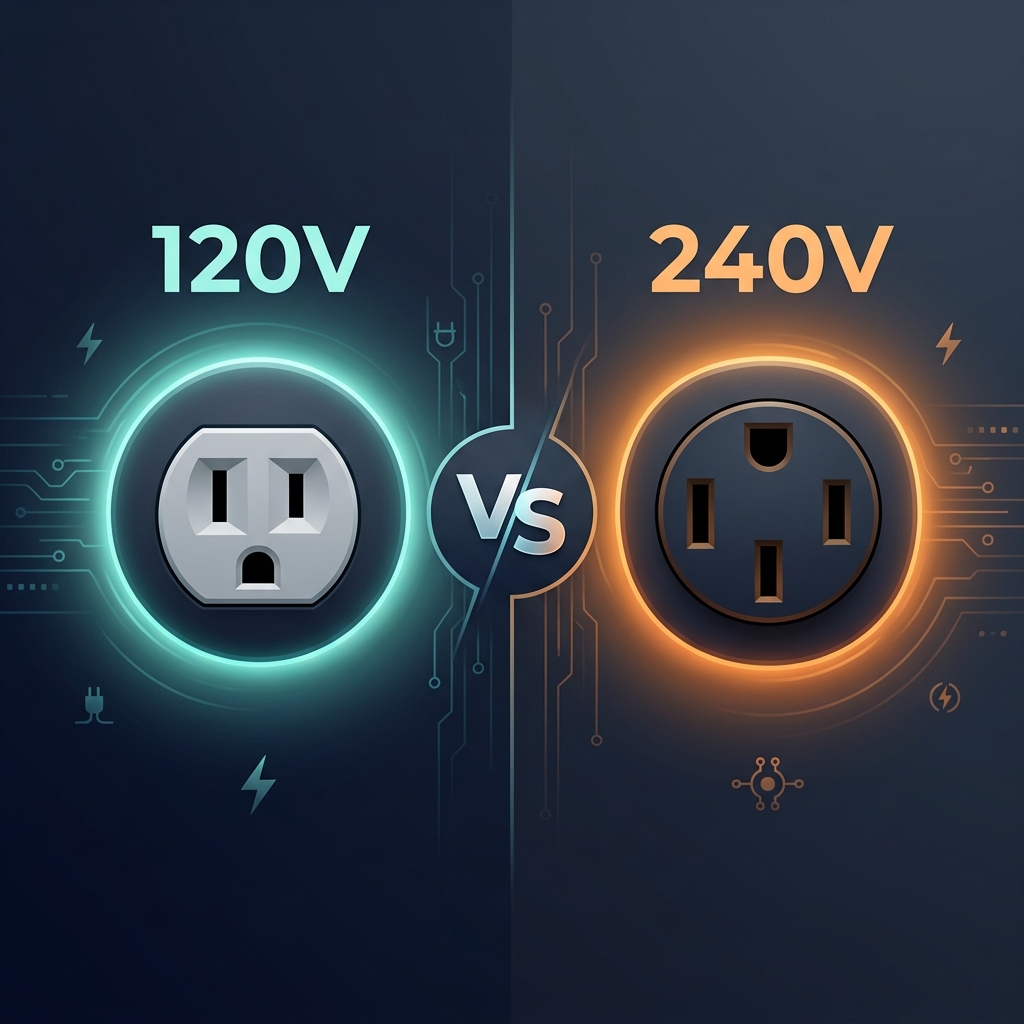
120V vs 240V — what’s the difference? A 120V circuit uses one hot wire and a neutral wire to deliver standard household power. A 240V circuit uses two hot wires together, doubling the voltage for heavy-duty appliances like dryers, ovens, and EV chargers. Both voltages exist in every North American home through a split-phase electrical panel — your utility delivers 240 volts, and your panel splits it into two 120V halves. The key practical difference? 240V delivers more power at lower amperage, which means less strain on your wiring.
120V = 1 hot wire + 1 neutral wire → powers lights, TVs, small appliances.
240V = 2 hot wires → powers dryers, ranges, water heaters, EV chargers.
Both come from the same electrical panel in your home. The difference is how many hot wires the circuit uses.
That’s the quick version. But if you’re trying to figure out whether your new appliance needs a special outlet, what it’ll cost to add a 240V circuit, or why your EV charger is agonizingly slow on a regular plug — keep reading. Everything below is written to actually help you make smart decisions, not just repeat the same formula in ten different ways.
How Your Home Gets Both 120V and 240V
Here’s something that surprises most homeowners: your house already has 240 volts. It’s been there since the day the power company connected your service. The question isn’t whether you have 240V — it’s whether you have a circuit wired to deliver it where you need it.
What the Transformer Does
Look at the utility pole nearest your house (or the green pad-mount transformer in your yard). That transformer steps down the high-voltage power line — typically 7,200 volts or more — to a usable 240 volts. It sends that 240V to your home through two hot wires, called “legs,” plus a neutral wire.
Think of it like a two-lane highway. The full highway carries 240V of electrical “traffic.” Each individual lane carries 120V.
Inside Your Electrical Panel
Your electrical panel — the gray metal box with all the breakers — is where the magic happens. Those two 120V legs from the transformer connect to two separate bus bars inside the panel. Every breaker slot on the left connects to one leg. Every slot on the right connects to the other.
When you install a single-pole breaker (the narrow ones), it taps into just one 120V leg. That’s your standard household circuit — 120 volts.
When you install a double-pole breaker (the wide ones that take up two slots), it bridges both 120V legs simultaneously. One leg at 120V plus the other leg at 120V equals 240V across the pair. No transformer tricks, no voltage boost — just combining what’s already there.
One Hot Wire vs Two Hot Wires
This is the single most important takeaway. A 120V circuit runs on one hot wire and returns current through a neutral wire. A 240V circuit runs on two hot wires — each carrying 120V but offset in phase, so the potential difference between them is 240V.
Some 240V circuits include a neutral wire too (like your dryer or range circuit), because those appliances need both 240V for heating elements and 120V for controls, timers, and lights. Others — like a baseboard heater or well pump — skip the neutral entirely because every component inside runs on 240V.
Key Differences Between 120V and 240V at a Glance
Side-by-Side Comparison Table
| Feature | 120V Circuit | 240V Circuit |
|---|---|---|
| Hot Wires | 1 | 2 |
| Neutral Wire | Yes (always) | Sometimes (depends on appliance) |
| Ground Wire | Yes | Yes |
| Breaker Type | Single-pole (15A or 20A) | Double-pole (20A–50A+) |
| Typical Wire Gauge | 14 AWG (15A) or 12 AWG (20A) | 10 AWG (30A), 8 AWG (40A), 6 AWG (50A) |
| Outlet Type | NEMA 5-15 / 5-20 (standard 3-prong) | NEMA 6-20, 14-30, 14-50 (specialized) |
| Typical Appliances | Lights, TVs, computers, small kitchen appliances | Dryers, ranges, water heaters, A/C, EV chargers |
| Max Power (typical) | 1,440W (15A) – 1,920W (20A) | 4,800W (20A) – 12,000W (50A) |
What the Numbers Actually Mean for You
The table looks technical, but the real-world takeaway is straightforward. Standard outlets in every room of your house run on 120V. They handle anything you’d plug in casually — phone chargers, lamps, the TV, a blender. The moment an appliance needs serious heating power or a big motor, it graduates to 240V.
And here’s the key relationship: at 240V, an appliance draws half the amperage for the same wattage. A 4,800-watt dryer at 240V pulls 20 amps. That same dryer hypothetically running at 120V would need 40 amps — overwhelming a standard circuit. Doubling the voltage cuts the current in half. That’s Ohm’s Law in action.
Which Appliances Use 120V and Which Use 240V?
Common 120V Appliances and Their Wattage
These all plug into standard three-prong wall outlets:
| Appliance | Typical Wattage | Amps at 120V |
|---|---|---|
| 💡 LED Light Bulb | 10W | 0.08A |
| 💻 Laptop | 50–65W | 0.4–0.5A |
| 📺 TV (55″) | 80–120W | 0.7–1A |
| 🍳 Microwave | 1,000–1,200W | 8.3–10A |
| 🔥 Space Heater | 1,200–1,500W | 10–12.5A |
| 💇 Hair Dryer | 1,200–1,875W | 10–15.6A |
Common 240V Appliances and Their Wattage
These need dedicated circuits with specialized outlets:
| Appliance | Typical Wattage | Amps at 240V | Breaker Size |
|---|---|---|---|
| 👗 Electric Dryer | 4,000–5,500W | 17–23A | 30A |
| 🍳 Electric Range/Oven | 8,000–12,000W | 33–50A | 40A or 50A |
| 🌡️ Water Heater | 4,500W | 18.75A | 30A |
| ❄️ Central Air Conditioner | 3,000–5,000W | 12.5–21A | 30A or 40A |
| 🔌 Level 2 EV Charger | 7,200–9,600W | 30–40A | 40A or 50A |
| ♨️ Tankless Water Heater | 18,000–36,000W | 75–150A | Multiple 40A–60A |
The 1,800-Watt Rule of Thumb
Here’s a handy guideline: anything that draws more than about 1,800 watts typically gets a 240V dedicated circuit. Why 1,800? Because that’s the maximum continuous load on a standard 120V, 15-amp circuit (120V × 15A = 1,800W). Go above that, and you’ve outgrown what a regular outlet can safely deliver.
Central air conditioners are among the biggest power consumers in any home — most draw between 3,000 and 5,000 watts on a 240V circuit. If you’re curious about the exact numbers, we’ve broken down how many watts a central AC unit actually uses with seasonal estimates and efficiency ratings.
How to Tell if Your Outlet Is 120V or 240V
You don’t need a multimeter to identify voltage — just look at the outlet. The physical shape tells you everything.
Standard 120V Outlets (NEMA 5-15 and 5-20)
The outlet in your living room, bedroom, and most kitchen countertop locations is a NEMA 5-15. It has two vertical slots (one slightly wider than the other) and a round grounding hole below them. Three prongs. Fits every standard plug you own.
A NEMA 5-20 looks almost identical but has one T-shaped slot instead of a simple vertical one. It’s a 20-amp receptacle — common in kitchens, bathrooms, and garages. Standard 15-amp plugs still fit into it, but 20-amp plugs (with a perpendicular blade) only fit the 5-20.
Both are 120V.
Common 240V Outlets (NEMA 6-20, 14-30, 14-50)
240V outlets look completely different from anything in your living room:
- NEMA 6-20 — Two horizontal slots and a round ground hole. Used for window air conditioners and some power tools. 20-amp, 240V.
- NEMA 14-30 — Three angled slots arranged in an L-shape plus a ground hole. This is your classic dryer outlet. 30-amp, 240V.
- NEMA 14-50 — Four slots in a unique pattern, larger than a 14-30. Used for ranges and Level 2 EV chargers. 50-amp, 240V.
Why the Shapes Are Different (Safety by Design)
The different slot configurations aren’t random — they’re an intentional safety feature established by NEMA. Each voltage and amperage combination has its own unique physical shape, making it physically impossible to plug a 120V device into a 240V outlet or vice versa.
That’s engineering solving a problem before it happens.
Is 240V More Efficient Than 120V?
This is one of the most persistent myths in household electricity. Let’s kill it with math.
The Electricity Bill Myth (You Pay for Watts, Not Volts)
Your utility company charges you per kilowatt-hour (kWh) — a measure of total energy consumed. Not voltage. Not amperage. Total energy.
Quick example: a 4,800-watt electric dryer runs for one hour.
Energy used = 4,800W ÷ 1,000 = 4.8 kWh
It doesn’t matter if that dryer runs at 240V (pulling 20 amps) or hypothetically at 120V (pulling 40 amps). The energy consumed is identical: 4.8 kWh. At the national average of $0.16/kWh, that’s $0.77 per hour either way.
You won’t save a single penny on your electric bill by switching between voltages. The wattage determines your cost. Period.
Where 240V Actually Has an Advantage
So if efficiency is identical, why bother with 240V at all? Because lower amperage has real engineering benefits:
Less heat in the wires. Current generates heat as it flows through conductors. Half the current means roughly one-quarter the heat (power loss is proportional to current squared). Over the life of your home, that reduced heat means less stress on wire insulation.
Thinner wires for the same power. A 4,800W load at 240V needs only 20 amps, which calls for 12 AWG wire. At 120V, that same load draws 40 amps, requiring much thicker (and more expensive) 8 AWG wire.
Less voltage drop over distance. This one matters most for long wire runs — detached garages, workshops, barn circuits. Lower current means less voltage drop per foot of wire.
Voltage Drop Over Long Wire Runs
Imagine you’re running power to a workshop 100 feet from your main panel. At 120V with a 20-amp load, you might see a 5–6% voltage drop — enough to make your tools run sluggish and your lights dim noticeably. The NEC recommends keeping voltage drop under 3% for branch circuits.
That same 20-amp load at 240V? The voltage drop is proportionally halved relative to the total voltage. Your tools run at full power, your lights stay bright, and you don’t need to upsize the wire to compensate.
If you’re wiring anything more than 50 feet from the panel, 240V is almost always the smarter choice.
120V vs 240V for EV Charging
Electric vehicle charging is one of the biggest reasons homeowners suddenly care about the difference between 120V and 240V. The performance gap between the two is enormous.
Level 1 Charging (120V) — The Slow Trickle
Every EV comes with a Level 1 charging cable that plugs into a standard 120V outlet. It works. Barely.
At 120V and 12 amps, you’re adding roughly 3–5 miles of range per hour. A Tesla Model 3 with a 60 kWh battery? That’s about 40–50 hours from empty to full. Nearly two full days of continuous charging.
Level 1 works if you drive fewer than 30 miles a day and can charge every single night. For everyone else, it’s an exercise in frustration.
Level 2 Charging (240V) — The Overnight Solution
A Level 2 charger runs on 240V — typically on a 40-amp or 50-amp circuit. The charging speed jumps to 25–40 miles of range per hour, depending on the charger and your vehicle.
That same Tesla Model 3? Roughly 8 hours from empty to full. Plug in when you get home from work, wake up with a full battery. No range anxiety. No weekend trips to a Supercharger.
What a 240V EV Charger Installation Actually Costs
Budget $500–$1,500 for a typical Level 2 installation. That covers the charger unit ($300–$600), a 50-amp double-pole breaker, 6 AWG wire, and the electrician’s labor. The biggest cost variable is distance — a panel right next to the garage might cost $500 total, while a long run through a finished basement could push past $1,200.
Many utility companies and state programs offer rebates for Level 2 installations. Check with your local provider before getting quotes — you might knock $200–$500 off the total.
Wiring Differences: 120V vs 240V Circuits
How Many Wires Each Circuit Uses
A 120V circuit has three wires:
- 1 hot wire (black) — carries 120V from one panel leg
- 1 neutral wire (white) — return path for current
- 1 ground wire (green or bare copper) — safety path
A 240V-only circuit (like a water heater or baseboard heater) also has three wires:
- 2 hot wires (black and red) — each carries 120V from opposite panel legs
- 1 ground wire (green or bare copper)
A 240V circuit with neutral (like a dryer or range) has four wires:
- 2 hot wires (black and red) — 240V across both
- 1 neutral wire (white) — powers the 120V components inside the appliance
- 1 ground wire (green or bare copper)
Wire Gauge Requirements (NEC Table)
The National Electrical Code specifies minimum wire sizes based on circuit amperage:
| Breaker Size | Min. Wire Gauge (Copper) | Common 120V Use | Common 240V Use |
|---|---|---|---|
| 15A | 14 AWG | General lighting, outlets | — |
| 20A | 12 AWG | Kitchen, bathroom, garage | Window A/C, power tools |
| 30A | 10 AWG | — | Dryer, water heater |
| 40A | 8 AWG | — | Range, EV charger |
| 50A | 6 AWG | — | Range, EV charger, welder |
Wire gauge requirements per NEC Table 310.16 for 60°C/75°C copper conductors. Always verify with local code requirements.
Understanding the relationship between volts, amps, and watts is the foundation of all circuit sizing — and if you ever need to quickly convert between them, our watts-to-volts calculator handles DC and AC conversions in seconds.
Single-Pole vs Double-Pole Breakers
A single-pole breaker clips onto one bus bar inside your panel. It protects one 120V hot wire. When the current exceeds the breaker’s rating, it trips and cuts the circuit.
A double-pole breaker clips onto both bus bars — bridging the two 120V legs to create a 240V circuit. Both halves are mechanically linked, so if one side trips, the other trips simultaneously. That’s a safety requirement: you never want one leg of a 240V circuit live while the other is dead.
Double-pole breakers come in 20A, 30A, 40A, 50A, and 60A ratings. The size you need depends entirely on the appliance’s power draw.
Can I Convert a 120V Outlet to 240V?
Short answer: you can’t just swap the outlet and call it done. A 120V-to-240V conversion requires new wire, a new breaker, and usually a permit.
What the Job Actually Involves
Here’s what an electrician does when you say “I need a 240V outlet”:
- Checks your panel — Is there room for a double-pole breaker? Does the panel have enough capacity?
- Runs new wire — The existing 120V wire (14 or 12 AWG, 2-conductor) can’t handle 240V loads. New, heavier cable gets pulled from the panel to the outlet location.
- Installs a double-pole breaker — Sized to match the appliance (30A for a dryer, 50A for a range, etc.).
- Mounts the correct receptacle — A NEMA 14-30, 14-50, 6-20, or whatever matches the appliance plug.
- Gets it inspected — Most jurisdictions require a permit and inspection for new 240V circuits.
You’re not “converting” the old outlet. You’re running a completely new circuit.
Cost Breakdown (Simple Run vs Panel Upgrade)
When You Might Need a Panel Upgrade
If your electrical panel is full — no empty breaker slots — an electrician has a few options. They might install a tandem breaker to free up space, add a subpanel, or recommend a full panel upgrade from 100-amp to 200-amp service.
A panel upgrade runs $1,500–$3,000+, but it’s often worth it if you’re adding an EV charger, hot tub, or workshop. Modern 200-amp panels give you plenty of capacity for today’s electric-everything lifestyle.
120V vs 240V Safety: What You Need to Know
Let’s be direct about this: both voltages can kill you. Neither is “safe” to work on live.
Which Voltage Is More Dangerous?
240V delivers more electrical energy per shock, which makes it more dangerous in theory. But here’s an uncomfortable truth: more electrocution deaths in the US involve 120V circuits than 240V.
Why? Because people respect 240V. They don’t touch dryer wires casually. But they’ll change a 120V outlet without turning off the breaker, “because it’s just 120.” That casualness is lethal. At 120 volts, your body can draw enough current — especially in wet conditions — to send your heart into fibrillation.
Always turn off the breaker before touching any wiring. 120V or 240V, the rule is the same.
The 80% Rule (NEC Continuous Load Requirement)
The NEC requires that continuous loads — anything running for 3 hours or more — shouldn’t exceed 80% of a circuit breaker’s rated capacity. This safety margin prevents wire overheating.
- 15-amp breaker: 15 × 0.80 = 12 amps max continuous
- 20-amp breaker: 20 × 0.80 = 16 amps max continuous
- 30-amp breaker: 30 × 0.80 = 24 amps max continuous
- 50-amp breaker: 50 × 0.80 = 40 amps max continuous
This rule applies equally to 120V and 240V circuits. Don’t run any circuit at 100% of its rated capacity for extended periods.
When to Call a Licensed Electrician
- You need a new 240V circuit installed
- Your breaker trips repeatedly under normal loads
- Outlets feel warm to the touch or smell like burning plastic
- Your panel is more than 25 years old and you’re adding major loads
- You’re unsure about anything — uncertainty around electricity isn’t a weakness, it’s wisdom
This article provides general educational information about residential electrical systems. For any electrical installation, wiring modifications, or circuit work, always hire a licensed electrician. All electrical work must comply with the National Electrical Code (NEC) and your local building codes, which vary by jurisdiction. Never work on live circuits.
Why Does the US Use 120V While Europe Uses 230V?
You’ve probably wondered about this at some point — especially if you’ve fried a hair dryer while traveling overseas.
The Edison Legacy
When Thomas Edison built the first DC power distribution system in the 1880s, he settled on about 110 volts. It was a compromise: high enough to power incandescent bulbs efficiently, low enough to reduce the risk of lethal shocks. As the US electrical grid expanded, that voltage standard became deeply embedded in the infrastructure. Changing it later would have meant rewiring every building in the country.
Europe electrified later and chose 220–240V from the start. Higher voltage meant less current, which meant thinner copper wires — a real cost advantage when wiring entire nations. They accepted the slightly higher shock risk in exchange for cheaper infrastructure.
Global Voltage Standards at a Glance
| Region | Standard Voltage | Frequency |
|---|---|---|
| 🇺🇸 United States / Canada | 120V | 60 Hz |
| 🇪🇺 Europe | 230V | 50 Hz |
| 🇬🇧 United Kingdom | 230V | 50 Hz |
| 🇦🇺 Australia | 230V | 50 Hz |
| 🇯🇵 Japan | 100V | 50/60 Hz |
Neither standard is inherently better. The US system prioritizes shock safety at the outlet level. European systems prioritize wiring efficiency. Both work well for their respective infrastructures.
120V vs 240V for Workshop and Power Tools
If you’ve ever tripped a breaker while running a table saw and a shop vac at the same time, you already understand the problem with 120V in a workshop.
Why Serious Workshops Run 240V
A 15-amp table saw on a 120V circuit draws the full capacity of a standard breaker. Turn on a dust collector or a shop light at the same time and — pop. Everything goes dark.
That same table saw on 240V? It draws half the current. Roughly 7.5 amps instead of 15. You’ve suddenly got headroom for a dust collector, overhead lighting, and a radio, all on the same circuit without breaking a sweat.
There’s another benefit workshop users love: motor performance. Electric motors experience a phenomenon called “voltage sag” when a circuit is loaded near its maximum. The motor slows down, loses torque, and struggles through thick hardwood cuts. On a 240V circuit with more headroom, the motor runs at full speed with consistent power.
Common Workshop Tools and Their Voltage Options
Many mid-range and professional power tools are dual-voltage — they can run on 120V or 240V with a simple internal wiring change. Check your tool’s motor plate. If it says “120/240V,” your electrician can switch it to 240V in about five minutes.
Tools that commonly benefit from 240V:
- Table saws (3–5 HP contractor and cabinet saws)
- Air compressors (5+ HP stationary units)
- MIG/TIG welders (most require 240V)
- Planers and jointers (2+ HP models)
- Dust collectors (2+ HP central systems)
What Happens If You Plug the Wrong Voltage?
Two scenarios, both bad.
120V Device into a 240V Outlet
The device receives double its rated voltage. Components fry instantly. Capacitors pop. Circuit boards burn. The motor (if it has one) overspeeds and destroys itself. You’ll likely trip the breaker — but not before the device is toast. In a worst case, it can start a fire.
Fortunately, NEMA outlet configurations make this physically impossible with standard equipment. The plug shapes don’t match.
240V Device into a 120V Outlet
The device receives half its rated voltage. A motor-driven appliance will barely spin — or won’t start at all. A heating element produces one-quarter of its rated heat (power = V²/R, so half voltage = quarter power). Your dryer would take four times longer to dry clothes, assuming it starts.
The appliance probably won’t be damaged, but it also won’t work. And depending on the motor type, forcing it to run at insufficient voltage can overheat the windings over time.
Frequently Asked Questions
Can I plug a 120V device into a 240V outlet?
No — and you physically can’t, either. The outlet shapes are deliberately different to prevent voltage mismatches. A standard 120V three-prong plug won’t fit into any 240V receptacle. If someone has modified a plug or outlet to force a connection, that’s a serious fire hazard and code violation.
Does 240V use more electricity than 120V?
No. Your electric bill is based on kilowatt-hours — total energy consumed — not voltage. A 5,000-watt dryer uses 5 kWh per hour regardless of whether it runs on 120V or 240V. The voltage affects how the power is delivered (more or less current), but the total energy cost is identical.
What happens if I run a 240V appliance on 120V?
The appliance receives half its rated voltage, which means it delivers roughly one-quarter of its rated power. Motors won’t reach full speed, heating elements produce minimal heat, and the device essentially doesn’t function. Prolonged operation at half voltage can also damage motor windings due to excessive current draw.
Is 240V wiring more expensive to install?
Somewhat. The wire is thicker (and pricier) because 240V circuits typically serve higher-amperage loads. A 30-amp, 240V dryer circuit using 10 AWG wire costs more in materials than a 15-amp, 120V circuit with 14 AWG wire. The bigger cost factor is labor — running new wire through finished walls or across long distances. Typical range: $250–$1,500 depending on complexity.
What’s the difference between 240V and 220V?
They’re essentially the same thing. The US residential standard was historically called “220V” but was officially standardized to 240V (with a ±5% tolerance, so 228–252V) by ANSI. When your electrician says “220,” they mean 240V. When your grandfather says “220,” he also means 240V. The old name stuck in casual conversation.
Do I need a permit to install a 240V outlet?
In most US jurisdictions, yes. Adding a new 240V circuit means running new wire from your electrical panel and installing a new breaker — work that requires a permit and inspection. This protects you: an inspector verifies the wire gauge, breaker size, outlet type, and grounding all meet code. Unpermitted electrical work can also create problems when you sell your home.
Can I run a 240V dryer on a 120V outlet with an adapter?
No. No adapter can change voltage — an adapter only changes the plug shape. To actually convert 120V to 240V, you’d need a step-up transformer rated for the dryer’s full wattage (typically 5,000W+), which would be expensive, bulky, and a terrible idea. The real solution: have an electrician install a proper 240V, 30-amp circuit and a NEMA 14-30 outlet.
How long does it take to install a 240V outlet?
A straightforward installation — panel nearby, accessible walls, available breaker slot — takes a licensed electrician about 2–4 hours. Complex jobs involving long wire runs, finished walls, or panel upgrades can take a full day. Most residential 240V outlet installations are completed in a single visit.
The Bottom Line — Which Voltage Do You Actually Need?
Don’t overthink this. Check the label on your appliance. If it says 120V, plug it into any standard outlet. If it says 240V, you need a dedicated 240V circuit with the matching NEMA outlet — and that means calling an electrician.
Neither voltage is “better” in an absolute sense. 120V handles everything from phone chargers to kitchen blenders. 240V handles the heavy stuff — dryers, ranges, water heaters, central AC, and EV chargers. Your home was designed for both, and your panel already has the capacity to deliver either one wherever you need it.
The only real question is: do you have a circuit run to the right spot? If not, that’s a phone call, a permit, and a few hours of an electrician’s time.