What Is Electrical Resistance? Ohms Explained (2026)
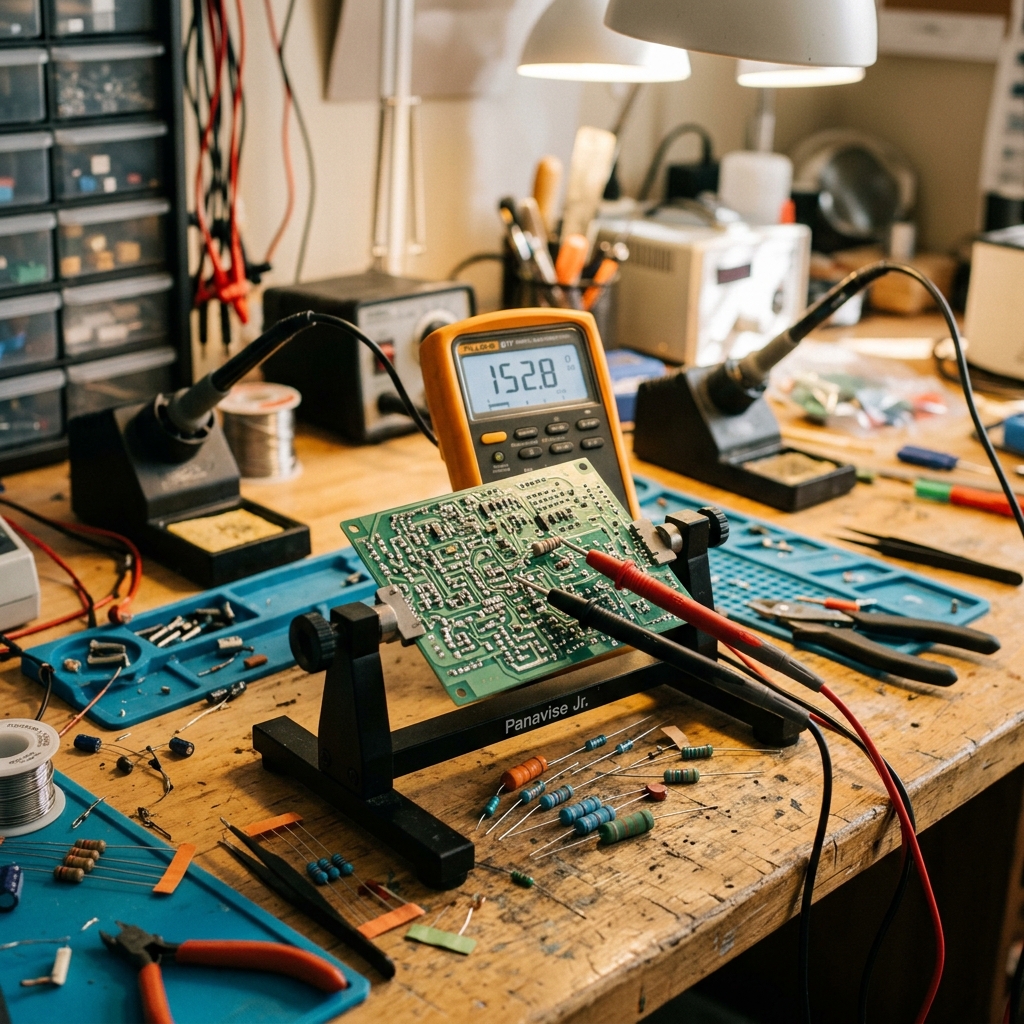
Electrical resistance is the opposition a material puts up against the flow of electric current — and it’s measured in ohms (Ω). Every conductor, from a copper wire to a light bulb filament, has some resistance that converts electrical energy into heat. The relationship is governed by Ohm’s Law: R = V ÷ I, meaning one ohm is the resistance that allows one amp of current to flow when one volt of pressure is applied. Higher resistance means less current gets through. Lower resistance means more current flows freely.
Electrical resistance = the opposition to the flow of electric current through a material.
Unit: Ohm (Ω) — named after German physicist Georg Simon Ohm.
Key formula: R = V ÷ I (Ohm’s Law — Resistance = Voltage ÷ Current).
One ohm = the resistance that allows one ampere to flow when one volt is applied. Without resistance, every circuit would be a short circuit.
You’ve seen the Ω symbol on your multimeter a hundred times. Maybe it’s printed on a resistor, stamped on a speaker, or buried in a spec sheet. But ask most people what an ohm actually measures — or why resistance matters — and you’ll get a shrug or a half-remembered formula from physics class.
Electrical resistance is simpler than it sounds. This guide breaks it down from scratch — what resistance is, what ohms measure, how resistance connects to voltage and current, the four factors that change it, how to measure it with a multimeter, and why any of this matters for your safety. No engineering degree required.
What Is Electrical Resistance? (The Plain-English Definition)
The Water Pipe Analogy — Why It Works
Picture a garden hose connected to a faucet. Turn the handle and water pressure pushes water through the hose. That pressure is voltage. The actual water flowing through? That’s current. Now imagine you stuff a sponge inside the hose — the water still flows, but the sponge fights it. The water has to push harder to get through, and some energy gets lost as friction and heat.
That sponge is resistance.
Every electrical circuit works the same way. Voltage creates the push. Current is the movement of charge. Resistance opposes that movement. Crank the faucet harder (more voltage) and more water gets through despite the sponge. Stuff in a bigger sponge (more resistance) and the flow drops even with the same pressure.
The analogy isn’t perfect — electrons don’t literally flow like water molecules through copper — but it captures the core relationship accurately enough to build real understanding.
The Formal Definition — Opposition to Current Flow
Technically, electrical resistance is the ratio of voltage across a component to the current flowing through it. One ohm equals the resistance that permits one amp of current when one volt is applied. That’s the definition the International System of Units (SI) gives, and it maps directly to Ohm’s Law.
What’s actually happening at the atomic level? Electrons moving through a conductor collide with the atoms making up the material’s crystal lattice. Each collision transfers a tiny bit of kinetic energy from the electron to the atom, producing heat. Materials with tightly packed atomic structures and few free electrons — like rubber or glass — create so many collisions that almost no current gets through. That’s high resistance. Materials like copper and silver have oceans of free electrons and a structure that lets them slip through with minimal friction. That’s low resistance.
Here’s the takeaway: resistance is the property that determines how much current a given voltage can push through a material. Everything else — Ohm’s Law, wire sizing, circuit breakers — builds on that one idea.
What Is an Ohm? (The Unit Behind the Ω Symbol)
An ohm (Ω) is the SI unit of electrical resistance, named after the German physicist who discovered the mathematical relationship between voltage, current, and resistance. One ohm equals the resistance between two points when applying one volt produces exactly one ampere of current flow.
You’ll encounter ohms on multimeter displays, resistor labels, speaker specifications, and heating element ratings. It’s the universal language for quantifying how strongly a material or component opposes current.
Milliohms, Kilohms, and Megohms — The Resistance Scale
Just like distance uses millimeters, meters, and kilometers, resistance has its own prefix system:
- Milliohm (mΩ) = one thousandth of an ohm — wire connections, bus bars, battery internal resistance
- Ohm (Ω) = the base unit — resistors, heating elements, speaker coils
- Kilohm (kΩ) = one thousand ohms — signal resistors, pull-up resistors, sensor circuits
- Megohm (MΩ) = one million ohms — insulation resistance, body resistance (dry skin), leakage testing
A copper bus bar might measure 0.001Ω (1 mΩ). A standard pull-up resistor in an Arduino circuit is 10,000Ω (10 kΩ). The insulation on a healthy power cable should test above 1,000,000Ω (1 MΩ). Same unit, wildly different scales.
Who Was Georg Ohm? (The Man Behind the Unit)
Georg Simon Ohm published his findings in 1827 — and the scientific community mostly ignored him for the next 15 years. His book Die galvanische Kette, mathematisch bearbeitet laid out the precise mathematical relationship between voltage, current, and resistance. The German academic establishment dismissed it. Ohm spent years teaching high school physics in Cologne, waiting for recognition that seemed like it would never come.
It finally did. The British Association for the Advancement of Science adopted the “ohm” as a unit of resistance in 1861 — well after Ohm’s death in 1854. By 1881, the International Electrical Congress made it an official SI unit. Every time you read “Ω” on a multimeter or spec sheet, you’re referencing the work of a man who was right before the world was ready to listen.
Ohm’s Law — The One Formula That Ties It All Together
German physicist Georg Ohm figured this out in 1827, and it remains the single most useful equation in electrical engineering:
If you know any two of the three values, you can calculate the third. That’s the beauty of it.
Three Real-World Examples (Find Resistance, Voltage, Current)
Find Resistance: A 120-volt outlet powers a space heater drawing 10 amps. What resistance does the heater’s element have?
R = 120V ÷ 10A = 12 ohms
Find Voltage: A circuit has 18 ohms of resistance and carries 0.5 amps. What voltage is driving it?
V = 0.5A × 18Ω = 9 volts
Find Current: A 240-volt dryer circuit has a heating element with 20 ohms of resistance. How much current flows?
I = 240V ÷ 20Ω = 12 amps
This relationship governs everything from phone charger design to high-voltage power grid engineering. Double the resistance while keeping voltage constant, and current drops by half. That’s not just theory — it’s the reason your dimmer switch works and your breaker trips.
Watt’s Law — Adding Power to the Picture (P = I²R)
Ohm’s Law handles voltage, current, and resistance. Watt’s Law adds the fourth piece: power.
P = V × I → Power (Watts) = Voltage (Volts) × Current (Amps)
But here’s where resistance plugs in directly. Substitute Ohm’s Law into Watt’s Law and you get:
P = I² × R → Power dissipated = Current² × Resistance
That squared current term matters. Double the current through a resistor and the heat output doesn’t double — it quadruples. This formula explains why your toaster glows red, why power lines run at high voltage, and why undersized wires start fires.
Resistance vs Voltage vs Current — How They Connect
This is the section that clears up the #1 confusion beginners have. Resistance, voltage, and current are three different things — but they’re connected so tightly that you can’t understand one without the other two.
| Property | What It Measures | Unit | Water Analogy | Symbol |
|---|---|---|---|---|
| Voltage | Electrical pressure | Volts (V) | Water pressure | V |
| Current | Flow of electrons | Amperes (A) | Water flow rate | I |
| Resistance | Opposition to flow | Ohms (Ω) | Pipe narrowness / sponge | R |
Why You Can Have Voltage Without Current (But Not the Other Way Around)
An open switch in a circuit is a perfect example. The battery still provides voltage — the potential difference exists between the two terminals. But because the switch creates an air gap (essentially infinite resistance), no current flows. Voltage without current.
Now try the reverse. Can you have current without voltage? No. Current only exists when voltage provides the push. Remove the battery, disconnect the generator, unplug the outlet — and the current stops immediately. Voltage is the cause. Current is the effect. Resistance determines how much effect you get for a given cause.
Voltage is the pressure that pushes current through a circuit — and if you want a full breakdown of how voltage works and how it’s measured, our complete beginner’s guide to voltage covers it from scratch.
What Affects Resistance? (The Four Factors)
Four variables determine the resistance of any conductor. Change any one of them and the resistance changes. They’re captured in a single formula:
Material Type — Why Copper Beats Rubber
Different materials have vastly different numbers of free electrons available to carry charge. Copper has roughly 8.5 × 10²⁸ free electrons per cubic meter — an almost incomprehensible number. Rubber has essentially none. That’s why copper is a conductor and rubber is an insulator.
The material’s inherent opposition to current is called resistivity (ρ), measured in ohm-meters (Ω·m). Silver has the lowest resistivity of any element (1.59 × 10⁻⁸ Ω·m), but copper (1.68 × 10⁻⁸ Ω·m) is nearly as good and far cheaper — which is why it’s the backbone of residential wiring worldwide.
Length — Why Long Wires Mean More Resistance
Resistance is directly proportional to length. Double the wire length, double the resistance. Think of it like running across a field of tall grass. A 50-yard run through tall grass is tiring. A 100-yard run through the same grass is twice as tiring. More distance means more collisions between electrons and atoms, and more energy lost as heat.
This is why long extension cords cause voltage drop. A hundred-foot run of 14 AWG copper wire adds about 2.5 ohms of resistance — enough to noticeably reduce the voltage reaching your power tool at the far end.
Cross-Sectional Area — Thicker Wire, Less Resistance
Resistance is inversely proportional to cross-sectional area. A thicker wire gives electrons more room to move, reducing congestion and collisions. Think of a four-lane highway versus a single-lane road — same traffic volume, but the highway handles it with far less friction.
That’s the entire reason the American Wire Gauge (AWG) system exists. A 14 AWG wire handles 15 amps safely. Need 20 amps? Step up to 12 AWG — a thicker wire with lower resistance and higher current capacity. The NEC’s Table 310.16 sets these ampacity limits specifically because thinner wire has higher resistance and generates more heat per amp.
Temperature — Why Hot Wires Resist More
For most metals, resistance increases as temperature rises. The atoms vibrate more energetically at higher temperatures, making it harder for electrons to slip through. The rate of change is described by the temperature coefficient of resistance (α).
Here’s where it gets practical. An incandescent bulb’s tungsten filament measures about 10 ohms at room temperature. Flip the switch, and within milliseconds the filament heats to roughly 2,500°C. Its resistance climbs to about 100 ohms — a tenfold increase. That’s why bulbs draw a massive surge of current at turn-on (low resistance = high current) and then settle to a lower steady-state current (high resistance = less current). It’s also why incandescent bulbs almost always burn out at the moment you flip the switch, not during steady use.
Resistance vs. Resistivity — What’s the Difference?
This is the #1 confusion point for people who’ve gotten past the basics. Resistance and resistivity are related but they’re not the same thing.
Resistance is a property of a specific object — this wire, this resistor, this heating element. It depends on the material, the length, the thickness, and the temperature. Change the wire’s length and the resistance changes.
Resistivity is a property of a material — copper, silicon, rubber. It’s the material’s built-in tendency to oppose current, independent of shape or size. Copper’s resistivity is always 1.68 × 10⁻⁸ Ω·m at 20°C, whether it’s a thin wire or a thick bus bar.
Think of it this way: resistivity is like the muddiness of a field. Resistance is how hard it is to cross this particular field — which depends on both the muddiness and how far you have to run.
Conductors vs. Semiconductors vs. Insulators — The Resistivity Spectrum
| Material | Resistivity (Ω·m) | Classification | Common Use |
|---|---|---|---|
| Silver | 1.59 × 10⁻⁸ | Conductor | Contacts, high-end connectors |
| Copper | 1.68 × 10⁻⁸ | Conductor | Wiring, circuit boards, motors |
| Aluminum | 2.65 × 10⁻⁸ | Conductor | Power transmission lines, heat sinks |
| Iron | 9.7 × 10⁻⁸ | Conductor | Structural, magnetic cores |
| Nichrome | 1.1 × 10⁻⁶ | Resistance alloy | Heating elements — toasters, hair dryers |
| Silicon (pure) | ~2,300 | Semiconductor | Transistors, chips, solar cells |
| Glass | ~10¹⁰ – 10¹⁴ | Insulator | Insulators on power lines |
| Rubber | ~10¹³ | Insulator | Wire insulation, gloves, mats |
Resistivity values at 20°C. The gap between silver and rubber spans roughly 21 orders of magnitude — a 1 followed by 21 zeros.
Silicon sits right in the middle of this spectrum — and that’s exactly what makes it useful. By adding tiny impurities (a process called doping), engineers can precisely tune silicon’s resistance up or down. That tunability is why semiconductors run the entire digital world.
Resistance in Series and Parallel Circuits
Series — Resistances Add Up
In a series circuit, there’s only one path for current to travel. Every component sits along the same loop. The total resistance is the sum of every individual resistance:
R_total = R₁ + R₂ + R₃ + …
Two 100Ω resistors in series give you 200Ω. Add a third, and you’re at 300Ω. Think of it like single-file traffic on a one-lane road. Every toll booth (resistor) adds more delay, and every car (electron) has to pass through every one of them.
Parallel — More Paths, Less Total Resistance
A parallel circuit offers multiple paths. Current reaches a junction and divides — some goes through branch A, some through branch B — then recombines at the other end.
1/R_total = 1/R₁ + 1/R₂ + 1/R₃ + …
Wire those same two 100Ω resistors in parallel and the total drops to 50Ω. That feels counterintuitive at first — how does adding more resistance lower the total? Think of a highway. One lane handles a certain amount of traffic. Open a second lane and the total traffic flow increases because there are more paths available. Each lane still has its own resistance to flow, but the overall system handles more current with less total opposition.
Worked Examples — Calculating Equivalent Resistance
Series: Three resistors — 10Ω, 22Ω, and 47Ω — connected in series.
R_total = 10 + 22 + 47 = 79 ohms
Parallel: Two resistors — 100Ω and 200Ω — connected in parallel.
1/R_total = 1/100 + 1/200 = 0.01 + 0.005 = 0.015 R_total = 1/0.015 = 66.7 ohms
Notice the parallel result: 66.7Ω is less than the smaller resistor (100Ω). That’s always true in parallel — the total is always less than the smallest individual resistance. More paths always reduce total opposition.
How Resistance Creates Heat (Joule Heating)
Every resistor converts electrical energy into thermal energy. That’s not a flaw — it’s physics. The heat output follows a simple formula:
P = I² × R → Power (Watts) = Current² × Resistance (Ohms)
That squared current term is the key. Double the current and the heat output quadruples. Triple it and heat goes up by nine times.
Why Your Toaster Glows Red But the Cord Stays Cool
Same 10 amps flowing through both. Completely different temperatures. Why?
Your toaster’s nichrome element has roughly 14 ohms of resistance. The power cord connecting it to the wall has about 0.1 ohms. Plug those into P = I²R:
- Toaster element: 10² × 14 = 1,400 watts → glows red-hot
- Power cord: 10² × 0.1 = 10 watts → barely warm to the touch
Same current. Different resistance. Massively different heat. That’s Joule heating in action, and it’s named after James Prescott Joule, who quantified the relationship between electrical energy and heat in the 1840s.
Power Line Losses — Why High Voltage Means Less Waste
Electrical utilities transmit power at extremely high voltages — 345,000V or more — for exactly this reason. The formula P = I²R tells you that heat losses depend on current squared. By stepping voltage up and current down (using transformers), the same amount of power reaches your neighborhood with dramatically less energy wasted as heat in the transmission lines. That’s resistance dictating the design of the entire power grid.
Resistance of Common Materials and Devices
Resistance of Everyday Objects — A Practical Reference
| Object | Typical Resistance | Notes |
|---|---|---|
| 1,000 ft of 14 AWG copper wire | 2.52 Ω | Enough to cause noticeable voltage drop on long runs |
| 1,000 ft of 12 AWG copper wire | 1.59 Ω | 37% less resistance than 14 AWG — that’s why code requires it for 20A circuits |
| Incandescent bulb filament (cold) | ~10 Ω | At room temperature — draws a huge inrush current |
| Incandescent bulb filament (hot) | ~144 Ω | At operating temperature (120V/100W bulb: R = 120²/100) |
| Toaster heating element | ~12–15 Ω | Nichrome alloy — designed for high resistance and heat |
| Speaker (typical home audio) | 4–8 Ω | Actually impedance, not pure DC resistance |
| Human body (dry skin) | ~100,000 Ω | Drops dramatically when wet — see safety section |
| Human body (wet skin) | ~1,000 Ω | 100× lower than dry — makes 120V outlets potentially lethal |
Resistance values are typical at operating conditions. Actual values vary by model, condition, and temperature.
The range is striking. A foot of copper wire has fractions of an ohm. Dry human skin has a hundred thousand. Rubber insulation? Billions. Same unit, incredibly different magnitudes — and every one of those values matters for circuit design and safety.
How to Measure Resistance with a Multimeter
A digital multimeter is the single most useful electrical tool you can own — and measuring resistance is one of its most straightforward functions.
Step-by-Step — Measuring a Resistor
Always de-energize the circuit before measuring resistance. A powered circuit feeds voltage into the meter, producing inaccurate readings and potentially damaging your multimeter. Disconnect power, then measure.
- Turn the dial to the Ω (ohms) setting on your multimeter
- Plug the probes into the correct jacks — black into COM, red into the Ω/V jack
- Touch both probes to opposite ends of the resistor or component
- Read the display — the number shown is the resistance in ohms (the meter auto-ranges on most modern models)
- Check for “OL” — if the display reads “OL” (overload), it means the resistance is too high for the selected range, or you’re looking at an open circuit
That’s it. A basic digital multimeter costs $20–$30 and gives you reliable resistance readings for any component you’re likely to encounter.
Continuity Mode vs. Resistance Mode — When to Use Each
Your multimeter probably has a continuity setting (often marked with a speaker/buzzer icon). Continuity mode doesn’t give you a number — it just beeps when the resistance between the probes is very low (typically under 50Ω). It’s faster for quick checks: “Is this wire broken? Does this fuse still conduct?”
Use resistance mode when you need the actual ohm value — checking a resistor, testing a heating element, or measuring wire resistance. Use continuity mode when you just need a yes/no answer — verifying a wire is intact, checking a fuse, confirming a solder joint.
How to Read Resistor Color Codes
Every through-hole resistor has colored bands printed on its body. Those stripes aren’t decoration — they encode the resistance value in ohms.
Color Code Quick-Reference Chart
| Color | Digit | Multiplier | Tolerance |
|---|---|---|---|
| ⬛ Black | 0 | ×1 | — |
| 🟤 Brown | 1 | ×10 | ±1% |
| 🔴 Red | 2 | ×100 | ±2% |
| 🟠 Orange | 3 | ×1,000 | — |
| 🟡 Yellow | 4 | ×10,000 | — |
| 🟢 Green | 5 | ×100,000 | ±0.5% |
| 🔵 Blue | 6 | ×1,000,000 | ±0.25% |
| 🟣 Violet | 7 | ×10,000,000 | ±0.1% |
| ⬜ Grey | 8 | ×100,000,000 | — |
| ⬜ White | 9 | ×1,000,000,000 | — |
| 🥇 Gold | — | ×0.1 | ±5% |
| 🥈 Silver | — | ×0.01 | ±10% |
4-Band Resistor — Reading Example
Take a resistor with bands: Brown – Black – Red – Gold
- Band 1 (Brown) = 1
- Band 2 (Black) = 0
- Band 3 / Multiplier (Red) = ×100
- Band 4 / Tolerance (Gold) = ±5%
Result: 10 × 100 = 1,000Ω (1kΩ) ±5%
That means the actual resistance falls between 950Ω and 1,050Ω. Good enough for most circuits, and you can verify the value in seconds with your multimeter’s ohm setting.
Resistance and Electrical Safety
Let’s be direct: resistance plays a central role in whether an electrical shock is annoying or fatal. Understanding why — and under what conditions — is part of understanding resistance itself.
Resistance of the Human Body — Why Wet Hands Change Everything
Your body’s resistance depends dramatically on conditions. Dry, intact skin might offer 100,000 ohms. Wet or sweaty skin drops that to 1,000 ohms or less. The difference is life-threatening.
| Skin Condition | Body Resistance | Current at 120V (I = V/R) | Danger Level |
|---|---|---|---|
| Dry, intact skin | ~100,000 Ω | 1.2 mA | Tingling sensation |
| Damp / sweaty skin | ~10,000 Ω | 12 mA | Muscle lock — can’t let go |
| Wet skin (water, sweat) | ~1,000 Ω | 120 mA | ⚠️ Potentially lethal |
| Broken skin / internal | ~500 Ω | 240 mA | ⚠️ Fatal |
Current values calculated using I = V ÷ R at 120V. Lethal threshold is approximately 100–200 mA through the chest. Reference: IEC 60479-1.
That same 120V outlet that barely tingles with dry hands can deliver a lethal shock with wet ones. This is Ohm’s Law applied to your body — lower resistance means more current for the same voltage. It’s why bathrooms and kitchens require GFCI outlets and why you should never work around electricity with wet hands.
The current that flows through your body during a shock depends on both the voltage and your body’s resistance — and if you’re not clear on what amps actually measure and how electric current affects the human body, that’s the piece that makes this all click.
Short Circuits — What Happens When Resistance Drops to Zero
A short circuit is what happens when current finds a path with near-zero resistance — usually through a damaged wire, a failed component, or a loose connection bridging the hot and neutral conductors. Ohm’s Law tells you exactly what comes next: if R approaches zero, current (I = V/R) spikes toward infinity.
The wire can’t handle that kind of current. It heats instantly. The insulation melts. If a circuit breaker or fuse doesn’t interrupt the current fast enough, you’ve got a fire. That’s not theoretical — the National Fire Protection Association (NFPA) reports that electrical failures are a leading cause of residential fires, and short circuits are among the top triggers.
Five Safety Rules for Working Around Resistance and Current
- Always turn off the breaker before touching any wiring — then verify it’s off with a voltage tester
- Assume every wire is live until you’ve personally tested it
- Never work around electricity with wet hands or while standing on a wet surface — moisture drops your body’s resistance from ~100,000Ω to ~1,000Ω
- De-energize before measuring resistance — a powered circuit gives false readings and can damage your meter
- When in doubt, call a licensed electrician — there’s nothing weak about respecting something that can kill you in a heartbeat
Advanced Resistance Concepts (Brief Overview)
Impedance — Resistance’s AC Cousin
When you see “8Ω” printed on a speaker, that’s not resistance — it’s impedance. In DC circuits, resistance is the only opposition to current. In AC circuits, two additional effects come into play: capacitive reactance and inductive reactance. Impedance is the total opposition to current in an AC circuit, combining resistance with these reactive components.
For purely resistive loads (heaters, incandescent bulbs), impedance equals resistance. For loads with coils or capacitors (motors, speakers, transformers), impedance varies with frequency. That’s why your 8Ω speaker doesn’t actually measure 8Ω with a DC ohmmeter — the DC resistance might read 6Ω, while the impedance at 1 kHz is 8Ω.
Superconductivity — When Resistance Hits Exactly Zero
Cool certain materials below a critical temperature and something remarkable happens: their electrical resistance drops to precisely zero. Not close to zero — zero. Current flows indefinitely with no energy loss whatsoever.
Dutch physicist Heike Kamerlingh Onnes discovered this in 1911 when he cooled mercury below 4.2 Kelvin (-269°C). Today, superconducting magnets power MRI machines in every hospital, accelerate particles at CERN, and make maglev trains float above their tracks. The catch? Most superconductors need extreme cold, which limits practical applications — but research into room-temperature superconductors continues.
Skin Effect — Why AC Resistance Isn’t the Same as DC
At high AC frequencies, current doesn’t distribute evenly through a wire’s cross-section. It concentrates near the outer surface — the “skin” — effectively reducing the usable area of the conductor and increasing resistance. At 60 Hz (household frequency), the skin effect is negligible for most wire sizes. At radio frequencies (MHz and above), it becomes significant enough to change circuit design entirely. That’s why RF cables use stranded or hollow conductors.
Common Mistakes People Make About Resistance
1. Confusing resistance with resistivity. Resistance belongs to a specific object (this wire, this component). Resistivity belongs to a material (copper, rubber). A 100-foot copper wire and a 10-foot copper wire have different resistances but the same resistivity.
2. Measuring resistance on a powered circuit. Your multimeter sends a tiny test current through the component to measure resistance. If the circuit is powered, external voltage interferes with that measurement and can damage your meter. Always de-energize first.
3. Assuming low resistance is always good. Low resistance lets more current flow — that’s great for power delivery, but terrible when it’s a short circuit. A wire’s insulation needs high resistance to keep current on the intended path. Context matters.
4. Ignoring temperature effects. A heating element’s resistance at room temperature is very different from its resistance at operating temperature. If you’re calculating current draw based on cold resistance, your numbers will be way off for any device that heats up significantly.
5. Using the wrong wire gauge for the run length. Thinner wire has higher resistance per foot. On short runs, the difference is negligible. On long runs (50+ feet), the accumulated resistance causes enough voltage drop to affect device performance and create heat. Match the wire gauge to both the current and the distance.
Frequently Asked Questions About Electrical Resistance and Ohms
What is electrical resistance in simple terms?
Electrical resistance is the opposition a material puts up against the flow of electric current. Think of it as electrical friction — it’s what prevents current from flowing freely and converts some electrical energy into heat. Measured in ohms (Ω), resistance is governed by Ohm’s Law: R = V ÷ I.
What is the unit of resistance?
The ohm (Ω) is the SI unit of electrical resistance, named after German physicist Georg Simon Ohm. One ohm is the resistance that allows one amp of current when one volt is applied. Larger values use prefixes: kilohms (kΩ = 1,000Ω) and megohms (MΩ = 1,000,000Ω).
What is Ohm’s Law?
Ohm’s Law is the fundamental equation linking voltage, current, and resistance: R = V ÷ I. It means voltage across a component equals the current through it multiplied by its resistance. If you know any two values, you can calculate the third. Named after Georg Ohm, who published it in 1827.
What are the four factors that affect resistance?
The four factors are: 1) Material type (resistivity) — copper resists less than iron. 2) Length — longer conductors have more resistance. 3) Cross-sectional area — thicker wires have less resistance. 4) Temperature — most metals become more resistive when heated. The formula R = ρ × L ÷ A captures the first three.
What is the difference between resistance and resistivity?
Resistance is a property of a specific object (this wire, this resistor) and depends on material, length, thickness, and temperature. Resistivity is a property of a material (copper, rubber) and is independent of shape or size. Resistance is measured in ohms (Ω); resistivity in ohm-meters (Ω·m).
Does resistance increase with temperature?
For most metals, yes — resistance increases as temperature rises because atoms vibrate more and impede electron flow. For semiconductors, the opposite is often true — higher temperature frees more charge carriers, decreasing resistance. The rate of change is described by the temperature coefficient of resistance (α).
How do you measure resistance with a multimeter?
De-energize the circuit first. Set your multimeter to the Ω (ohms) setting, touch the red and black probes to opposite ends of the component, and read the display. The meter sends a tiny test current through the component and calculates resistance from the resulting voltage. Never measure resistance on a powered circuit.
What is the resistance of the human body?
It varies dramatically. Dry, intact skin offers roughly 100,000Ω. Wet skin drops to about 1,000Ω — a 100× reduction. At 120V, Ohm’s Law shows that wet skin allows 120 mA of current through the body, which exceeds the lethal threshold of 100–200 mA identified by IEC 60479.
What is the difference between resistance and impedance?
Resistance opposes current in DC circuits and is constant regardless of frequency. Impedance opposes current in AC circuits and includes frequency-dependent effects (capacitive and inductive reactance) in addition to resistance. Speaker ratings (like 8Ω) are impedance values, not pure DC resistance.
How do you read a resistor color code?
Read the colored bands from left to right. The first two bands are digits, the third is a multiplier, and the fourth is the tolerance. Example: Brown-Black-Red-Gold = 1, 0, ×100, ±5% = 1,000Ω (1kΩ) ±5%. Gold tolerance means the actual value falls between 950Ω and 1,050Ω.
This article provides general educational information about electrical resistance and electrical systems. For any electrical installation, wiring, or work involving circuits, always hire a licensed electrician. All electrical work must comply with the National Electrical Code (NEC/NFPA 70) and your local building codes. Never work on live circuits.
Resistance is the invisible gatekeeper in every circuit you’ll ever work with. It determines how much current flows, how much heat gets generated, what wire size you need, and whether a shock from a 120V outlet is a tingle or a trip to the hospital. Once you understand that resistance is just opposition — and that ohms put a number on that opposition — Ohm’s Law stops feeling like a formula and starts feeling like common sense.
Grab a $20 multimeter, set it to Ω, and measure a few resistors from a starter kit. You’ll see 1kΩ, 10kΩ, 4.7kΩ — and you’ll understand exactly what those numbers mean. Five minutes of real measurement teaches more than any article ever will.
For quick electrical calculations — watts to volts, volts to amps, resistance to current, or any combination of the core formulas — use our free Watts, Volts, Amps & Ohms calculator to get instant answers for both AC and DC circuits.
Last updated: June 11, 2026. This article is reviewed and updated periodically to reflect current NEC standards and electrical safety guidelines.