What Is Electric Current? Amps Explained Simply (2026)
Electric current is the flow of electric charge through a conductor — and amps (amperes) are the unit we use to measure that flow. One amp equals one coulomb of charge passing a point in a circuit every second. Think of it this way: if voltage is the pressure pushing water through a pipe, current is the actual water flowing. A standard US household circuit carries 15 or 20 amps, your phone charger draws about 1–2 amps, and a lightning bolt unleashes over 200,000 amps in a fraction of a second.
Electric current = the movement of electric charge through a wire or conductor.
Unit: Ampere (amp, A) — named after French physicist André-Marie Ampère.
Key formula: I = V ÷ R (Ohm’s Law — Current = Voltage ÷ Resistance).
One amp = one coulomb of charge flowing past a point every second. Without current, nothing in your house works.
You’ve seen “amps” printed on every power strip, breaker panel, and phone charger in your house. But ask most people what an amp actually is, and you’ll get a blank stare or a half-remembered formula from high school physics. That gap between seeing the number and understanding it is exactly what this guide closes.
Electric current is simpler than you think. This guide breaks it down from scratch — what current is, what amps measure, how current connects to voltage and resistance, the difference between AC and DC, how to measure amps safely, and why any of this matters for your safety. No engineering degree required.
What Is Electric Current? (The Plain-English Definition)
The Water Pipe Analogy — Why It Works
Picture a garden hose connected to a faucet. Turn the handle, and water pressure pushes water through the hose. That pressure is voltage. The actual water flowing through the hose? That’s electric current. The narrowness of the hose — how much it fights the flow — is resistance.
Crank the faucet harder and you increase pressure (higher voltage). More water flows through (higher current). Pinch the hose and you add resistance — the flow drops even though the pressure stays the same.
Every electrical circuit works the same way. Voltage creates the push. Current is the movement that results. Resistance opposes that movement. They’re locked together, and changing one always affects the others.
The analogy isn’t perfect — electrons don’t literally flow like water molecules through copper — but it captures the core relationship accurately enough to build real understanding.
The Formal Definition — Charge Flow Per Second
Technically, electric current is the rate of flow of electric charge through a conductor. One ampere equals one coulomb of charge passing a specific point every second. That’s a mouthful, so here’s what it means in practice: current tells you how much charge moves from point A to point B in a given amount of time.
What’s a coulomb? A massive packet of electrons — roughly 6.24 × 10¹⁸ of them. That’s 6.24 quintillion. You’ll never need to count them, but it puts the scale in perspective: even a single amp involves a staggering number of electrons drifting through the wire.
Here’s what surprises most people — those electrons move incredibly slowly. The average drift velocity in a household copper wire is about 0.1 millimeters per second. At that pace, a single electron would take over an hour to travel one foot. Yet the electrical signal itself propagates at nearly the speed of light. It’s the wave of energy that moves fast, not the individual electrons.
What Are Amps? (And Why They’re Called Amperes)
Who Was André-Marie Ampère?
The ampere — usually shortened to “amp” — gets its name from André-Marie Ampère, a French physicist who lived from 1775 to 1836. Ampère didn’t just study electric current. He practically invented the science of electrodynamics — the study of forces between current-carrying conductors.
His work was so fundamental that the first International Electrical Congress in 1881 named the unit of current in his honor. Every time you read “15A” on your circuit breaker, you’re referencing 200 years of physics history packed into a single letter.
The 2019 Ampere Redefinition — What Changed
For over a century, the ampere was defined by a thought experiment: the force between two infinitely long parallel wires carrying current. Impractical to actually measure. In 2019, the General Conference on Weights and Measures (CGPM) replaced that definition with something exact — one ampere now equals exactly 1/(1.602 176 634 × 10⁻¹⁹) elementary charges flowing past a point per second. The number is fixed. The definition is cleaner. And for everyday use, nothing changed — your 15-amp breaker still does the same job it always did.
Amps vs Volts vs Watts — The Three Musketeers of Electricity
This is the section that clears up the #1 confusion beginners have. Amps, volts, and watts are three different things — but they’re connected so tightly that you can’t understand one without the other two.
| Property | What It Measures | Unit | Water Analogy | Symbol |
|---|---|---|---|---|
| Current | Flow of electrons | Amperes (A) | Water flow rate | I |
| Voltage | Electrical pressure | Volts (V) | Water pressure | V |
| Resistance | Opposition to flow | Ohms (Ω) | Pipe narrowness | R |
| Power | Rate of energy use | Watts (W) | Total output | P |
Why You Can’t Have Current Without Voltage
Imagine a perfectly still lake. The water has mass and volume, but nothing’s flowing — there’s no pressure difference pushing it anywhere. That’s a circuit with zero voltage. Electrons exist in the wire, but they’re sitting still.
Now tilt the lake. Gravity creates a pressure difference between the high end and the low end, and water starts flowing downhill. That tilt is voltage. Without it, nothing moves.
Every electrical circuit works the same way. A battery, generator, or wall outlet creates a voltage — a potential difference — that pushes electrons through the conductor. Remove the voltage source, and the current stops. Period.
If you want a deeper breakdown of voltage — what it is, how it’s measured, and why it matters — we’ve covered it from scratch in our complete beginner’s guide to voltage.
Ohm’s Law — The One Formula You Actually Need
German physicist Georg Ohm figured this out in 1827, and it remains the single most useful equation in electrical engineering:
If you know any two of the three values, you can calculate the third. That’s the beauty of it.
Three Real-World Examples (Find Current, Voltage, Resistance)
Find Current: A 120-volt outlet powers a heater with 12 ohms of resistance. How much current flows?
I = 120V ÷ 12Ω = 10 amps
Find Voltage: A circuit carries 3 amps through a 4-ohm load. What’s the voltage?
V = 3A × 4Ω = 12 volts
Find Resistance: A 9-volt battery drives 0.5 amps. What resistance is the circuit seeing?
R = 9V ÷ 0.5A = 18 ohms
This relationship governs everything from phone charger design to high-voltage power grid engineering. Double the resistance while keeping voltage constant, and current drops by half. That’s not just theory — it’s the reason your dimmer switch works and your breaker trips.
Watt’s Law — Adding Power to the Picture (P = V × I)
Ohm’s Law handles voltage, current, and resistance. Watt’s Law adds the fourth piece: power.
P = V × I → Power (Watts) = Voltage (Volts) × Current (Amps)
A 120-volt outlet supplying 10 amps delivers 1,200 watts of power. That’s enough to run a space heater, a microwave, or a hair dryer. Change either the voltage or the current, and the power changes with it.
Types of Electric Current — AC vs DC
Not all current behaves the same way. The two types you’ll encounter everywhere — alternating current and direct current — move electrons through wires in fundamentally different patterns.
AC Current — What Your Wall Outlet Delivers
Alternating current (AC) reverses direction many times per second. In North America, it completes 60 full cycles every second (60 Hz). In Europe and most of Asia, it’s 50 Hz. If you graphed AC current over time, it would trace a smooth sine wave — rising, crossing zero, dropping to a negative peak, and repeating.
Every wall outlet in your house delivers AC. Power plants generate it, transformers step the voltage up and down for transmission, and your electrical panel distributes it room by room. AC won the grid because transformers — simple devices with no moving parts — can efficiently change AC voltage for long-distance transmission.
DC Current — What Every Battery Produces
Direct current (DC) flows in one constant direction. No oscillation, no sine wave — just steady movement from negative to positive. Every battery you’ve ever touched produces DC. So does every solar panel, USB charger, and fuel cell.
Your phone, laptop, and LED lights all run on DC internally. The charger plugged into your wall converts AC from the outlet into the DC your device needs. That warm brick on your laptop cable? It’s doing exactly that conversion.
For a full comparison of how AC and DC power work — including why the grid uses AC and why your phone uses DC — read our complete guide to DC vs AC power.
Conventional Current vs Electron Flow — Why the Arrows Go Backwards
Franklin’s Lucky Guess (And Why We’re Stuck With It)
Here’s a quirk that confuses every beginner: circuit diagrams show current flowing from the positive terminal to the negative terminal. But electrons — the actual particles carrying charge in a copper wire — move from negative to positive. The arrows point the wrong way.
Why? Blame Benjamin Franklin. In the 1750s, Franklin had to guess which direction charge flowed. He picked wrong. He assumed positive charge moved from the positive terminal through the circuit to the negative terminal. A century later, when J.J. Thomson discovered the electron in 1897, it turned out electrons carry a negative charge and move the opposite direction.
Does It Actually Matter? (No — Here’s Why)
By the time we discovered the mistake, every equation, every circuit diagram symbol, and every engineering convention was built around Franklin’s guess. Changing it would’ve been like switching every country to drive on the opposite side of the road — technically doable, but not worth the chaos.
The good news: the math works either way. Ohm’s Law gives the same answer regardless of which direction you assume the current flows. Just pick one convention and stick with it. Every textbook and circuit diagram uses conventional current (positive to negative), so that’s what you’ll see on schematics.
How to Measure Amps (Multimeter & Clamp Meter)
Two tools handle this job, and they work very differently.
Using a Clamp Meter (Step-by-Step)
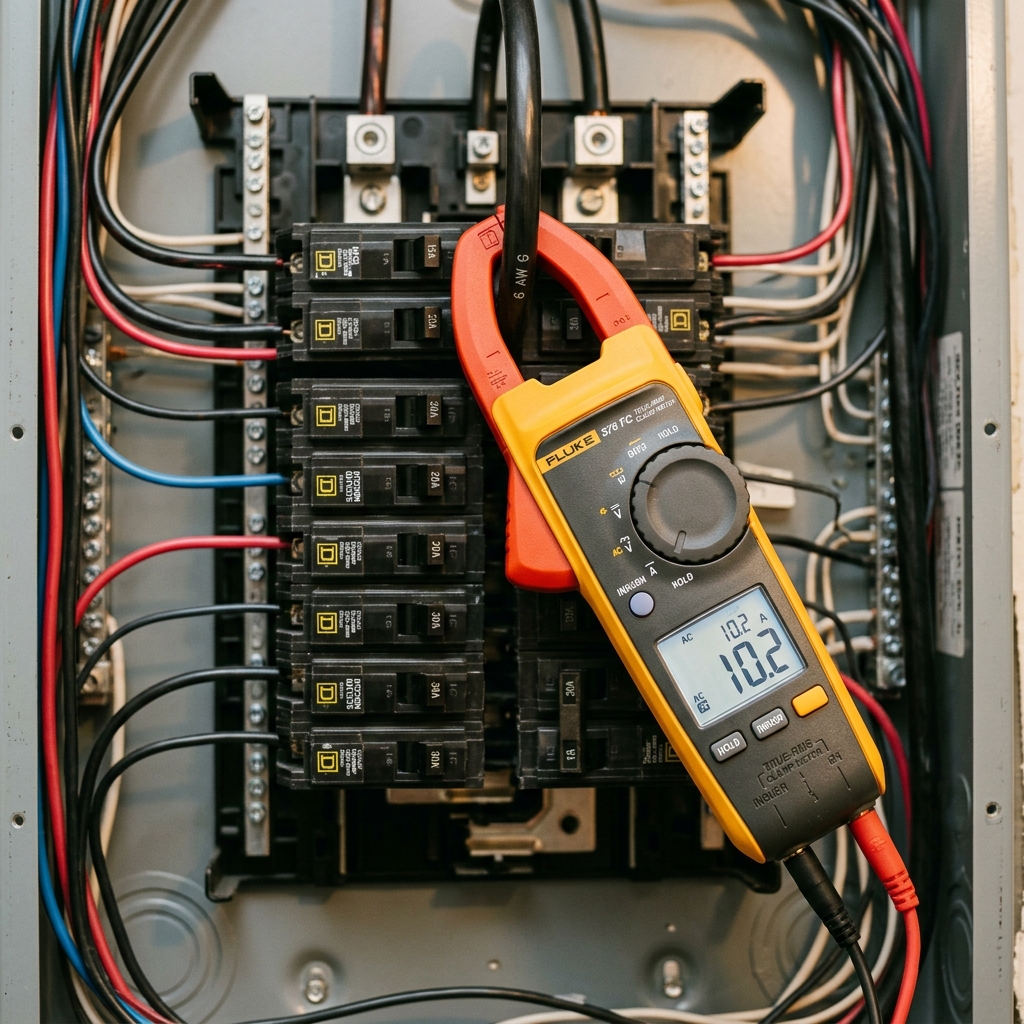
A clamp meter is the easiest and safest way to measure current. It wraps around a single wire and reads the magnetic field that current produces — no need to break the circuit or touch any bare conductors.
- Turn the dial to the AC amps or DC amps setting (depending on what you’re measuring)
- Open the clamp jaw by squeezing the trigger
- Clamp around a single conductor — not the entire power cord (which has two or three wires that cancel each other out)
- Read the display — it shows the current flowing through that wire in amps
That’s it. A clamp meter costs $25–$50 for a quality model, and it’s the tool professional electricians reach for first.
Ammeter vs Clamp Meter — Which One to Use
An ammeter (built into most multimeters) measures current by inserting itself directly into the circuit path. Every electron passes through the meter. This means you have to break the circuit — disconnect a wire, insert the meter in series, then reconnect.
That works fine for low-current bench circuits. For anything in your house wiring? A clamp meter is faster, safer, and doesn’t require disconnecting anything.
Never connect a multimeter’s amp setting across a circuit (in parallel). An ammeter has near-zero resistance — putting it in parallel creates a short circuit, which can blow the meter’s fuse, damage the meter, or cause a dangerous arc. Always connect an ammeter in series — or skip the risk entirely and use a clamp meter.
Reading the Amp Rating on a Device Label
Flip over any electrical device and you’ll find a label like this:
120V ~ 60Hz 10A 1200W
Here’s what each part means:
- 120V — the voltage the device needs
- ~ — the tilde symbol means alternating current (AC)
- 60Hz — expects 60 cycles per second (North American standard)
- 10A — draws 10 amps of current at rated voltage
- 1200W — consumes 1,200 watts of power (120V × 10A = 1,200W)
That amp number matters. It tells you whether your circuit can handle this device — and whether you can safely share the circuit with anything else.
How Many Amps Do Common Devices Use?
One of the best ways to build amp intuition is to see how current scales across everyday objects.
| Device | Typical Current | Voltage | Notes |
|---|---|---|---|
| 💡 LED Light Bulb | 0.05–0.1A | 120V AC | Barely sips power — 6–12 watts |
| 📱 Phone Charger (USB-A) | 1–2.4A | 5V DC | Higher amps = faster charging |
| 💻 Laptop Charger (USB-C PD) | 3–5A | 20V DC | USB-C Power Delivery negotiates voltage and current |
| 📺 TV (55” LED) | 0.5–0.8A | 120V AC | Modern TVs are surprisingly efficient |
| 🔌 Microwave Oven | 8–12.5A | 120V AC | Input draw is higher than cooking wattage |
| 🔥 Space Heater | 10–12.5A | 120V AC | The classic breaker-tripper |
| 💇 Hair Dryer (high) | 12.5–15.6A | 120V AC | Pushes a 15A breaker near its limit |
| ❄️ Central A/C Unit | 15–25A | 240V AC | Dedicated circuit required |
| 🚗 EV Charger (Level 2) | 30–50A | 240V AC | Needs 40A or 60A dedicated breaker |
| ⚡ Arc Welder | 40–200A | 20–40V DC | Low voltage, massive current |
| 🌩️ Lightning Bolt | ~200,000A | ~300MV | Peak current for ~1 millisecond |
Current values are typical for US residential use. Actual draw varies by model and operating conditions.
The scale is striking. An LED bulb sips 0.05 amps. A Level 2 EV charger pulls 50 amps through the same panel. And a lightning bolt? Over 200,000 amps in a fraction of a second. Same unit, astonishingly different magnitudes.
Understanding Milliamps, Amps, and Kiloamps
Just like distance has millimeters, meters, and kilometers, current has its own prefix system:
- Microamp (µA) = one millionth of an amp — pacemakers, sensor circuits
- Milliamp (mA) = one thousandth of an amp — LEDs, Arduino projects, body current thresholds
- Amp (A) = the base unit — household devices, circuit breakers
- Kiloamp (kA) = one thousand amps — industrial equipment, arc flash calculations, lightning
When someone says “100 milliamps can stop your heart,” they mean 0.1 amps. That prefix matters.
How Current Behaves in Series and Parallel Circuits
Series Circuits — Same Current, Every Component
In a series circuit, there’s only one path for current to travel. Every component sits along the same loop. That means the same current flows through every part — the battery, the switch, the first resistor, the second resistor, all of it.
Think of cars on a single-lane road. Every car passes through every section of road. No shortcuts, no alternate routes. The flow rate is the same everywhere along the path.
Parallel Circuits — Current Splits at Every Branch
A parallel circuit offers multiple paths. Current reaches a junction and divides — some goes through branch A, some through branch B — then recombines at the other end.
Now picture a highway with multiple lanes. The total traffic flow stays the same, but individual lanes carry different amounts depending on how “open” each lane is. Lower resistance in a branch means more current takes that path.
Kirchhoff’s Current Law — Current In = Current Out
Gustav Kirchhoff formalized this principle in 1845: at any junction in a circuit, the total current entering equals the total current leaving. Not approximately — exactly.
If 10 amps flows into a junction that splits into two branches, and 6 amps goes through branch A, then exactly 4 amps goes through branch B. Charge doesn’t appear or disappear — it’s conserved at every node. That’s Kirchhoff’s Current Law (KCL), and it works for every circuit, no matter how complex.
Wire Gauge and Ampacity — Why Thicker Wire Carries More Amps
Every wire has resistance, and current flowing through that resistance generates heat. The thinner the wire, the more heat per amp. Push too many amps through a thin wire, and the insulation melts. That’s how electrical fires start.
AWG Wire Gauge & Amp Ratings — Quick Reference
| Wire Gauge (AWG) | Max Amps (60°C) | Breaker Size | Common Use |
|---|---|---|---|
| 14 AWG | 15 amps | 15A | General lighting and outlet circuits |
| 12 AWG | 20 amps | 20A | Kitchen, bathroom, garage circuits |
| 10 AWG | 30 amps | 30A | Dryers, water heaters |
| 8 AWG | 40 amps | 40A | Ranges, cooktops, EV chargers |
| 6 AWG | 55 amps | 50–60A | Subpanels, heavy-duty EV chargers |
Based on NEC Table 310.16 for copper conductors at 60°C. Lower AWG number = thicker wire = more current capacity.
Think of it like a garden hose. A narrow hose handles a gentle stream. Force a fire hydrant’s worth of water through that same narrow hose, and something’s going to burst. Thicker wire handles more current the same way a wider hose handles more water — with less friction and less heat.
The 80% Rule (NEC Continuous Load Requirement)
The National Electrical Code requires that continuous loads — anything running for 3 hours or more — shouldn’t exceed 80% of the circuit breaker’s rated capacity. A 15-amp breaker handles 12 amps continuous. A 20-amp breaker handles 16 amps continuous.
A 1,200-watt space heater drawing 10 amps sits at 67% of a 15-amp breaker — safe on its own. Add a TV, a lamp, and a computer on the same circuit, and you’re approaching the limit.
What Is an Amp-Hour? (Battery Capacity Explained)
Amp-Hours vs Milliamp-Hours — Batteries Big and Small
An amp-hour (Ah) tells you how long a battery can deliver a certain current before it’s empty. A 100 Ah battery can (theoretically) supply 10 amps for 10 hours, or 5 amps for 20 hours, or 1 amp for 100 hours.
Smaller batteries — phones, wireless earbuds, smartwatches — use milliamp-hours (mAh). Your phone battery is probably around 4,000–5,000 mAh. That’s 4–5 Ah.
Real Example: Phone Battery vs Car Battery
Your phone’s 5,000 mAh battery holds about 5 amp-hours of charge at 3.7 volts. A car battery holds roughly 50–70 Ah at 12 volts. That’s 10–14 times the capacity, at more than three times the voltage.
The car battery needs that capacity because starting the engine draws 150–300 amps for a few seconds. Your phone never draws more than about 3 amps, even during fast charging.
Is Electric Current Dangerous? Amps and Safety
Let’s be direct: electric current can kill you. Understanding at what levels — and under what conditions — is part of understanding current itself.
Current Kills — But Voltage Drives It Through You
You’ve probably heard the saying: “It’s not the volts that kill you, it’s the amps.” That’s half right. Current through your body is what causes injury. But voltage is what forces that current through your body’s resistance. Ohm’s Law applies to your body just like any other resistor: I = V ÷ R.
Higher voltage pushes more current through the same resistance. Your body’s resistance determines how much current a given voltage can deliver. Both matter — you can’t separate them.
Body Current Effects Table (mA → Sensation → Danger)
| Current Through Body | Effect | Danger Level |
|---|---|---|
| 1 mA | Tingling sensation — barely perceptible | Harmless |
| 5 mA | Slight shock felt — not painful | Low |
| 10–20 mA | Muscle lock — can’t let go of the conductor (AC “let-go threshold”) | Serious |
| 50–100 mA | Severe pain, difficulty breathing, possible respiratory arrest | ⚠️ Dangerous |
| 100–200 mA | Ventricular fibrillation — heart rhythm disruption | ⚠️ Potentially lethal |
Values are for 60 Hz AC current through the chest (hand-to-hand path). Reference: IEC 60479-1. DC thresholds are roughly 3–4× higher for the same effects.
One hundred milliamps through the chest. That’s 0.1 amps. A fraction of what your phone charger delivers to your phone — but routed through your heart instead of a battery, it can be fatal.
Five Safety Rules Every Beginner Should Know
- Always turn off the breaker before touching any wiring — then verify it’s off with a voltage tester
- Assume every wire is live until you’ve personally tested it
- Never work around electricity with wet hands or while standing on a wet surface — moisture drops your body’s resistance from ~100,000Ω to ~1,000Ω
- Don’t touch both terminals of a high-voltage source simultaneously — current takes the shortest path between your hands, crossing your chest
- When in doubt, call a licensed electrician — there’s nothing weak about respecting something that can kill you in a heartbeat
Circuit Breakers and Fuses — How Overcurrent Protection Works
Breakers vs Fuses — Same Job, Different Mechanism
Both circuit breakers and fuses do one thing: they cut the current when it exceeds a safe level. The difference is how they do it.
A circuit breaker uses a bimetallic strip or an electromagnetic trip mechanism. When current gets too high, the strip heats and bends (or the electromagnet pulls hard enough), and the breaker “trips” — opening the circuit. Reset it by flipping the switch. Reusable.
A fuse uses a thin metal wire or strip. When current exceeds the fuse’s rating, the wire melts — physically breaking the circuit. One-time use. You replace it, not reset it.
Why Your Breaker Trips (And What to Do About It)
The #1 reason breakers trip in homes: too many devices on the same circuit. A space heater (10A) plus a microwave (12A) on a single 15A circuit adds up to 22 amps — well over the limit.
The breaker isn’t broken. It’s doing exactly what it’s designed to do — protecting your wiring from overheating. The fix is simple: spread high-draw devices across different circuits, or have an electrician install a dedicated 20-amp circuit for heavy-use appliances.
Common Mistakes Beginners Make About Amps
1. Confusing amps with volts. Amps measure the flow of charge. Volts measure the pressure driving that flow. A circuit can have high voltage with very low current (like a static shock from a doorknob — thousands of volts, almost zero amps) or low voltage with massive current (like a car battery’s 12 volts delivering 300 amps to the starter motor).
2. Thinking low voltage always means safe. A car battery is “only” 12 volts — but it can deliver 500+ amps, enough to weld metal and start fires. Low voltage doesn’t mean low danger when the current capacity is massive. The risk depends on both voltage and available current.
3. Overloading shared circuits. Running a space heater, a hair dryer, and a microwave on the same 15-amp circuit isn’t creative problem-solving — it’s a fire hazard. Know the total amps your devices draw and keep them within the breaker’s rating.
4. Connecting an ammeter in parallel. An ammeter has near-zero internal resistance. Connecting it across a voltage source (in parallel) creates a dead short — blowing the meter’s fuse at best, creating a dangerous arc at worst. Ammeters go in series. Always.
5. Ignoring wire gauge when extending circuits. Plugging a 12.5-amp space heater into a 150-foot lightweight extension cord is asking for trouble. The wire overheats, the voltage at the device drops, and you’ve created a fire risk. Match the wire gauge to the current draw.
Frequently Asked Questions About Electric Current and Amps
What is electric current in simple terms?
Electric current is the flow of electric charge — usually electrons — through a conductor like copper wire. It’s the actual movement of electricity through a circuit, measured in amperes (amps). Without current, no energy gets delivered from the power source to the device.
What is the difference between current and amps?
Current is the phenomenon — the flow of charge through a conductor. Amps (amperes) are the unit of measurement for that flow. Saying “the current is 10 amps” is like saying “the speed is 60 miles per hour” — speed is the thing, miles per hour is how you measure it.
How many amps is a standard US outlet?
A standard US wall outlet is on a circuit rated for 15 or 20 amps at 120 volts AC. The outlet itself can deliver up to the breaker’s limit (minus anything else on the same circuit). Heavy-duty 240V outlets for dryers and ranges are typically on 30A or 50A breakers.
What is the difference between amps and volts?
Amps measure the flow of electric charge (current). Volts measure the pressure driving that flow (voltage). You can have voltage without current (an open switch), but you can’t have current without voltage providing the push. They’re connected by Ohm’s Law: I = V ÷ R.
How many amps can kill a person?
As little as 100–200 milliamps (0.1–0.2 amps) of AC current through the chest can cause ventricular fibrillation and death, according to IEC 60479. The actual current depends on voltage and your body’s resistance — wet skin drops resistance dramatically, making the same voltage far more dangerous.
What does amp-hour (Ah) mean?
An amp-hour is a measure of battery capacity. A 50 Ah battery can theoretically deliver 5 amps for 10 hours, or 10 amps for 5 hours, before it’s depleted. Phone batteries are usually rated in milliamp-hours (mAh) — a 5,000 mAh phone battery equals 5 Ah.
Is household electricity AC or DC current?
Every household outlet worldwide delivers AC (alternating current). In North America, that’s 120V at 60 Hz. Most of your electronics convert that AC to DC internally — your phone charger, laptop adapter, and TV all contain AC-to-DC rectifiers.
How do I measure amps safely?
The safest method is a clamp meter — it clips around a single wire and reads the current through its magnetic field, without breaking the circuit or touching any conductors. For direct measurement, a multimeter’s amp setting works but must be connected in series (never in parallel).
Why does conventional current flow from positive to negative?
Benjamin Franklin guessed the direction of charge flow before anyone discovered the electron. He picked positive-to-negative, and by the time we learned electrons actually flow negative-to-positive, every equation and circuit diagram was already built around his convention. The math works identically either way.
How many amps does a phone charger use?
A standard USB-A phone charger delivers 1–2.4 amps at 5 volts DC. USB-C fast chargers using Power Delivery can deliver up to 3–5 amps at voltages up to 20V, reaching 60–100 watts of total charging power.
This article provides general educational information about electric current and electrical systems. For any electrical installation, wiring, or work involving circuits, always hire a licensed electrician. All electrical work must comply with the National Electrical Code (NEC/NFPA 70) and your local building codes. Never work on live circuits.
Electric current is the foundation everything else in electricity builds on. Voltage pushes, resistance opposes, and current is the actual movement that delivers energy from a source to your device. Once you understand that amps simply measure how much charge flows per second, the formulas stop feeling abstract and start feeling obvious.
Grab a $25 clamp meter, wrap it around the wire to your space heater, and read the display. You’ll see roughly 10 amps — and you’ll understand exactly what that number means. Five minutes of real measurement teaches more than any article ever will.
For quick electrical calculations — watts to volts, volts to amps, or any combination of the core formulas — use our free Watts to Volts calculator to get instant answers for both AC and DC circuits.
Last updated: June 11, 2026. This article is reviewed and updated periodically to reflect current NEC standards and electrical safety guidelines.