What Is Electrical Power? Watts vs Kilowatts (2026)
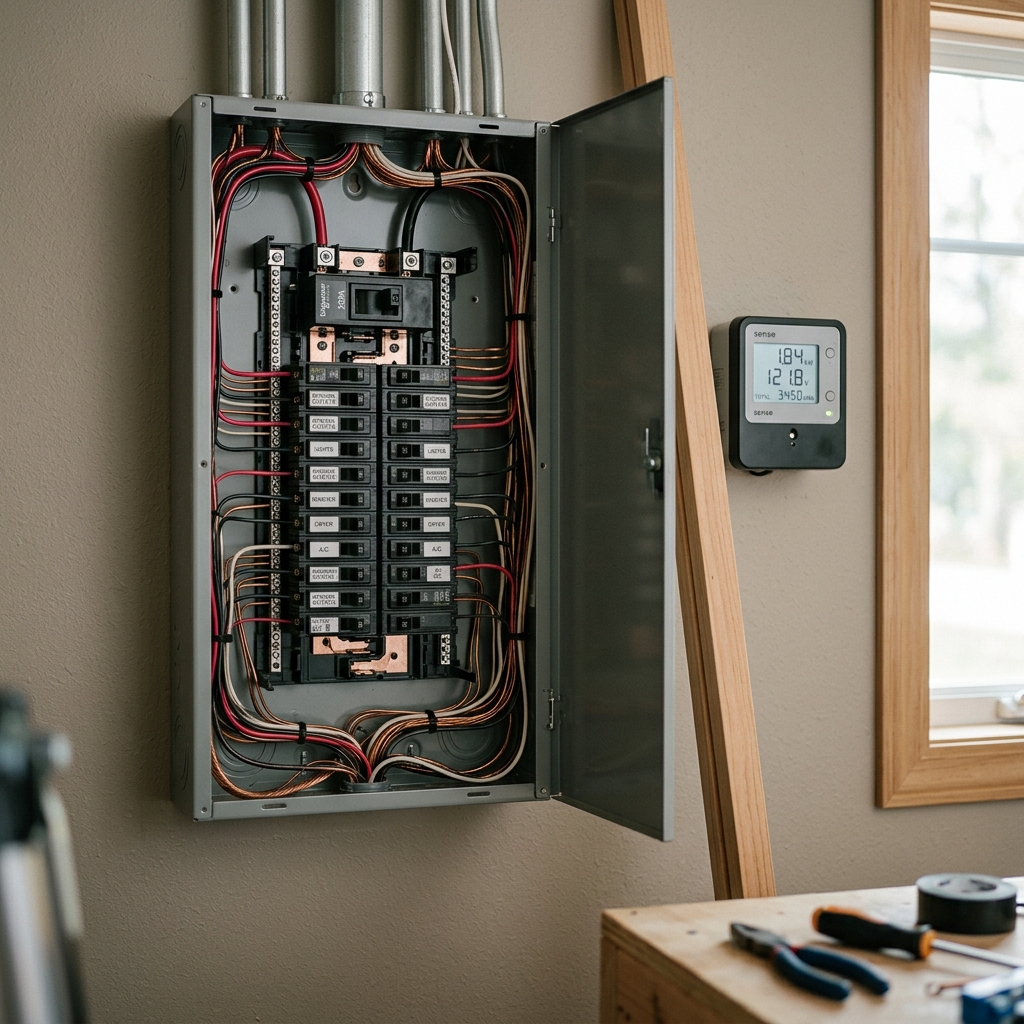
Electrical power is the rate at which electrical energy is consumed or produced, and it’s measured in watts (W). One watt equals one joule of energy transferred per second. A kilowatt (kW) is simply 1,000 watts — the same measurement at a larger scale. Your 60-watt LED bulb uses power in watts; your home’s total demand is measured in kilowatts. The formula is straightforward: Power (W) = Voltage (V) × Current (A).
Electrical power = the rate at which a device uses or produces electrical energy.
Unit: Watts (W) — named after Scottish engineer James Watt.
Key formula: P = V × I (Power = Voltage × Current).
Watts vs Kilowatts: 1 kilowatt = 1,000 watts. Same measurement, different scale.
You’ve seen “watts” printed on every light bulb, power tool, and appliance in your house. But what does that number actually mean — and why do solar companies, generator sellers, and your electric bill suddenly switch to “kilowatts”?
The answer is simpler than you think: watts and kilowatts measure the same thing — electrical power — at different scales. This guide covers what electrical power is, how watts and kilowatts differ, the formulas you need to calculate power, and how all of it connects to the number on your electricity bill.
What Is Electrical Power? (The Plain-English Answer)
Electrical power measures how fast a device converts electrical energy into something useful — whether that’s light, heat, motion, or sound. It’s a rate, not a total. A device with a higher wattage uses energy faster. A device with a lower wattage uses it slower.
That distinction matters more than most people realize. Power tells you how fast energy is being consumed right now. It doesn’t tell you how much total energy gets used over an hour, a day, or a month — that’s a different number entirely (kilowatt-hours, which we’ll get to).
The Garden Hose Analogy — How Power Actually Works
Picture a garden hose. The water pressure at the faucet is voltage — it’s the force pushing water through the hose. The actual flow of water is current — the volume moving through per second. Now, the useful work the water does when it hits the sprinkler — the spinning, the spraying, the coverage — that’s power.
Crank up the faucet pressure (voltage) and the flow increases (current). The sprinkler spins harder. More work gets done per second. That’s higher power.
Electrical power works the same way. Multiply the voltage (pressure) by the current (flow), and you get power in watts. More voltage or more current — or both — means more power.
The Formal Definition (One Watt = One Joule per Second)
The International System of Units (SI) defines one watt as one joule of energy transferred per second. That’s the technical version of “how fast energy moves.” The watt is the SI unit of power, whether you’re measuring a phone charger or a power plant.
For most practical purposes, you don’t need the formal definition. But it helps to know that a watt isn’t an arbitrary unit — it’s anchored to real physics. One joule per second. That’s all a watt is.
What Is a Watt? (And Where the Name Comes From)
A watt (W) is the base unit of electrical power. Every appliance, light bulb, and electronic device in your home has a wattage rating that tells you how much power it draws during operation.
But the watt isn’t just a unit — it has a human story behind it.
James Watt and the Invention of Horsepower
James Watt didn’t invent the steam engine. He improved it so dramatically that the scientific community named the unit of power after him.
In the 1760s, Watt — a Scottish instrument maker — figured out how to make steam engines far more efficient by adding a separate condenser. To sell his improved engines to coal mine owners, he needed a comparison they’d understand. So he measured how fast a horse could lift heavy loads, coined the term “horsepower,” and told mine owners exactly how many horses his engines could replace.
The marketing worked. His engines spread across Britain and launched the Industrial Revolution. In 1882, the British Science Association honored Watt by naming the SI unit of power after him. One horsepower equals roughly 746 watts.
What Does a Watt Look Like in Real Life?
Here’s where the number starts to make sense:
- LED light bulb: 9W — barely sipping power
- Phone charger: 18W — a trickle
- Laptop: 65W — modest
- Microwave: 1,200W — a noticeable draw
- Space heater: 1,500W — one of the biggest household loads
- Electric oven: 3,000–5,000W — serious power
The range is huge. An LED bulb and a space heater are separated by a 167x difference in power consumption. That gap is the difference between a device that costs pennies per month and one that costs $50+.
What Is a Kilowatt? (And When to Use kW Instead of W)
A kilowatt (kW) is simply 1,000 watts. It’s the same measurement at a larger, more convenient scale — like switching from meters to kilometers when the distance gets big enough that counting meters becomes awkward.
Once you start talking about whole-house loads, solar systems, or commercial equipment, watts get unwieldy. Nobody says their central AC draws “3,500 watts.” They say “3.5 kilowatts.” Same number, cleaner expression.
How to Convert Watts to Kilowatts (And Back)
The math is about as simple as it gets:
- 1,500 watts / 1,000 = 1.5 kW
- 7.2 kW x 1,000 = 7,200 watts
That’s it. Move the decimal point three places. For quick conversions on any electrical unit, try our free watts-to-volts calculator.
When Do You Use Kilowatts Instead of Watts?
The rule of thumb: once the number exceeds about 1,000, switch to kilowatts. You’ll see kW on:
- Solar panel system specs (a “6 kW system”)
- Generator output ratings
- EV charger power levels
- Electric utility bills (demand charges in kW)
- Commercial and industrial equipment
Watts vs Kilowatts — Side-by-Side Comparison
| Attribute | Watt (W) | Kilowatt (kW) |
|---|---|---|
| Definition | Base unit of electrical power | 1,000 watts |
| Symbol | W | kW |
| Scale | Small devices and components | Whole-house and system-level |
| Typical Use | Light bulbs, chargers, tools | Solar systems, generators, EV chargers |
| Example | 1,200W microwave | 1.2 kW microwave |
Same measurement, different scale — like meters and kilometers. A 1,200-watt microwave and a 1.2-kW microwave are the exact same appliance. The only difference is how you write the number.
The Power Formula — How to Calculate Watts (P = V x I)
This is the formula that ties everything together. If you remember one equation from this article, make it this one:
If you know the voltage and the current, you can calculate the power of any device. The formula works for batteries, wall outlets, solar panels, and everything in between.
If you’re not sure what voltage means or how it connects to current and resistance, our guide on what voltage actually is and how it works breaks it down from scratch.
Formula 1: P = V x I (Voltage x Current)
This is the most common version. A device running on 120 volts and drawing 10 amps uses 1,200 watts of power.
120V x 10A = 1,200W (1.2 kW)
That’s your microwave. Or your space heater. Or your hair dryer. Most 120V household devices draw between 5 and 15 amps.
Formula 2: P = I squared x R (When You Know Current and Resistance)
Sometimes you know the current flowing through a circuit and the resistance of the load — but not the voltage. Using Ohm’s Law (V = I x R), you can derive this version:
A 12.5-amp current flowing through a 12-ohm heating element: P = 12.5 squared x 12 = 156.25 x 12 = 1,875W
This version is especially useful for calculating heat generated in wires and cables. When current flows through a wire with resistance, some power dissipates as heat. Those I squared R losses are why extension cords get warm under heavy loads.
Formula 3: P = V squared / R (When You Know Voltage and Resistance)
If you know the voltage across a component and its resistance:
A 240V water heater element with 11.5 ohms of resistance: P = 240 squared / 11.5 = 57,600 / 11.5 = 5,009W (about 5 kW)
That checks out — electric water heaters are among the highest-wattage appliances in any home.
Quick Worked Examples with Real Devices
| Device | Known Values | Formula | Power |
|---|---|---|---|
| LED Bulb | 120V, 0.075A | P = V x I | 9W |
| Phone Charger | 5V, 3.6A | P = V x I | 18W |
| Space Heater | 120V, 12.5A | P = V x I | 1,500W |
| Electric Dryer | 240V, 20.8A | P = V x I | 4,992W |
The Full Power Scale — From Milliwatts to Gigawatts
One of the best ways to build power intuition is to see how it scales. This chart shows what each unit actually looks like:
| Unit | Value | Real-World Example |
|---|---|---|
| Milliwatt (mW) | 0.001 W | Bluetooth earbud (10 mW) |
| Watt (W) | 1 W | LED night light (1-3 W) |
| Kilowatt (kW) | 1,000 W | Microwave oven (1.2 kW) |
| Megawatt (MW) | 1,000,000 W | Wind turbine (2-3 MW) |
| Gigawatt (GW) | 1,000,000,000 W | Large nuclear plant (1 GW) |
From a Bluetooth earbud at 10 milliwatts to a nuclear power plant at 1 gigawatt — that’s a 100-billion-fold range. But it’s all the same unit, just scaled up.
kW vs kWh — Why Your Electricity Bill Uses Both
This trips people up all the time. Kilowatts (kW) and kilowatt-hours (kWh) look similar, but they measure completely different things.
- Kilowatts (kW) = power — how fast you’re using electricity right now
- Kilowatt-hours (kWh) = energy — how much total electricity you’ve used over time
The Speedometer vs Odometer Analogy
Think of your car’s dashboard. The speedometer shows how fast you’re going at this moment — that’s kilowatts. The odometer shows the total distance you’ve traveled — that’s kilowatt-hours.
You can be going 60 mph (high speed/power) for a short time or 30 mph (low speed/power) for a long time and cover the same total distance (energy). Same idea with electricity.
How Your Utility Charges You — Demand (kW) vs Consumption (kWh)
Your electricity bill typically tracks two things:
- Consumption charge (kWh): How much total energy you used during the billing period. This is the big number — the one most people recognize.
- Demand charge (kW): Your highest power draw during any 15-minute window. Commercial customers almost always see this; some residential plans include it too.
Real-World Example: Calculating Your Cost
Let’s put real numbers on it. You run a 2 kW space heater for 3 hours:
2 kW x 3 hours = 6 kWh consumed 6 kWh x $0.16/kWh = $0.96
That single session cost about a dollar. Run it daily for a month, and you’re looking at $28.80 in extra electricity costs — just from one appliance.
Common Appliance Wattage Chart (Watts and Kilowatts)
Every household appliance has a wattage label telling you how much power it draws. Here’s a reference table covering the most common ones:
| Appliance | Typical Watts | Kilowatts (kW) | Est. Daily Hours | Daily kWh |
|---|---|---|---|---|
| LED Light Bulb | 9 W | 0.009 kW | 8 | 0.07 |
| Phone Charger | 18 W | 0.018 kW | 2 | 0.04 |
| Laptop | 65 W | 0.065 kW | 8 | 0.52 |
| Television (55 inch) | 80 W | 0.08 kW | 5 | 0.40 |
| Refrigerator | 150 W | 0.15 kW | 8* | 1.20 |
| Vacuum Cleaner | 700 W | 0.70 kW | 0.5 | 0.35 |
| Microwave | 1,200 W | 1.2 kW | 0.5 | 0.60 |
| Space Heater | 1,500 W | 1.5 kW | 8 | 12.00 |
| Hair Dryer | 1,800 W | 1.8 kW | 0.25 | 0.45 |
| Dishwasher | 1,800 W | 1.8 kW | 1 | 1.80 |
| Central AC (3 ton) | 3,500 W | 3.5 kW | 8 | 28.00 |
| Clothes Dryer | 4,500 W | 4.5 kW | 1 | 4.50 |
| Electric Water Heater | 4,500 W | 4.5 kW | 3 | 13.50 |
* Refrigerator compressor cycles on/off; 8 hours represents estimated active runtime per day. Wattage values are typical ranges — your specific model may differ.
Central air conditioning is usually the biggest power draw in any home — if you’re sizing a system or troubleshooting high bills, our detailed breakdown of how many watts a central AC unit actually uses covers tonnage, SEER ratings, and real-world consumption numbers.
How to Read a Device Label (Volts, Amps, Watts Decoded)
Decoding the Label: 120V ~ 60Hz 10A 1200W
Flip over any electrical device and you’ll find something like this printed on a sticker or stamped into the housing:
120V ~ 60Hz 10A 1200W
Here’s what each part tells you:
- 120V — the voltage the device needs to receive from the outlet
- ~ — the tilde symbol means alternating current (AC)
- 60Hz — designed for 60 cycles per second (the North American standard)
- 10A — draws 10 amps of current during operation
- 1200W — total power consumption (120V x 10A = 1,200W)
What If the Label Only Shows Amps?
Some devices list voltage and amps but skip the wattage entirely. No problem — just multiply them:
120V x 10A = 1,200 watts
If you’re working with a 240V appliance (dryer, range, EV charger), use 240 instead:
240V x 20A = 4,800 watts (4.8 kW)
You’ll see this on every label. Once you know the formula, decoding device specs takes about three seconds.
Wattage and Circuit Breaker Sizing — A Safety Connection
Every circuit in your home has a breaker rated for a specific amperage. Exceed the wattage that breaker can handle, and it trips — cutting power to prevent overheating and potential fire.
Maximum Watts Per Breaker Size (Quick Reference Table)
| Breaker Rating | Circuit Voltage | Max Watts | 80% Rule Safe Limit |
|---|---|---|---|
| 15 Amp | 120V | 1,800W | 1,440W |
| 20 Amp | 120V | 2,400W | 1,920W |
| 30 Amp | 240V | 7,200W | 5,760W |
| 50 Amp | 240V | 12,000W | 9,600W |
The 80% Rule — Why You Shouldn’t Max Out a Circuit
The National Electrical Code (NEC) recommends that continuous loads — anything running for 3+ hours — should not exceed 80% of the breaker’s rated capacity. That’s why a 15-amp breaker’s safe continuous limit is 1,440 watts, not 1,800.
If you’ve ever plugged a space heater and a hair dryer into the same circuit and tripped the breaker, you’ve hit the wattage ceiling. The fix isn’t resetting the breaker repeatedly — it’s distributing loads across different circuits.
Power in AC Circuits — Why Watts Aren’t Always What They Seem
If you’ve followed along so far, you know P = V x I gives you power in watts. But for AC circuits, there’s a catch.
Real Power (W) vs Apparent Power (VA)
In AC circuits, voltage and current don’t always peak at the same instant. When they’re out of sync — which happens with motors, transformers, and fluorescent lighting — some of the power oscillates back and forth without doing useful work.
- Apparent power (VA): Voltage x Current — the total power flowing in the circuit
- Real power (W): The portion that actually does useful work
- Reactive power (VAR): The portion that oscillates without doing work
This is why UPS (uninterruptible power supply) units and generators are often rated in VA instead of watts. A 1,000 VA UPS doesn’t necessarily deliver 1,000 watts — the actual usable watts depend on the power factor.
What Is Power Factor? (The 30-Second Version)
Power factor is the ratio of real power to apparent power. It ranges from 0 to 1:
Real Power (W) = Apparent Power (VA) x Power Factor
A power factor of 1.0 means voltage and current are perfectly in sync — all the power does useful work. A power factor of 0.8 means only 80% is doing useful work; the other 20% just sloshes back and forth. Most residential loads run at a power factor between 0.85 and 0.99.
For most household calculations, P = V x I is close enough. Power factor matters more for commercial and industrial users — and for anyone shopping for a UPS or generator.
How to Calculate Your Electricity Cost from Wattage
Here’s where the abstract becomes personal. Every watt has a price tag.
The Cost Formula (Step-by-Step)
- Find the device’s wattage (check the label)
- Estimate how many hours per day you run it
- Divide by 1,000 to convert to kilowatts
- Multiply by your electricity rate ($/kWh)
Three Real Examples: LED Bulb, Space Heater, Refrigerator
LED Bulb (9W, 8 hours/day, $0.16/kWh):
9 x 8 / 1,000 x $0.16 = $0.01/day — about $0.35/month
Space Heater (1,500W, 8 hours/day, $0.16/kWh):
1,500 x 8 / 1,000 x $0.16 = $1.92/day — about $57.60/month
Refrigerator (150W average, 24 hours/day, $0.16/kWh):
150 x 24 / 1,000 x $0.16 = $0.58/day — about $17.28/month
The difference is stark. That space heater costs 164x more to run than the LED bulb. Higher wattage doesn’t just mean “more power” — it means a bigger electricity bill every single month.
How Much Electricity Does the Average US Home Use?
According to the U.S. Energy Information Administration (EIA), the average American household consumed about 10,500 kWh in 2024 — roughly 29 kWh per day. At the national average rate of approximately $0.16 per kWh, that works out to about $140 per month.
Sizing Solar Systems, Generators, and EV Chargers in Kilowatts
Kilowatts aren’t just a unit you see on labels — they’re the language of system sizing. Whether you’re shopping for solar, a backup generator, or an EV charger, kW is the number that matters.
Solar Panel Systems — What Does “6 kW” Actually Mean?
A “6 kW solar system” means 6,000 watts of panels on your roof. Under ideal sunlight conditions (around 5 peak sun hours per day in most of the US), that system generates roughly 30 kWh of electricity daily — enough to cover the average American home’s consumption.
System sizes typically range from 4 kW (small home, low usage) to 12+ kW (large home, high usage, or EV charging included).
Generator Sizing — Running Watts vs Peak Watts
Generators list two power numbers, and confusing them is a common mistake:
- Running watts: What the generator can sustain continuously
- Peak (surge) watts: What it can handle for a few seconds during motor startup
A generator rated at 3,000 running watts and 4,500 peak watts can run 3,000 watts of continuous load. But when your refrigerator compressor kicks on and momentarily surges to 1,200W, the peak capacity handles the spike.
Sizing rule: Add up the running watts of everything you want to power simultaneously. Add 20% headroom. That number — in kilowatts — is your minimum generator size.
EV Charger Power Levels Explained
| Charger Level | Power (kW) | Voltage | Miles of Range/Hour |
|---|---|---|---|
| Level 1 (Standard Outlet) | 1.4 kW | 120V | 3-5 mph |
| Level 2 (Home/Public) | 7-19 kW | 240V | 25-35 mph |
| DC Fast Charging | 50-350 kW | 400-800V DC | 150-1,000+ mph |
The difference between Level 1 and DC fast charging is massive — from 1.4 kW to 350 kW. That’s why a Level 1 charger takes 40+ hours for a full charge while a DC fast charger can hit 80% in 20 minutes.
Common Mistakes People Make with Watts and Kilowatts
Five Wattage Mistakes (And How to Avoid Them)
1. Saying “kilowatts per hour.” The correct term is kilowatt-hours (kWh). A kilowatt-hour is energy (power x time). “Kilowatts per hour” doesn’t mean anything useful — it implies a rate of change of power, which isn’t what your bill measures.
2. Confusing watts with watt-hours. Watts measure the rate of energy use right now. Watt-hours measure total energy consumed over time. Your 1,500W heater running for 2 hours uses 3,000 watt-hours (3 kWh). The wattage alone doesn’t tell you the total energy cost.
3. Thinking higher wattage always means higher electricity cost. A 1,500W space heater costs nothing if you never turn it on. A 150W refrigerator running 24/7 uses more total energy per day than a 1,800W hair dryer used for 15 minutes. Usage time determines your bill, not wattage alone.
4. Ignoring power factor on AC equipment. A device rated at 500 VA doesn’t necessarily deliver 500 watts. If the power factor is 0.8, it delivers only 400 watts of real, usable power. Check for “watts” on the label, not just “VA.”
5. Overloading circuits by adding up watts incorrectly. Before plugging a space heater, microwave, and hair dryer into outlets on the same circuit, add their wattages: 1,500 + 1,200 + 1,800 = 4,500W. That’s far beyond a 15-amp breaker’s 1,800W capacity. The breaker will trip, or worse — an undersized wire could overheat.
Frequently Asked Questions About Electrical Power
What is electrical power in simple terms?
Electrical power is the speed at which a device uses or produces electrical energy. It’s measured in watts (W). A higher wattage means the device consumes energy faster. Think of it as the “speed” of electricity use — not the total amount used.
What is the formula for electrical power?
The core formula is P = V x I — power in watts equals voltage in volts times current in amps. Two additional forms exist for different situations: P = I squared x R (when you know current and resistance) and P = V squared / R (when you know voltage and resistance). All three give the same result.
What is the difference between watts and kilowatts?
A watt (W) is the base unit of electrical power. A kilowatt (kW) is 1,000 watts. They measure the same thing at different scales. You’ll see watts on small devices (LED bulbs, chargers) and kilowatts on larger systems (solar panels, generators, EV chargers).
How many watts are in a kilowatt?
Exactly 1,000 watts equal one kilowatt. To convert watts to kilowatts, divide by 1,000. To convert kilowatts back to watts, multiply by 1,000.
What is the difference between kW and kWh?
A kilowatt (kW) measures power — how fast you’re using electricity at a given moment. A kilowatt-hour (kWh) measures energy — the total electricity consumed over time. Running a 1 kW appliance for one hour uses 1 kWh. Your electricity bill charges per kWh.
How many kilowatts does a house use?
The average US home’s peak demand is about 5-10 kilowatts, depending on how many appliances run simultaneously. Total daily consumption averages about 29 kWh, according to the U.S. Energy Information Administration.
What is the relationship between watts, volts, and amps?
They’re connected by the power formula: Watts = Volts x Amps. Voltage is the electrical pressure pushing current through a circuit. Current (amps) is the flow of electrons. Power (watts) is the result of pressure and flow combined. Change any one, and the others adjust accordingly.
Is 1000 watts the same as 1 kW?
Yes. One kilowatt (1 kW) is exactly 1,000 watts. The “kilo” prefix means “one thousand” in the metric system, just like one kilometer equals 1,000 meters.
This article provides general educational information about electrical power and wattage. For any electrical installation, wiring, or work involving circuits, always hire a licensed electrician. All electrical work must comply with the National Electrical Code (NEC/NFPA 70) and your local building codes. Never work on live circuits.
Electrical power is just a rate — how fast energy gets used. The watt is the unit. The kilowatt is 1,000 of those units bundled together for convenience. Once that clicks, everything else — your electricity bill, your breaker panel, your solar quote — starts making a lot more sense.
For quick electrical calculations — watts to kilowatts, watts to volts, or any combination of the core formulas — use our free Watts to Volts calculator to get instant answers for both AC and DC circuits.
Last updated: June 11, 2026. This article is reviewed and updated periodically to reflect current EIA data, NEC standards, and electrical safety guidelines.