How Many Watts Does a Central AC Unit Use? (US Home Guide)
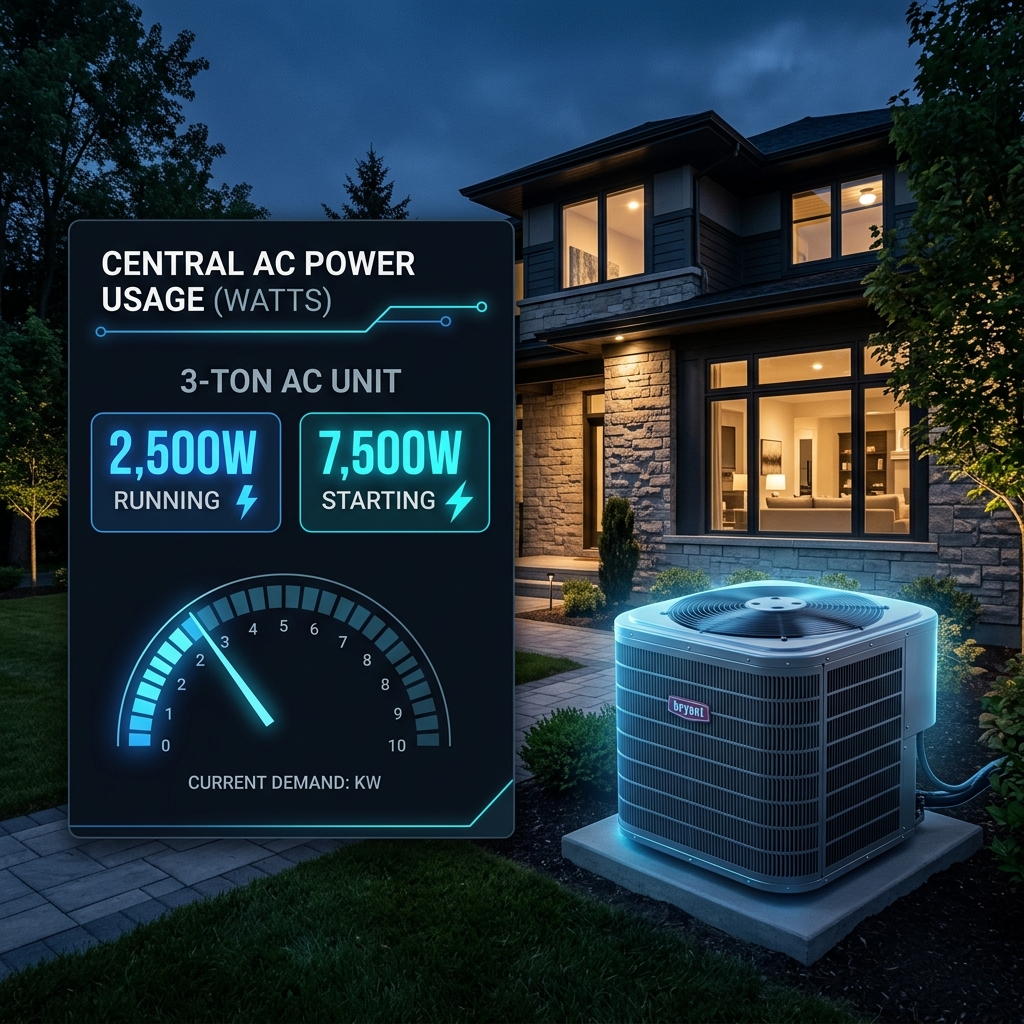
A central AC unit uses between 1,000 and 5,000 watts of electricity to run, depending on its size (tonnage), SEER2 efficiency rating, and local climate conditions. The most common 3-ton central AC unit draws approximately 2,400–3,000 running watts and requires a dedicated 240V circuit.
Most competing guides stop right there. This one doesn’t. Below you’ll find exact wattage by tonnage, the critical starting watt numbers needed to size a generator or solar system, a state-by-state electricity cost breakdown, and a step-by-step method to find your specific unit’s actual wattage from its nameplate.
A central AC unit uses 1,000–5,000 running watts depending on size (1.5–5 tons). The most common residential size — a 3-ton unit — uses roughly 2,400–3,000 running watts but surges to 6,000–9,000 watts for 2–3 seconds at startup. Always size your generator and solar system to the starting wattage, not the running wattage.
How Many Watts Does a Central AC Unit Use? Wattage by Ton
Tonnage describes a central AC’s cooling capacity. One ton of cooling equals 12,000 BTUs per hour of heat removal. Wattage scales with tonnage, but it also varies based on SEER2 rating, outdoor temperature, refrigerant type, and how hard the compressor is cycling on any given day.
The table below shows typical wattage ranges for central AC units from 1.5 tons to 5 tons based on standard SEER2-compliant equipment sold in the US as of 2023.
| Size | BTU/hr | Sq. Footage | Running Watts | Starting Watts ⚡ | Amps at 240V |
|---|---|---|---|---|---|
| 1.5 ton | 18,000 | 600–900 sq ft | 1,000–1,400 W | 2,500–3,500 W | 4.2–5.8 A |
| 2 ton | 24,000 | 900–1,200 sq ft | 1,400–1,800 W | 3,500–5,000 W | 5.8–7.5 A |
| 2.5 ton | 30,000 | 1,200–1,500 sq ft | 1,800–2,200 W | 4,500–6,000 W | 7.5–9.2 A |
| 3 ton ★ | 36,000 | 1,500–2,000 sq ft | 2,400–3,000 W | 6,000–9,000 W | 10–12.5 A |
| 3.5 ton | 42,000 | 2,000–2,400 sq ft | 2,800–3,500 W | 7,000–10,500 W | 11.7–14.6 A |
| 4 ton | 48,000 | 2,400–3,000 sq ft | 3,200–4,000 W | 8,000–12,000 W | 13.3–16.7 A |
| 5 ton | 60,000 | 3,000–3,500 sq ft | 4,000–5,000 W | 10,000–15,000 W | 16.7–20.8 A |
★ Most common residential size. Running watts reflect modern SEER2-rated equipment. Older units will fall toward the top of each range or exceed it.
Use our free Watts to Amps calculator to find exactly how many amps your AC draws on your 240V circuit.
Starting Watts vs Running Watts: The Number That Really Matters
This is the single most important section for anyone sizing a generator or solar-plus-battery system, and it’s the section every competing article skips.
Running watts is the steady-state power your AC draws while the compressor is actively running. It’s what shows up on your electricity bill. Starting watts — also called surge watts or locked rotor amps (LRA) — is the massive, brief power spike that occurs when the compressor motor first kicks on.
Here’s why it matters: an AC compressor is an induction motor. When it starts from a dead stop, it momentarily draws 2–3x its normal running current for approximately 2–3 seconds. This startup surge is unavoidable with standard compressors. If your generator or inverter can’t meet that surge, it will trip the breaker, shut down, or damage the compressor motor.
Hard start kits can reduce the starting surge by 30–50% by adding a capacitor that gives the compressor motor an electrical “boost” at startup. If you’re running a generator or a battery inverter with a tight startup watt limit, a hard start kit (typically $25–$60) is one of the best investments you can make before attempting to power central AC off-grid.
Variable-speed (inverter-driven) compressors, common in modern high-SEER2 systems, ramp up gradually and produce a starting surge of only 1.2–1.5x their running wattage — a significant advantage for generator and solar users.
SEER2 vs SEER: What the 2023 DOE Update Means for Your Wattage
The US Department of Energy (DOE) mandated SEER2 as the new minimum efficiency standard for central AC units starting January 1, 2023. If your unit was manufactured in 2023 or later, it carries a SEER2 rating. If it’s older, it has a SEER rating.
SEER (Seasonal Energy Efficiency Ratio) measured the ratio of cooling output (BTU) to energy consumed (watt-hours) under an older test procedure (M1). SEER2 uses a stricter test procedure (M2) that better reflects real-world installation conditions, including external static pressure in the duct system. A SEER2 rating is roughly 5% lower numerically than an equivalent SEER rating — so a 15 SEER unit is approximately 14.3 SEER2.
A higher SEER2 rating means fewer watts consumed per BTU of cooling. Here’s what that looks like for a 3-ton (36,000 BTU/hr) unit:
| Efficiency Rating | Running Watts (3-ton) | Annual Energy (1,500 hrs) |
|---|---|---|
| 10 SEER (old baseline) | ~3,600 W | ~5,400 kWh |
| 14 SEER / 13.4 SEER2 | ~2,571 W | ~3,857 kWh |
| 16 SEER / 15.2 SEER2 | ~2,250 W | ~3,375 kWh |
| 18 SEER2 | ~2,000 W | ~3,000 kWh |
| 20 SEER2 ✓ Best | ~1,800 W | ~2,700 kWh |
Formula: Running Watts = (BTU/hr ÷ SEER2) × 1.05 (real-world adjustment)
The DOE’s minimum SEER2 requirements by region as of 2023:
- Southeast and Southwest US: 15 SEER2 minimum (split systems)
- North US: 14 SEER2 minimum (split systems)
Upgrading from a 10 SEER unit to a modern 18 SEER2 system cuts the running wattage by more than 40% for the same cooling output. That’s not a marginal difference — it meaningfully changes your electricity bill, your generator sizing requirements, and your solar panel count.
Why Central AC Power Consumption Varies So Much
Even two identical AC units in the same city can have different real-world wattage. Compressor cycling is the main driver. A properly sized unit will run in 15–20 minute cycles. An oversized unit short-cycles (runs for only 5–8 minutes), while an undersized unit in extreme heat may run nearly continuously. Both reduce efficiency and distort average watt usage.
Other factors that raise or lower your AC’s actual watt draw:
- Duct leakage: The EPA estimates that a typical US home loses 20–30% of conditioned air through leaky ducts. Your AC works harder to compensate, pulling more watts.
- Air filter condition: A clogged filter restricts airflow, forcing the blower motor and compressor to work against higher static pressure — raising watt draw by 5–15%.
- Refrigerant level: A unit that’s low on refrigerant runs the compressor harder to achieve the same cooling, increasing both wattage and wear.
- Outdoor temperature: Every 1°F rise above 95°F pushes a standard AC’s power draw up by approximately 2–3%.
- Insulation quality: A well-insulated home reduces the load the AC must overcome, directly reducing average watt consumption.
A Manual J load calculation — the ACCA-standard method HVAC engineers use — accounts for all of these factors to properly size a new AC system. An oversized or undersized unit is the single biggest source of inefficiency in residential cooling.
How to Find Your Specific AC’s Exact Wattage
Competing guides say “check your unit.” Here’s what that actually means, step by step.
Example: 11.5 A × 240V × 0.92 = 2,541 W
How Much Does Central AC Cost to Run? (US Cost Calculation)
The US Energy Information Administration (EIA) reported a national average residential electricity rate of $0.17/kWh as of March 2025. Using a 3-ton central AC at 2,500 running watts as the baseline:
| Period | Calculation | Cost (3-ton AC) |
|---|---|---|
| Per hour | 2.5 kW × $0.17 | $0.43 / hr |
| Per day (8 hrs runtime) | $0.43 × 8 | $3.40 / day |
| Per month (30 days) | $3.40 × 30 | $102 / month |
| Per cooling season (5 months) | $102 × 5 | $510 / season |
| Per year (incl. mild months) | 1,400 hrs × $0.43 | ~$600 / year |
Runtime of 8 hours/day is a reasonable summer average for a properly sized 3-ton unit in a mid-Atlantic or Midwest climate.
State-by-State Electricity Cost Comparison for Central AC
Your actual cost depends heavily on where you live. The EIA data below reflects average residential electricity rates by state as of early 2025. Annual cost estimates assume a 3-ton central AC running 1,400 hours per year.
| State | Avg. Rate (¢/kWh) | Monthly Cost | Annual Cost |
|---|---|---|---|
| 🏝 Hawaii | 39.0¢ | $234 | $1,365 |
| 🌴 California | 28.0¢ | $168 | $980 |
| 🍂 Connecticut | 26.5¢ | $159 | $927 |
| 🦞 Massachusetts | 25.0¢ | $150 | $875 |
| 🗽 New York | 22.0¢ | $132 | $770 |
| 🤠 Texas | 14.5¢ | $87 | $507 |
| 🍑 Georgia | 13.5¢ | $81 | $472 |
| ⚜️ Louisiana | 10.5¢ | $63 | $367 |
Sources: EIA Electric Power Monthly, January 2025. Monthly cost assumes 240 runtime hours. Annual cost assumes 1,400 hours for a 3-ton unit.
Louisiana homeowners pay less than 27% of what Hawaii residents pay for the same central AC running the same hours. If you live in a high-rate state like California or Connecticut, upgrading to a higher SEER2 unit pays back its cost significantly faster.
US Climate Zones and Annual AC Runtime
Your annual central AC power consumption depends not just on your electricity rate, but on how many months your AC actually runs. The DOE divides the US into 8 climate zones:
- Zone 1–2 (Hot/Very Hot): Florida, South Texas, Arizona, Southern California — AC runs 6–8 months per year, often with overnight cooling loads. Annual runtime can exceed 2,000 hours.
- Zone 3–4 (Mixed/Moderate): Georgia, Tennessee, Virginia, Colorado — 4–6 months of meaningful AC use, with roughly 1,200–1,600 runtime hours annually.
- Zone 5–6 (Cool/Cold): Illinois, Michigan, Minnesota, upstate New York — 2–3 months of significant AC use, typically 600–900 runtime hours annually.
- Zone 7–8 (Very Cold/Subarctic): Northern Minnesota, Alaska — AC is rarely needed; under 200 runtime hours annually.
A Phoenix homeowner (Zone 2) running a 3-ton AC for 2,000 hours at $0.14/kWh pays roughly $700/year. A Minneapolis homeowner (Zone 6) running the same unit for 700 hours at $0.15/kWh pays roughly $263/year. Climate zone, not just unit size, is a primary driver of real-world energy cost.
Generator Sizing for Central AC: What You Actually Need
This is where most guides completely fail their readers. Here’s a concrete answer.
The rule: Your generator must handle the starting wattage of your AC, not the running wattage. Starting wattage for a standard (non-inverter) central AC compressor is 2–3x the running wattage. If your generator can’t supply that surge for 2–3 seconds, the compressor motor stalls, the generator shuts down, and your AC never starts.
| AC Size | Running Watts | Starting Watts ⚡ | Min. Generator | Recommended ✓ |
|---|---|---|---|---|
| 2 ton | ~1,600 W | ~4,500 W | 5,000 W | 6,000–7,000 W |
| 3 ton ★ | ~2,500 W | ~7,500 W | 8,000 W | 10,000–12,000 W |
| 4 ton | ~3,500 W | ~10,500 W | 12,000 W | 14,000–15,000 W |
| 5 ton | ~4,500 W | ~13,500 W | 15,000 W | 17,500–20,000 W |
★ Most common size. “Recommended” adds ~25–30% headroom above starting watts to also run a refrigerator, lights, and other loads simultaneously.
What happens if you undersize? A generator that’s too small for the startup surge will either trip its own overload breaker, shut down under voltage (brownout), or in worst cases damage the compressor’s start winding — a repair that often costs $400–$800 for the start capacitor and winding replacement.
Two ways to reduce generator size requirements:
- Install a hard start capacitor kit (~$30–$60) — reduces starting surge by 30–50%, potentially dropping you one generator size tier.
- Use a variable-speed (inverter compressor) AC — these start gradually and have very low surge requirements, sometimes as low as 1.2x running watts.
A standby generator (propane or natural gas, permanently installed) is always preferable to a portable generator for central AC. Standby units are sized for whole-home loads, transfer automatically, and handle the startup surge reliably with no extension cords.
Tips to Reduce Your Central AC’s Wattage and Energy Cost
Small changes compound into real savings over a cooling season.
- Set a smart thermostat to pre-cool before peak rate hours. Utilities in many states (California, Texas, New York) charge more per kWh between 4–9 PM. Pre-cooling to 74°F by 3 PM and raising the setpoint to 78°F during peak hours can cut your daily AC cost by 15–20%.
- Seal your ducts. Duct leakage wastes 20–30% of cooled air in the typical US home. Aeroseal or mastic sealant on accessible ductwork pays back in 2–4 years in most climates.
- Change your air filter every 1–3 months. A clogged 1” filter increases static pressure, forces the blower motor to draw more power, and reduces airflow to the condenser coil — raising compressor wattage by 5–15%.
- Add attic insulation. Raising attic insulation from R-19 to R-38 in a hot climate can cut cooling load by 10–15%, reducing both runtime hours and AC watt draw.
- Upgrade to a higher SEER2 unit. Moving from a 10 SEER unit to an 18 SEER2 system cuts running watts by over 40% for the same cooling output. In high-rate states, the payback period on a higher-efficiency unit is often 5–8 years.
- Have refrigerant levels checked annually. A 10% undercharge of refrigerant increases compressor work by approximately 20% and accelerates wear.
Cooling System Comparison: Central AC vs Your Other Options
Not every home needs central AC. Here’s how the major cooling options compare on wattage, coverage, and best use case.
| Cooling System | Typical Wattage | Coverage Area | Best For |
|---|---|---|---|
| Central AC (standard) | 2,500–5,000 W | Whole home | Homes with existing ductwork |
| Central AC (variable-speed) | 1,200–3,500 W | Whole home | Whole-home + generator/solar use |
| Heat pump (cooling mode) | 1,200–3,500 W | Whole home | Mild climates; dual heating/cooling |
| Mini-split (single zone) | 600–2,500 W | 250–1,500 sq ft | Additions, garages, zoned cooling |
| Window AC unit | 500–1,440 W | 100–700 sq ft | Single room; no ductwork needed |
| Portable AC unit | 900–1,800 W | 100–500 sq ft | Renters; temporary use |
| Whole-house fan | 200–600 W | Whole home | Mild climates; night cooling only |
| Evaporative cooler | 100–400 W | Whole home | Dry climates (Southwest US) only |
Key insight: A modern variable-speed mini-split can cool 500 sq ft using roughly 600–800 W — a fraction of what a central AC uses for the same space. For additions, sunrooms, or homes without ductwork, a mini-split dramatically reduces central AC power consumption for the portion of the home it serves.
A heat pump in cooling mode operates identically to a central AC but uses a refrigerant cycle that can reverse for heating in winter. Modern heat pumps achieve SEER2 ratings of 18–22, making them among the most energy-efficient cooling options available.
Frequently Asked Questions
1. How many watts does a 3-ton central AC use?
A 3-ton central AC unit uses approximately 2,400–3,000 running watts during normal operation, depending on its SEER2 efficiency rating and outdoor conditions. At startup, the compressor draws a surge of 6,000–9,000 watts for 2–3 seconds. Using the EIA average rate of $0.17/kWh, a 3-ton unit running 8 hours per day costs roughly $3.40 per day in electricity.
2. How many watts does a 2-ton central AC use?
A 2-ton central AC unit uses 1,400–1,800 running watts during operation. The startup surge is approximately 3,500–5,000 watts. A 2-ton unit is typically sized for homes between 900 and 1,200 square feet, though the correct size for any home should be determined by a Manual J load calculation, not square footage alone.
3. How many watts does a 5-ton central AC use?
A 5-ton central AC unit uses 4,000–5,000 running watts, making it one of the largest residential loads in any home. Its startup surge reaches 10,000–15,000 watts, which requires a generator of at least 15,000–20,000 rated watts. A 5-ton unit is designed for homes in the 3,000–3,500 square foot range in moderate climates, or for homes with high thermal loads in hot climates.
4. What is the difference between starting watts and running watts for AC?
Running watts is the steady power your AC draws while the compressor is operating normally — this is what determines your electricity bill. Starting watts (also called surge watts) is the brief spike in power that occurs when the compressor motor first turns on, typically lasting 2–3 seconds. For a standard AC compressor, starting watts are 2–3 times the running watts. This distinction matters critically for generator and solar-plus-battery sizing — an undersized power source will fail to start the AC even if it can sustain it while running.
5. How many amps does a central AC use?
Central AC units draw 10–21 amps at 240V during normal operation, depending on size. A 3-ton unit typically draws 10–12.5 amps running, while a 5-ton unit can draw up to 20+ amps. All central AC systems require a dedicated 240V circuit with a breaker sized to the unit’s MOCP (Maximum Overcurrent Protection) rating, typically 30–60 amps. Use our free Watts to Amps calculator to find your exact amperage from the running watt value.
6. Can a 7,500-watt generator run central AC?
A 7,500-watt generator can run a 2-ton central AC reliably, as the startup surge (~4,500 W) is within the generator’s peak capacity. However, it will struggle with a 3-ton unit, which needs 6,000–9,000 watts at startup. Installing a hard start capacitor kit on a 3-ton unit can reduce its startup surge to roughly 4,500–5,500 W, potentially bringing it within range of a 7,500 W generator. Always check the generator’s peak/surge watt rating (not just the rated watts) before attempting to start a central AC.
7. How many solar panels does it take to run a central AC?
Running a 3-ton central AC (2,500 running watts) requires approximately 8–12 standard 300-watt solar panels to offset the energy it consumes while running, assuming 5 peak sun hours per day. However, solar panels don’t supply surge power on demand — that requires a battery inverter with sufficient peak output. For an off-grid solar system capable of starting a central AC, you need a battery inverter rated for at least 7,500–10,000 VA surge output and a battery bank sized to sustain AC runtime without grid backup. Net metering in most US states allows excess solar generation to offset AC costs even if your panels don’t directly power the unit in real time.
8. Does a central AC use 120V or 240V?
Central AC units use 240V (technically 208–240V in residential applications). They require a dedicated 240V double-pole circuit breaker, with two hot wires and a ground. The outdoor condenser, indoor air handler, and blower motor all operate on the 240V circuit. This is different from window AC units (most 5,000–12,000 BTU models run on standard 120V outlets) and from the thermostat, which typically operates on low-voltage 24V control wiring. Never attempt to connect a central AC to a 120V circuit.
Conclusion
A central AC unit uses 1,000–5,000 running watts depending on size, efficiency, and conditions — but the starting watt surge (2–3x the running load) is the number that determines whether your generator or solar system can handle it. Modern SEER2-rated units use significantly less electricity than older units for the same cooling output, and the difference compounds dramatically in high-rate states like California, Hawaii, and Connecticut.
To get your AC’s exact wattage: find the RLA on the outdoor condenser nameplate, multiply by 240V and a 0.92 power factor, and cross-check against the EnergyGuide label. For real-time measurement, a CT-clamp energy monitor at your breaker panel gives you live data on every run cycle.
For more electrical calculations, visit WattsToVolts.com — including our free Watts to Amps calculator for sizing your AC’s dedicated 240V circuit correctly.