How Many Volts Is a Taser? (Voltage, Amps & Safety Explained)
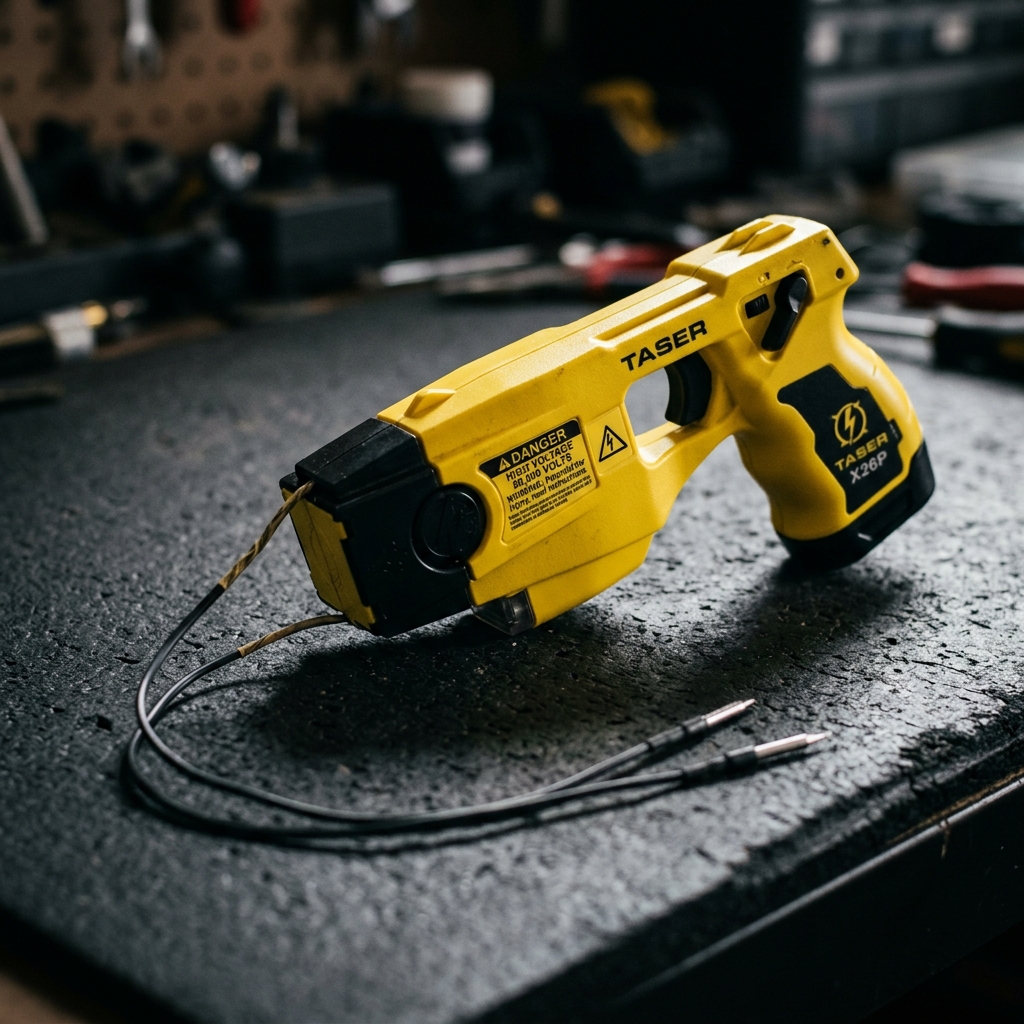
A TASER delivers approximately 50,000 volts. That number sounds terrifying — it’s nearly 420 times the voltage of a US wall outlet. But voltage alone doesn’t determine how dangerous an electrical device is. The current a TASER pushes through your body is only about 2–4 milliamps, well below the 100–200 mA threshold that can cause cardiac arrest. The high voltage punches through clothing and arcs across the air gap between probes, but once the circuit completes through the body, the delivered voltage drops dramatically.
Open-circuit voltage: ~50,000 volts.
Average current: 2–4 milliamps (0.002–0.004 A).
Pulse cycle: 5 seconds per trigger pull, 15–19 pulses per second.
Lethal? Classified as “less-lethal” — not “non-lethal.” Deaths are rare but documented.
That’s the short version. But if you’ve ever wondered why 50,000 volts from a TASER won’t kill you while 120 volts from a wall outlet can — or what actually happens to your body during those five seconds — you’ll want the full picture.
What the 50,000-Volt Rating Actually Means
Open-Circuit Voltage vs. What Reaches Your Body
Here’s something that almost every article about tasers gets wrong: the 50,000-volt number isn’t what your body experiences. It’s the open-circuit voltage — the reading you’d get if you measured the output with nothing connected, like checking a battery’s voltage without any load attached.
Once the two probes make contact with skin or clothing and the circuit closes through your body, the voltage drops significantly. The actual delivered voltage across the body is roughly 1,200 to 1,500 volts, depending on probe spread, clothing thickness, and skin resistance.
Think about static electricity. When you shuffle across a carpet and touch a metal doorknob, that spark is 10,000 to 25,000 volts. You flinch, maybe curse a little, but you’re fine. The voltage was sky-high, the current was negligible, and the duration was a fraction of a millisecond. A TASER operates on a similar principle — enormous voltage to establish the connection, but tightly controlled current once that connection is made.
Why the Voltage Has to Be That High
Air is a natural insulator. So is clothing — especially thick winter jackets, leather, or multiple layers. To arc across the gap between two probes and punch through fabric, the TASER needs enough electrical pressure to overcome that insulation. That’s what the 50,000 volts is for: breaching the gap.
Once the circuit closes through the body, the device’s internal circuitry takes over and regulates the current to about 2–4 milliamps. The voltage does the reaching. The current does the work. And the circuitry makes sure the current stays in a controlled range.
Taser Voltage vs. Stun Gun Voltage — The Real Difference
Most people use “taser” and “stun gun” interchangeably. They’re not the same thing — and the voltage comparison between them is one of the most misunderstood topics in self-defense.
| Feature | TASER (CEW) | Stun Gun (Contact) |
|---|---|---|
| Voltage (open-circuit) | ~50,000V | 20,000V–1,000,000V (claimed) |
| Amperage | 2–4 mA (regulated) | Varies widely (unregulated) |
| Deployment | Fires 2 probes up to 15–25 ft | Direct body contact required |
| Primary Effect | Neuromuscular incapacitation (NMI) | Localized pain compliance |
| Probe Spread | 2+ inches (wider = more effective) | N/A — fixed contact points |
| Brand vs. Category | TASER = brand (Axon Enterprise) | Generic — many manufacturers |
| Price Range | $400–$1,700+ | $15–$80 |
Why Stun Gun Voltage Claims Are Misleading
You’ve seen the ads: “10 MILLION VOLTS!” printed in bold on a $25 stun gun from Amazon. Those numbers are essentially meaningless.
There’s no standardized testing requirement for consumer stun guns. A manufacturer can slap any voltage number on the packaging without independent verification. And even if a stun gun could genuinely produce a million volts at the terminals, the current it delivers might be so low that the device causes pain but zero incapacitation. You’d zap someone, they’d yell, and they’d keep coming.
TASER’s 50,000-volt spec, by contrast, comes from Axon Enterprise — a publicly traded company with engineering documentation, independent testing, and law enforcement contracts that demand verifiable performance. The number is real, measured, and meaningful.
TASER Is a Brand Name — Here’s Why That Matters
TASER stands for Thomas A. Swift’s Electric Rifle — named after a character in a science fiction novel. The original inventor, Jack Cover, was a NASA researcher who built the first prototype in 1974.
Today, TASER is a product line manufactured exclusively by Axon Enterprise (formerly TASER International). Using “taser” as a generic term for any electroshock weapon is like calling every tissue “Kleenex.” Legal and regulatory documents use the term conducted electrical weapon (CEW) or conducted energy device (CED) to describe the category.
How a TASER Works — The Electrical Mechanism
The 5-Second Cycle
Pull the trigger and here’s what happens in roughly half a second:
- Compressed nitrogen fires two small probes — barbed darts connected to the device by thin insulated wires
- The probes embed in skin or clothing at two separate points on the body
- The circuit closes — current flows from one probe, through the body, and back through the second probe
- The device delivers 15–19 electrical pulses per second for a standard 5-second cycle
- Each pulse lasts about 100 microseconds and carries roughly 100 microcoulombs of charge — about 0.07 joules of energy per pulse
After five seconds, the cycle stops automatically. The officer (or civilian user) can pull the trigger again for another 5-second cycle, but each deployment is a discrete, timed event — not a continuous stream of electricity.
Neuromuscular Incapacitation — Why You Can’t Fight Through It
This is the engineering achievement that separates a TASER from a cheap stun gun. TASER pulses are specifically designed to mimic the electrical signals your nervous system uses to control skeletal muscles. The device doesn’t just cause pain — it overrides your voluntary motor nerve signals.
When those 15–19 pulses per second hit the motor neurons between the two probes, your muscles receive conflicting commands. The result: involuntary, full-body muscle contraction. Your legs lock. Your arms seize. You fall — and you can’t break your fall because your muscles aren’t responding to your brain’s instructions.
This isn’t about pain tolerance. Someone hopped up on adrenaline or drugs can shrug off a stun gun’s localized pain. They can’t shrug off NMI. The electrical signal doesn’t go through the pain-processing centers of the brain — it goes directly to the muscles. Willpower is irrelevant.
The wider the probe spread, the more effective the incapacitation. Two probes landing 12 inches apart capture far more motor nerve pathways than probes landing 2 inches apart. That’s why TASER cartridges are engineered for specific probe-spread angles at different distances.
Can a Taser Kill You? What the Research Says
TASERs are classified as “less-lethal” weapons — not “non-lethal.” That distinction matters. It acknowledges a non-zero risk of serious injury or death, particularly for individuals with pre-existing health conditions.
The “Less-Lethal” Classification
Every TASER manual, every law enforcement training program, and every Axon product data sheet uses the term “less-lethal.” They never call it “non-lethal.” That’s a deliberate choice backed by real data.
A Reuters investigation documented over 1,000 deaths in the United States that occurred after police taser use between 2000 and 2018. That number requires context, though. In many of those cases, the TASER wasn’t the sole or even primary cause of death. Contributing factors frequently included drug intoxication (particularly stimulants like cocaine and methamphetamine), pre-existing cardiac conditions, prolonged physical restraint, and repeated or extended taser cycles.
Establishing direct causation is difficult. But the pattern is clear enough that medical organizations and device manufacturers acknowledge the risk.
Cardiac Risk — What the Medical Studies Show
The American Heart Association published a statement acknowledging that conducted electrical weapons can, under specific circumstances, cause cardiac arrest. The risk increases when:
- Probes land directly over the heart — creating a current path through cardiac tissue
- The subject has a pre-existing heart condition — structural abnormalities, long QT syndrome, or other arrhythmia-prone conditions
- Stimulant drugs are in the system — cocaine and methamphetamine increase cardiac sensitivity to electrical stimulation
- Multiple or prolonged taser cycles are applied — exceeding the standard 5-second deployment
- The subject is in a state of extreme physiological stress — “excited delirium” or equivalent agitated states
Animal studies using pig models (whose cardiac physiology closely resembles humans) have demonstrated that CEW discharges can “capture” the heart’s electrical rhythm under controlled conditions — essentially overriding the heart’s natural pacemaker signals and triggering ventricular fibrillation.
On the other side: large-scale studies of law enforcement volunteers who were tased during training found no dangerous cardiac effects in healthy individuals receiving single standard 5-second exposures. The consensus isn’t that TASERs are safe or unsafe — it’s that the risk is low for healthy people and meaningfully higher for vulnerable populations.
Why Amperage Is the Real Safety Factor
Here’s where the electrical engineering matters. A TASER operates at 2–4 milliamps average current. The generally accepted lethal threshold for cardiac fibrillation is 100–200 milliamps (per IEC 60479, the international standard for effects of current on the human body).
That puts the TASER’s operating current at roughly 50 times below the lethal threshold. The current is also delivered in brief pulses — not as a continuous stream — which further reduces cardiac risk compared to sustained current flow.
The reason voltage is just electrical pressure — not a measure of danger by itself — is central to understanding why a 50,000-volt TASER is survivable while a 120-volt wall outlet can kill. Voltage pushes. Current is what flows through your body and does the damage. And the TASER’s circuitry is specifically engineered to keep that current in a narrow, controlled band.
TASER Voltage Compared to Everyday Electrical Sources
Context helps. Here’s how a TASER’s electrical output stacks up against sources you encounter daily.
| Electrical Source | Voltage | Current Available | Danger Level |
|---|---|---|---|
| 🔋 AA Battery | 1.5V | Low | Harmless |
| 🔌 USB Charger | 5V | 0.5–3A | Harmless |
| 🚗 Car Battery | 12V | 500+ A | Fire / burn risk |
| 🔌 US Wall Outlet | 120V AC | 15–20A | ⚠️ Potentially lethal |
| ⚡ TASER ★ | 50,000V | 2–4 mA | Painful, rarely lethal |
| 🧤 Static Doorknob Shock | 10,000–25,000V | < 1 mA | Harmless (startling) |
| 🌩️ Lightning Bolt | ~300,000,000V | ~20,000A | ⚡ Lethal |
★ TASER voltage is open-circuit rating. Delivered voltage through the body is ~1,200–1,500V. Current is electronically regulated.
Why a 120V Wall Outlet Is More Dangerous Than a 50,000V TASER
This seems backwards until you look at the current.
A standard household outlet can sustain 15–20 amps continuously through your body for as long as you’re touching it. At 1,000 ohms of wet-skin resistance, Ohm’s Law gives you: I = 120V ÷ 1,000Ω = 120 mA — right in the lethal cardiac fibrillation range. And that current doesn’t stop after five seconds. It keeps flowing until you let go, the breaker trips, or someone pulls you free.
A TASER delivers 2–4 mA in controlled pulses for exactly 5 seconds. The wall outlet delivers 30–60 times more current, continuously, with no built-in shutoff.
Understanding how current flows and why amps matter is the key to understanding why high voltage doesn’t automatically mean high danger. Voltage is the pressure. Current is the flow. And it’s the flow through your heart that determines whether you walk away.
Current TASER Models and Their Voltage Specs
Every TASER model on the market today — civilian and law enforcement — outputs the same 50,000-volt open-circuit voltage. What changes between models is the deployment range, pulse pattern, cartridge system, and data features.
| Model | Intended Use | Voltage | Range | Key Feature |
|---|---|---|---|---|
| TASER 7 | Law enforcement | 50,000V | 12 ft / 25 ft | Adaptive cross-connect, dual cartridge |
| TASER 7 CQ | Close-quarters LE | 50,000V | 4 ft / 12 ft | Designed for confined spaces |
| TASER X2 | Law enforcement | 50,000V | 15 ft / 25 ft | Dual-shot capability |
| TASER Bolt 2 | Civilian self-defense | 50,000V | 15 ft | Single cartridge, laser sight |
| TASER Pulse+ | Civilian self-defense | 50,000V | 15 ft | Compact, Noonlight app integration |
All models manufactured by Axon Enterprise. Law enforcement models include data logging of every trigger pull for accountability records.
Civilian Models vs. Law Enforcement Models
The voltage is identical across the lineup. What separates a $400 civilian TASER Bolt 2 from a $1,500+ law enforcement TASER 7 comes down to deployment options and accountability features.
Law enforcement models carry two cartridges (so the officer gets a second shot without reloading), offer multiple range cartridges (close and far), and log every single trigger pull with a timestamp and duration. That data gets downloaded during evidence reviews and use-of-force investigations.
Civilian models are simpler: single cartridge, fixed range, and a “Safe Escape” design philosophy. Deploy the TASER, drop it on the ground, and run. Axon will replace the device for free if you report the incident to police — the logic being that the TASER gave you time to get away, and that’s all it needed to do.
What Getting Tased Feels Like
The Physical Experience
Police trainees and military personnel who’ve been tased during training consistently describe it as one of the most intense experiences of their lives. Not the most painful — the most overwhelming.
The moment the probes connect, every muscle between the two probe points contracts at maximum intensity. Simultaneously. You don’t have time to react because your muscles have already been commandeered. Your legs buckle, your arms lock, and you go down. Hard. You can’t break your fall because your arms won’t respond to the frantic commands your brain is sending.
For five seconds, you’re a passenger in your own body. The sensation isn’t a sharp pain like a cut or a burn — people describe it more like the worst full-body cramp imaginable, combined with an electrical buzzing sensation that radiates through your torso and limbs.
Then it stops. Muscle control returns within seconds. You’re left with soreness (like a hard workout), small marks at the probe entry points, and occasionally minor burns where the probes made contact. Most people are fully functional within a few minutes, though the adrenaline dump and psychological shock can linger longer than the physical effects.
Why You Can’t “Fight Through” a TASER
With a stun gun, pain is the mechanism. Tough enough, aggressive enough, or chemically numbed enough — and some people can push through it. The stun gun hurts, but it doesn’t take control.
A TASER doesn’t rely on pain. The electrical pulses bypass your brain’s pain-processing centers entirely and talk directly to your motor neurons. Your brain says “move your legs.” The TASER says “no.” The TASER wins, every time, regardless of the person’s size, strength, pain tolerance, or mental state.
That’s the entire engineering point. NMI works on physiology, not psychology. It’s why law enforcement agencies worldwide have adopted TASERs as a primary less-lethal tool — they work on people who won’t respond to verbal commands, pepper spray, or pain-compliance holds.
Frequently Asked Questions About Taser Voltage
How many volts is a police taser?
Most law enforcement agencies use the TASER 7, which delivers 50,000 volts at the probes. Older models like the X26P also output 50,000V open-circuit. The voltage is consistent across Axon’s professional product line — what changes between models is the pulse pattern, deployment range, and data connectivity features.
Is a taser actually 50,000 volts?
Yes, but that’s the open-circuit voltage — the reading with no load connected. Once the probes make contact with a person, body resistance drops the delivered voltage to roughly 1,200–1,500 volts. The 50,000V figure represents the device’s maximum output capability, not the voltage your body experiences.
How many amps does a taser use?
A TASER operates at approximately 2–4 milliamps (0.002–0.004 amps) average current. That’s a fraction of the current available from a household wall outlet, which can deliver 15–20 amps. The taser’s current is electronically regulated — the circuitry limits current regardless of body resistance.
Can a taser kill you?
In rare cases, yes. Deaths have been documented following TASER use, particularly when combined with pre-existing cardiac conditions, stimulant drug use, or repeated/prolonged exposure. TASERs are classified as “less-lethal” — not “non-lethal” — acknowledging a small but real risk of fatal outcomes.
How long does a taser shock last?
Each trigger pull delivers a standard 5-second cycle of electrical pulses. The operator can release the trigger early to shorten the cycle, or pull the trigger again for an additional 5-second cycle. Each pulse within the cycle lasts about 100 microseconds.
Is a taser stronger than a stun gun?
In terms of incapacitation effectiveness, yes — significantly. A TASER causes neuromuscular incapacitation (involuntary full-body muscle lockup), while most stun guns only cause localized pain at the contact point. However, “stronger” in terms of raw voltage is misleading — cheap stun guns often claim higher voltages than a TASER, but those numbers are unverified marketing claims.
Are tasers legal?
Taser legality varies by state and country. TASERs are legal for civilian purchase in most US states, though some states (like Hawaii and Rhode Island) restrict or ban them. Many countries outside the US prohibit civilian taser ownership entirely. Always check your specific state and local laws before purchasing.
What does getting tased feel like?
Law enforcement trainees describe it as the most intense muscle cramp imaginable — across your entire body at once. Every muscle between the two probes contracts involuntarily at maximum force for five seconds. You fall, you can’t break your fall, and voluntary movement is physically impossible until the cycle ends. Muscle control returns within seconds afterward.
Fifty thousand volts is the headline. Two to four milliamps is the story. The voltage is what gets the TASER’s probes through clothing and across the air gap — it’s the battering ram that opens the door. But the current that flows through your body is what actually causes incapacitation, and it’s engineered to be far below lethal thresholds. A wall outlet at 120 volts is genuinely more dangerous to your heart than a TASER at 50,000, because the outlet can deliver 30–60 times more current with no time limit and no built-in shutoff.
For quick electrical calculations — watts to volts, volts to amps, or any combination — use our free Watts to Volts calculator to get instant answers for both AC and DC circuits.
Last updated: June 13, 2026. This article is reviewed and updated periodically to reflect current TASER specifications and medical research. This content is for educational purposes only. Always consult local laws regarding taser ownership and use.