Why Do Contractors Implement Electrical Cost Analysis

Winning the competitive bid is just one part of the process, but it’s equally necessary to ensure that the number provided can be achieved without losing profits. All contractors go through this dilemma during the bidding process: the number should neither be too high, which will lead to the loss of the job, nor should the contractor offer a lower price and incur losses later on. In this regard, specialized electrical costing has appeared to be one of the best solutions to tackle the problem. Instead of using historical averages or adjusting the costs at the last moment, the electrical costing breaks down the project into its components: labor, materials, equipment, overhead, and contingency costs. Through this level of depth, the contractors may define which costs may be optimized and where they should take the risks. This article will analyze why many contractors are implementing specialized costing and how it benefits the construction industry.
The Value of Hiring Outsourcing Specialists in Cost Analysis
Creating a team of professionals specializing in cost analysis can be costly and insufficient. Both small and medium contracting companies may see it as a challenge to sustain a competent internal team and choose to rely on the services of well-known Electrical Estimating Companies. By utilizing this approach, contractors have an opportunity to work with skilled analysts and reliable cost databases as well as various types of industry benchmarks that are typically not provided by small companies. As a result, business owners enjoy the quick turnaround of bids and more competitive prices since the estimators rely on the actual market figures and not only on previous project data.
Key Takeaways
- In-house teams have difficulty becoming a good solution for smaller companies.
- Outsourcing helps companies get access to specialized information.
- Such partnerships make the process of bidding faster and cheaper.
In-House Estimating versus Specialized Cost Analysis
The differences in the operational and financial aspects of relying solely on in-house estimating and combining it with specialized cost analysis become evident once they are contrasted with each other. The table provided below summarizes these distinctions by the factors affecting the bottom line of a contracting firm.
| Factor | In-House Estimating Only | Specialized Cost Analysis |
|---|---|---|
| Access to real-time market pricing | Limited | Extensive |
| Depth of labor productivity benchmarking | Basic | Detailed |
| Bid preparation speed | Slower | Faster |
| Consistency across multiple estimators | Variable | Standardized |
| Risk contingency accuracy | Rough estimate | Data-calibrated |
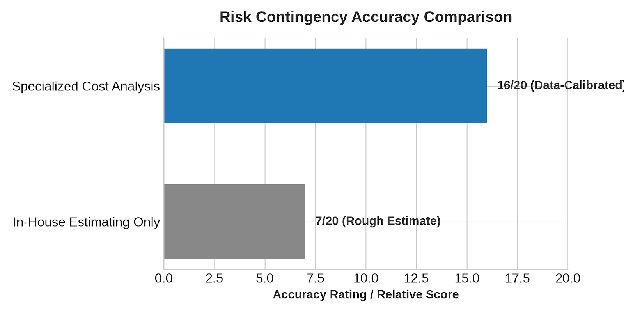
This comparison shows the rationale behind the growing perception of specialized cost analysis as a strategic instrument rather than simply a value-added service.
How Using Structured Electrical Estimating Improves the Competitiveness of Estimates
The key aspect of good cost analysis is the use of structured electrical estimating in a company that provides bids. The essence of the procedure involves breaking the entire project into separate identifiable pricing parts instead of treating the entire project as the same sum. The use of this approach enables the company to determine the costs of specific things in the project — whether it is a specialized lighting service, a length of conduit, or any complicated system involving low voltage. Organizations that make use of this aspect can present different pricing alternatives, such as alternative options for certain components of the cost, and do not lose validity. This aspect makes it possible for clients to choose companies with bids that are more flexible since they will be able to explain every point in their bids clearly.
Key Takeaways
- Structured cost analysis helps divide bids into manageable parts.
- Each part of the cost can be priced separately.
- Structured estimates result in more trust from the client.
Assessing the Financial Impact of Specialized Cost Analysis
The worth of specialized cost analysis is most clearly seen when it is compared to the outcome of real-time analysis. Contractors that use detailed cost analysis during their bidding process usually see beneficial results in terms of their wins and profitability, as seen in the example shown below.
| Metric | Without Cost Analysis | With Specialized Cost Analysis |
|---|---|---|
| Average bid win rate | 15–20% | 25–32% |
| Post-project profit margin | 5–8% | 10–15% |
| Frequency of underbid losses | High | Low |
| Client renewal rate | 50–60% | 72–80% |
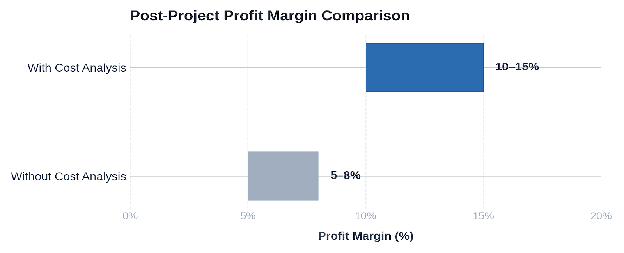
These figures show a trend that exists in the construction industry: contractors who invest in specialized analysis win more bids and are able to maximize their profit.
Applying Cost Analysis to Specialty Building Components
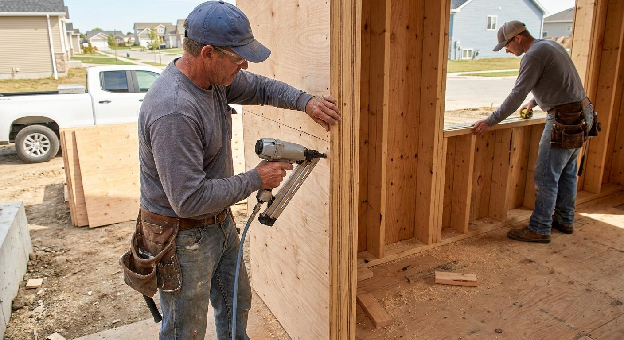
The same analytical approach that is used for electrical systems provides good results when used for other specialty components with complex costs, such as exterior wall systems where you need to analyze the quality of materials, fastening techniques, and waste factors. Therefore, most contractors use Sheathing Takeoff and Estimation services that allow them to assess this category of items in the same way they assess electrical items. The smallest miscalculations are enough to derail construction budgets. Research has discovered that 35% of projects cost more because of material mistakes. Accuracy is paramount in plywood sheathing estimating to provide accurate budgets, not overstated material orders and wastage. Iff all specialty components are analyzed rather than just electrical systems, then the project bid will be less likely to be affected by missing data. This demonstrates that the industry has matured and thoroughness is now a key quality in all spheres of construction.
Key Takeaways
- Analytical approach should not be limited only to electrical scope.
- Costing items like sheathing have their own complexities.
- Universal application of cost analysis leads to better estimates.
- Cost “discipline” improves profitability.
Read more: 99% Accurate Lumber Takeoff Services in California
Final Thoughts
In conclusion, the precise analysis of electrical costs is emerging as a fundamental factor leading to distinguishing successful contractors with stable profit margins from unsuccessful ones. The nature of the evidence confirms that precise analysis of data lowers the frequency of losses and enhances the level of obtaining clients’ trust, thus becoming successful in the process of making lucrative deals. In a time when the number of bids grows bigger, and clients expect to see transparency in figures, contractors applying cost analysis or creating partnerships with other companies specializing in cost analysis will get ahead of their competitors. The only way to succeed in the future is to regard cost analysis as a permanent service rather than as a one-off service.
Frequently Asked Questions
What does the term specialized electrical cost analysis mean?
Cost analysis is a comprehensive assessment of all aspects involved in the electrical bidding process, which is created to lead to very favorable and sustainable pricing.
Why do existing contractors decide to use outsourcing instead of merely relying on their own resources?
Using outside resources means getting access to the latest data on the market and specialized experience, which is much more time-consuming and expensive to acquire.
How do structured estimations make bids more attractive?
Dividing the bid into parts allows contractors to prepare flexible and value-engineered solutions and offer their clients clear and trustworthy pricing.
Is it true that specialized cost analysis leads to higher profit margins?
Indeed, it is. Statistics show that contractors applying detailed cost analysis achieve more favorable profit margins in their projects than those companies relying on rough estimations.
Why should cost analysis be applied to other areas apart from electrical work?
It should be noted that the areas of expertise that are not analyzed thoroughly (such as sheathing or framing) may have an important impact on the profit of the project.