What to Include in a Cooling Tower Repair Request Before Calling a Contractor

A cooling tower repair request should state the equipment and site, the symptom as observed, when it started, the operating context, safe evidence, site constraints, and who to contact. Share facts, not suspected causes, because a qualified assessment still decides the diagnosis and scope.
Use this cooling tower repair request checklist before you call a cooling tower repair contractor, so the first conversation starts with usable information and fewer follow-up questions.
Start with the Equipment and Site Details
A cooling tower repair enquiry stalls when the contractor cannot tell what and where the tower is. Write “unknown” for any detail you lack, and never guess a model number.
- Site and location: Name the facility, address, and tower area.
- Tower identity: Add the manufacturer, model, and serial number if available.
- Asset tag and cells: State the tag and the number of cells.
- Component involved: Name the part only if the team can clearly see it.
- Documents: List the drawings and manuals you hold.
For readers reviewing service options, ICST Thailand outlines its cooling tower repair and maintenance support here.
Describe the Problem as Observed
State what the team saw, heard, or measured. Put suspected causes on a separate line, marked as unconfirmed.
- Start: Say when it began and what changed beforehand.
- Pattern: Say whether it is continuous or intermittent.
- Operating state: Say what the tower was doing when it occurred.
Include Evidence That Can Be Shared Safely
Evidence helps a contractor judge the situation before a visit. Collect it only from safe, permitted positions, and never open guards or reach into rotating equipment.
- Photos and videos: Label each one with the location and date.
- Logs and trends: Add readings and alarm history, and makeup water readings if you track them. Leaks and overflows add to a tower’s water use, according to the U.S. EPA.
- Earlier references: Quote previous work order IDs.
Explain Operational Impact and Timing Constraints
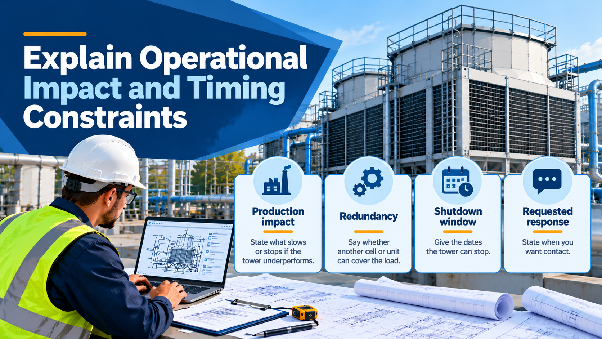
Timing shapes how a provider plans the assessment. Describe the situation without overstating urgency, because site procedures govern emergencies.
- Production impact: State what slows or stops if the tower underperforms.
- Redundancy: Say whether another cell or unit can cover the load.
- Shutdown window: Give the dates the tower can stop.
- Requested response: State when you want contact.
Gather Prior Maintenance and Repair History
History shows what the team already tried, though prior work does not prove a root cause. Add the manufacturer’s maintenance recommendations if you hold them. The U.S. Department of Energy’s O&M guidance defers to manufacturer recommendations first.
- Records: Share recent cooling tower maintenance and repair notes.
- Repeat symptoms: Note earlier occurrences and their dates.
- Replaced parts: List the parts and when crews fitted them.
Identify Site Requirements Before a Visit
Visits stall when access rules surface late. List only what applies, because authorized site staff control safety procedures.
- Induction and permits: Name who issues them.
- Isolation and lockout: State the site process for isolating the tower.
- Access equipment: Note lifts, scaffolds, and lifting limits. OSHA says a competent person inspects a scaffold before each work shift.
- Credentials: List the insurance or documents the site requires.
Ask for a Clear Assessment and Repair Scope
A good cooling tower repair enquiry also asks questions back. These help you compare providers fairly.
- Inspection: What inspection do you propose?
- Inclusions: What does the scope include and exclude?
- Assumptions: Which assumptions remain open?
- Verification: What testing follows the work?
- Approvals: How do you approve additional work?
Separate Initial Assessment from Confirmed Quotation
A firm scope, cost, and timeline can depend on inspection, data, parts identification, and site access. A request alone cannot confirm them.
A Copy-Ready Repair Enquiry Template
Copy these fields into an email or form. This generic template is not an official ICST form. It suits any cooling tower repair contractor.
| Field | What to write | Illustrative wording | Attach | Avoid |
|---|---|---|---|---|
| Tower and site | Facility, tag, cells | “Tower T-2, three cells” | Nameplate photo | A guessed model |
| Symptom | What you observed | “Unusual noise near the fan drive” | Labeled photo | A named failure |
| Start and trend | When, how often | “Intermittent since last week” | Log extract | “Always like this” |
| Operating context | Load, mode | “Normal load” | Trend readings | Assumed causes |
| Impact | Output, redundancy | “Spare cell available” | Schedule | “Urgent” alone |
| History | Recent work | “Fan serviced in spring” | Work order ID | A blamed cause |
| Access | Permits, isolation | “Permit required” | Site rules | Unknown rules |
| Next step | Assessment, contact | “Site visit, weekdays” | None | Price promises |
Conclusion
A complete cooling tower repair request gives the first call a firm starting point. Use the cooling tower repair request checklist to record equipment, symptoms, evidence, history, and site limits, then ask clear scope questions.
A cooling tower repair contractor still decides the diagnosis and the industrial cooling tower repair scope after assessment.
Frequently Asked Questions
What details belong in a repair request?
Include the site, tower identity, asset tag, and the component involved. Add the observed symptom, start date, operating state, and safe evidence. Describe site access and timing limits, then give a contact name and your availability. These details let a provider route a cooling tower repair enquiry without repeated calls and plan the right assessment.
Which photos or readings are safe to share?
Share only what the team captures from permitted positions without opening guards or entering restricted areas. Label each photo with the location and date. Add logged readings, alarm history, and earlier work order references where available. When in doubt, ask site safety staff before collecting anything, and skip any evidence that needs unsafe access.
How do I describe a symptom without guessing the cause?
Write what someone saw, heard, or measured, such as “unusual noise near the fan drive.” Add when it occurs and under which load or mode. Put any suspicion on a separate line marked unconfirmed. A qualified assessor then tests the idea against inspection findings and site documents before naming any cause.
Why can scope and cost stay provisional until inspection?
Remote notes cannot show the real condition, the exact parts, or the site access needed. A provider therefore proposes an assessment first and confirms scope, cost, and timing afterward. Ask what assumptions the first estimate carries, and how the provider handles changes once the inspection finishes and the team identifies parts.