Watt Hour Calculator: Calculate Battery Energy, Runtime & Power Usage
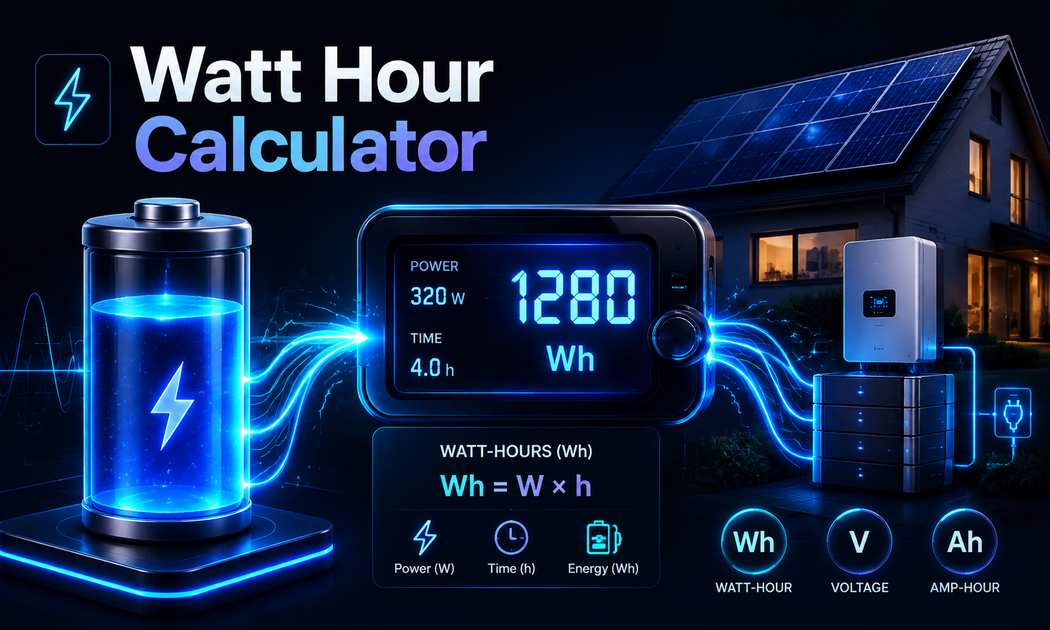
A watt hour (Wh) measures the amount of energy a device uses or a battery stores over time. If you run a 100-watt light bulb for 1 hour, it consumes 100 watt hours. Understanding watt hours is crucial for calculating electricity costs, sizing batteries, estimating solar panel output, and managing your energy consumption efficiently.
Watt Hours = Watts × Hours
Watt Hours = Volts × Amps × Hours
Watt Hours = Volts × Amp Hours (Ah)
For energy cost: Cost = (Wh ÷ 1000) × Price per kWh
Watt Hour Calculator
⚡ Watt Hour Calculator
Choose a calculation mode and enter your values
What Is a Watt Hour?
A watt hour (Wh) is a unit of energy equal to one watt of power sustained for one hour. It’s the standard way to measure how much energy a device consumes or how much energy a battery stores.
- 1 Wh = 1 watt for 1 hour = 3,600 joules
- 1 kWh (kilowatt hour) = 1,000 Wh — this is what your electric bill measures
- 1 MWh (megawatt hour) = 1,000,000 Wh
How to Calculate Watt Hours
There are several ways to calculate watt hours depending on what values you know:
Method 1: From Watts and Time
Wh = Watts × Hours
Example: A 60W light bulb running for 5 hours uses 60 × 5 = 300 Wh
Method 2: From Volts, Amps, and Time
Wh = Volts × Amps × Hours
Example: A 12V battery delivering 3A for 4 hours provides 12 × 3 × 4 = 144 Wh
Method 3: From Battery Ah Rating
Wh = Volts × Amp Hours (Ah)
Example: A 12V, 100 Ah battery stores 12 × 100 = 1,200 Wh
Common Device Power Consumption
| Device | Typical Watts | Hours/Day | Daily Wh |
|---|---|---|---|
| LED Light Bulb | 10W | 8h | 80 Wh |
| Laptop | 50W | 8h | 400 Wh |
| Refrigerator | 150W | 8h (cycles) | 1,200 Wh |
| TV (55”) | 80W | 5h | 400 Wh |
| Space Heater | 1,500W | 6h | 9,000 Wh |
| Phone Charger | 5W | 3h | 15 Wh |
Why Watt Hours Matter
• Calculate your electricity bill (kWh × rate = cost)
• Size solar panels and battery storage
• Compare portable power stations and batteries
• Estimate generator fuel consumption
• Plan off-grid power budgets for RVs and camping
• Compare energy efficiency of appliances
Electricity Costs
Your electric company charges by the kilowatt hour (kWh). To find cost: divide watt hours by 1,000 to get kWh, then multiply by your rate. The average US electricity rate is about $0.12/kWh, but this varies significantly by state and provider.
Battery Sizing
When choosing a portable power station or battery bank, watt hours tell you exactly how much energy is stored. A 500 Wh power station can run a 50W device for 10 hours, or a 100W device for 5 hours.
Solar Panel Output
Solar panels are rated in watts, but their daily energy production is measured in watt hours. A 300W solar panel getting 5 peak sun hours produces approximately 1,500 Wh (1.5 kWh) per day.
Watt Hours vs Amp Hours
| Feature | Watt Hours (Wh) | Amp Hours (Ah) |
|---|---|---|
| Measures | Energy (total work capacity) | Charge (current over time) |
| Voltage dependent? | No — it’s absolute energy | Yes — need voltage to find energy |
| Better for comparing | Batteries at different voltages | Batteries at same voltage |
| Conversion | Wh = Ah × Volts | |
When comparing batteries, always use watt hours for an apples-to-apples comparison. A 100 Ah battery at 12V (1,200 Wh) stores very different energy than a 100 Ah battery at 48V (4,800 Wh). Watt hours eliminate voltage confusion.
FAQs
How Many Watt Hours Does a House Use Per Day?
The average US household uses about 30 kWh (30,000 Wh) per day. This varies widely based on climate, home size, and lifestyle — ranging from 20 kWh to 50+ kWh daily.
How Do I Convert Watt Hours to Kilowatt Hours?
Divide by 1,000. For example, 1,500 Wh ÷ 1,000 = 1.5 kWh.
How Many Watt Hours Do I Need for Camping?
A basic camping setup might need 500–1,000 Wh per day. This covers phone charging, LED lighting, a small fan, and charging a laptop. Heavy users with CPAP machines or mini-fridges should plan for 1,500–2,000 Wh.
What Size Battery Do I Need for a 1,000W Inverter?
For a 1,000W inverter running at full load for 2 hours, you need at least 2,000 Wh of battery capacity. For a 12V system, that’s about 200 Ah (accounting for 80% DoD: 2,000 ÷ 12 ÷ 0.8 ≈ 208 Ah).
Conclusion
Watt hours are the universal language of energy consumption. Whether you’re calculating your electric bill, sizing a solar battery system, or choosing a portable power station, understanding watt hours puts you in control. Use the calculator above to quickly convert between watts, time, voltage, and amps — or estimate your energy costs directly.