The Role of Automation Hardware in Modern Research Environments
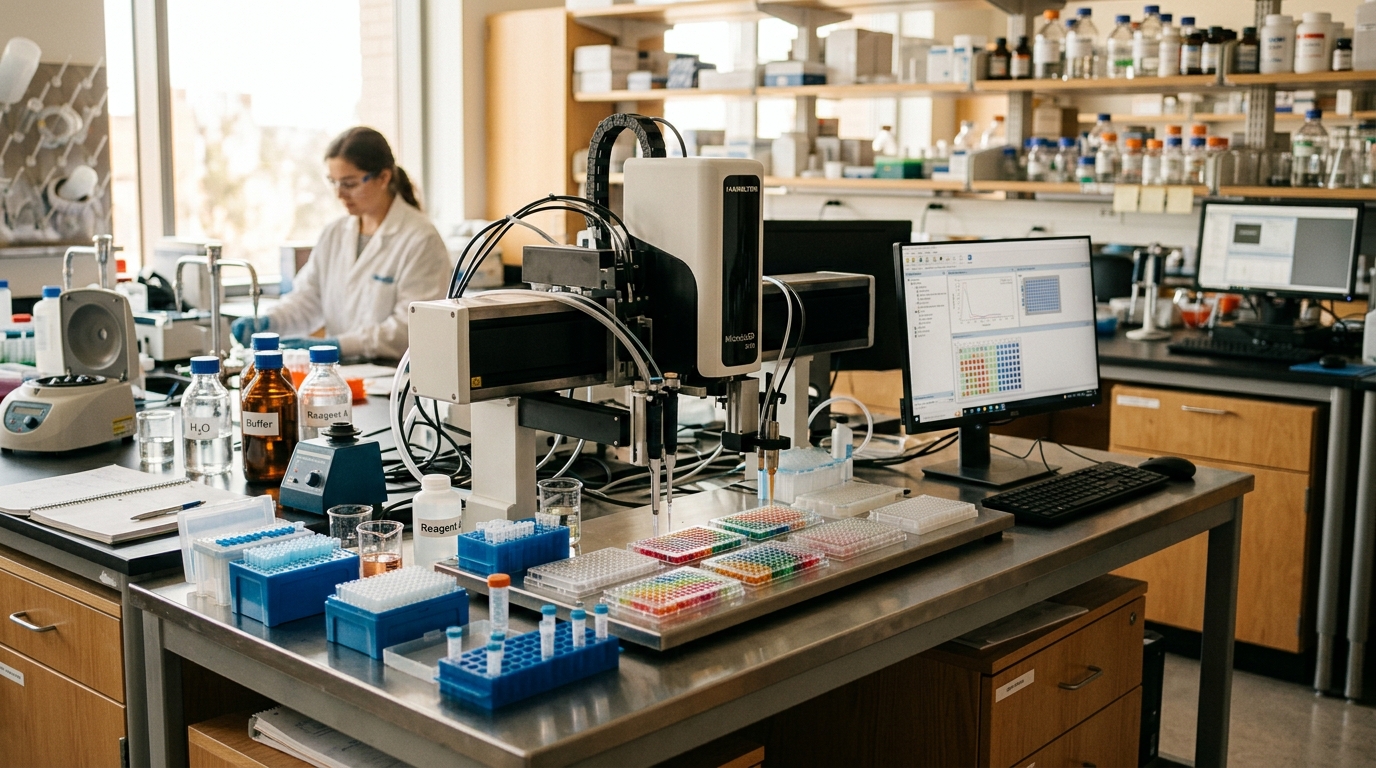
At two in the morning, a heavily automated lab is not silent. A gripper hums as it rotates a plate, a rail carriage slides left, a reader lid closes with a soft knock, and a freezer door seals itself again after giving up one tube out of forty thousand. There is nobody standing there to watch any of it happen.
That night shift is the clearest argument for automation hardware. Software gets the attention, and yet software cannot pick up a plate or weigh out a powder. Every scheduling decision eventually has to be carried out by a motor, a gripper, a pump, or a sensor, and the quality of those physical parts sets the ceiling on everything built above them.
It helps to look at the machinery piece by piece, because a research platform is rarely bought as a single object. It accumulates: an arm one year, a dispenser the next, an automated store once sample volumes outgrow a chest freezer. Knowing what each component contributes makes it far easier to see why an integrated system behaves the way it does.
Robotic Arms That Move Work Between Stations
The robotic arm is the part most people picture first, and in daily use it does something less theatrical than it looks: lifting a microplate, rotating it ninety degrees, then setting it into a reader with a tolerance measured in fractions of a millimeter. Some arms sit on a fixed base, while others travel along a rail or roll across the floor, which lets one arm cover a long bench or several adjoining rooms. Argonne National Laboratory’s Polybot platform pairs a wheeled mobile robot with a six axis arm and interchangeable grippers, so samples move between synthesis, coating, and characterization stations without anyone carrying a tray. Smaller plate movers do a narrower version of the same job, and for plenty of workflows they are all the motion anyone needs.
Liquid Handlers and the Honest Limits of the Human Hand
Manual pipetting is accurate for a while. Then the wrist tires, thumb pressure drifts, and the last column of a plate stops matching the first. Automated liquid handlers remove that drift by repeating the same aspirate and dispense motion thousands of times with identical force and timing. Multichannel heads fill 96 or 384 wells in a single pass, and acoustic dispensers move nanoliter droplets with no tip touching anything at all. The gain is not only speed. It is that assay variance starts coming from the biology rather than from whoever happened to run the plate.
Sensors That Tell the System What Just Happened
Hardware that moves is only half of the story. Barcode and RFID readers confirm which plate sits in the gripper, load cells weigh powders to the milligram, and capacitive tips sense liquid level before they plunge. Those signals are what let a run recover from a small fault instead of quietly ruining a week of work. IEEE Spectrum’s reporting on closed loop research platforms describes systems that analyze their own results and then choose the next set of conditions, and that loop only closes when sensors report the physical state honestly.
Automated Storage and Retrieval of Samples
Biobanks and compound libraries run into a problem that has nothing to do with chemistry: finding one tube. Automated stores hold racks at controlled temperature, pick individual tubes under software control, and keep the door shut while they work, which spares every neighboring sample a round of thermal cycling. The retrieval log doubles as a chain of custody, so a question asked about a sample two years later has an answer.
Where Separate Instruments Become One Workflow
Integration is where hardware either pays off or disappoints. The A-Lab at Lawrence Berkeley National Laboratory processes fifty to a hundred times as many samples per day as a person can, and its team had to adapt robots, furnaces, and analysis tools to talk to a central hub. Choosing lab automation equipment that shares a common plate footprint and exposes a usable control interface strips out a good deal of that custom engineering, and tracking what you own across its whole service life, much the way IT teams track returned devices, keeps a growing platform from decaying into a drawer of orphaned parts.
None of this removes the scientist from the room. It moves the work. Fewer hours go into holding a pipette and more go into deciding what is worth measuring in the first place.
What is changing fastest is modularity. An automated workcell used to be a bespoke installation that one vendor assembled and one engineer understood. Arms, dispensers, readers, and stores now ship with documented interfaces, so a lab can add one capability without rebuilding the whole bench around it.
The sensible way in is still small. Put a plate mover next to the instrument that eats the most hands on time, add a liquid handler where variance hurts most, and watch where the queue forms next. Grown that way, the quiet two in the morning run stops looking like a showpiece and starts looking like a Tuesday.