How Many Watts Does a Refrigerator Use? (2026 Guide)
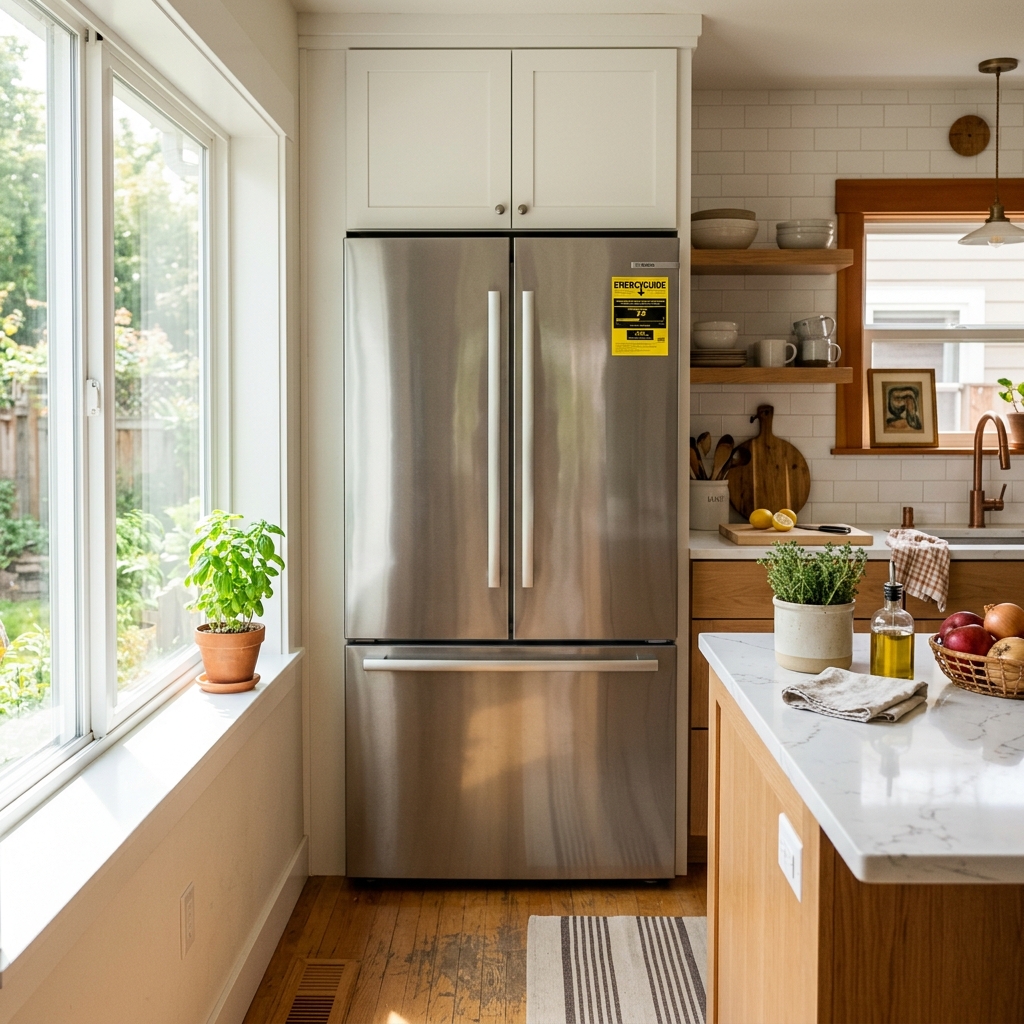
A typical household refrigerator uses between 300 and 800 watts while its compressor is running, with the average model drawing roughly 400–500 watts. But here’s the part most guides leave out: your fridge’s compressor doesn’t run nonstop. It cycles on and off throughout the day, so actual energy consumption averages about 1–2 kWh per day — or roughly 400–600 kWh per year.
That number matters more than you’d think. Whether you’re trying to figure out why your electric bill spiked, sizing a backup generator for hurricane season, or calculating how many solar panels you need, your refrigerator’s wattage is the starting point for every calculation.
A refrigerator uses 300–800 running watts depending on type and size. Mini fridges draw 50–100W, top-freezer models pull 300–500W, and French door refrigerators hit 500–800W. Because the compressor cycles on and off, actual daily consumption averages 1–2 kWh. For generator sizing, plan for 1,200–2,000 starting watts to handle the compressor surge.
How Many Watts Does a Refrigerator Use? (The Quick Answer)
A standard refrigerator uses 300–800 watts while its compressor is actively running. The average model draws about 400–500 watts.
But one number doesn’t tell the whole story. Think of it like a car’s gas pedal — your engine doesn’t burn fuel at full throttle every second you’re driving. Similarly, your fridge’s compressor kicks on to cool things down, then shuts off once the temperature hits its target. That on-off pattern is called the duty cycle, and it typically means the compressor runs only 30–50% of the time under normal conditions.
So while your fridge might be rated at 500 watts, its average power draw over a full day is closer to 150–250 watts. That distinction between rated watts and actual watts is the key to every calculation in this guide — from your electric bill to your solar panel count.
Refrigerator Wattage by Type and Size
Not all fridges are built the same, and wattage varies dramatically depending on the type, cubic footage, and age of the unit. Here’s how the main categories stack up.
| Refrigerator Type | Size (cu. ft.) | Running Watts | Starting Watts ⚡ | Annual kWh |
|---|---|---|---|---|
| Mini fridge | 1.5–4.5 | 50–100 W | 150–300 W | 100–250 |
| Compact / dorm | 5–10 | 200–400 W | 500–1,000 W | 200–350 |
| Top-freezer ★ | 14–20 | 300–500 W | 800–1,400 W | 350–500 |
| Bottom-freezer | 18–22 | 350–550 W | 900–1,500 W | 400–550 |
| Side-by-side | 22–28 | 400–700 W | 1,000–1,800 W | 500–700 |
| French door | 22–30 | 500–800 W | 1,200–2,000 W | 550–800 |
★ Most energy-efficient full-size configuration. Starting watts estimated at 2–3× running watts. Annual kWh based on ENERGY STAR 2025 data.
The pattern is straightforward: bigger fridges need more powerful compressors, which pull more watts. A mini fridge sips about the same electricity as a single light bulb. A French door model drinks closer to what a desktop computer uses.
But size isn’t the only factor. A 20-year-old top-freezer can easily outdrink a brand-new French door in energy consumption. Age, maintenance, and efficiency ratings all shift the math — which is why knowing your specific fridge’s wattage beats relying on averages.
Running Watts vs. Starting Watts — Why It Matters
Your fridge has two wattage numbers, and confusing them can cause real problems.
Running watts is the steady power your refrigerator draws while the compressor hums along. For most models, that’s somewhere between 100 and 500 watts. Starting watts — also called surge watts — is the brief, intense burst of power needed to kick the compressor motor from a dead stop. That surge typically hits 2–3× the running wattage and lasts only 2–3 seconds.
Think of it like pushing a car. Getting it rolling from a standstill takes a huge shove. Once it’s moving, keeping it going is easy. Your fridge’s compressor works the same way.
This distinction doesn’t affect your monthly electric bill — the surge is too short to register meaningfully. But it’s critical when sizing a generator, battery backup, or portable power station. If your power source can’t handle the startup spike, the fridge simply won’t turn on.
How Inverter Compressors Change the Game
Modern refrigerators from brands like Samsung, LG, and Whirlpool increasingly use inverter compressors. Unlike conventional compressors that slam on at full power and shut off completely, inverter compressors ramp up gradually and adjust their speed to match cooling demand.
The practical benefit? Lower surge wattage at startup (often just 1.2–1.5× running watts instead of 2–3×), smoother energy consumption throughout the day, and quieter operation. If you’re running a fridge on solar or a small generator, an inverter compressor model makes your life significantly easier.
How to Find Your Refrigerator’s Exact Wattage
Averages are useful, but your fridge has a specific number. Here are three ways to find it.
Example: 120V × 5.0A = 600 W
The Kill-A-Watt approach is especially useful if your fridge is older and you suspect it’s pulling more power than it should. Nameplate ratings show maximum draw, but actual consumption depends on the compressor’s duty cycle, which varies with temperature, food load, and how often you open the door.
How Much Electricity Does a Refrigerator Use Per Day, Month, and Year?
Here’s where we translate watts into the numbers that actually show up on your electric bill. Let’s use a typical full-size refrigerator rated at 500 running watts as our example.
| Time Period | Calculation | Energy Used |
|---|---|---|
| Per day | 500W × 8 hrs ÷ 1,000 | ~1.5 kWh |
| Per month | 1.5 kWh × 30 days | ~45 kWh |
| Per year | 1.5 kWh × 365 days | ~548 kWh |
Assumes a 500W fridge with ~33% duty cycle (compressor runs ~8 hours out of every 24). Actual duty cycle varies from 30–50% depending on conditions.
The 8-hour compressor runtime might seem low for an appliance that runs “all day,” but remember — the compressor cycles on and off. Your fridge’s thermostat kicks the compressor on when the internal temperature rises above the setpoint, then shuts it off once things cool back down. In a well-sealed fridge at room temperature, that typically works out to 6–10 hours of actual compressor runtime per day.
What Does It Cost to Run a Refrigerator?
Now for the number you actually care about: dollars.
The formula is simple: (daily kWh) × (days) × (your electricity rate) = cost.
At the US national average electricity rate of $0.17/kWh (per EIA data, early 2026), here’s what different fridges cost to operate:
| Annual kWh | Monthly Cost | Annual Cost | Typical Fridge Type |
|---|---|---|---|
| 200 kWh | $2.83 | $34 | Mini fridge |
| 400 kWh | $5.67 | $68 | ENERGY STAR top-freezer |
| 550 kWh | $7.79 | $94 | Average full-size fridge |
| 700 kWh | $9.92 | $119 | Older side-by-side |
| 800+ kWh | $11.33+ | $136+ | Old/inefficient large model |
Based on $0.17/kWh US average. Your actual rate may range from $0.10 (Louisiana) to $0.39 (Hawaii). Plug in your local rate for accurate results.
Your electricity rate makes an enormous difference. A fridge that costs $68/year in Louisiana at $0.10/kWh costs $156/year in California at $0.28/kWh — same fridge, same usage, more than double the price.
Old Refrigerator vs. New Refrigerator — Energy Use Comparison
If your fridge is old enough to drive, it’s probably costing you more in electricity than you realize.
A refrigerator manufactured in the early 2000s typically consumes 600–800 kWh per year. A comparable ENERGY STAR model from 2025 uses roughly 350–450 kWh per year — a 40–50% reduction. At $0.17/kWh, that’s a savings of $40–60 every single year.
For 2025, the ENERGY STAR “Most Efficient” designation requires a refrigerator to consume 637 kWh per year or less. The best models on the market today beat that number by a wide margin.
Does replacing an old fridge make financial sense? If your current unit is 15+ years old, the $50+/year savings typically pays back a mid-range replacement ($600–$900) within 5–8 years — while you get a quieter, better-performing fridge immediately.
What Size Generator Do You Need for a Refrigerator?
When the power goes out, your fridge is usually the first appliance you want to keep running. Here’s the sizing math.
Your generator needs to handle the starting watts, not just the running watts. A fridge with 500 running watts can surge to 1,000–1,500 watts for a few seconds when the compressor kicks on. If your generator can’t meet that spike, the fridge won’t start.
| Scenario | Running Watts | Surge Watts ⚡ | Recommended Generator |
|---|---|---|---|
| Fridge only | 300–500 W | 800–1,500 W | 2,000–2,400 W |
| Fridge + freezer | 500–800 W | 1,400–2,500 W | 3,000–3,500 W |
| Fridge + freezer + lights + phones | 700–1,200 W | 1,800–3,000 W | 3,500–4,500 W |
Recommended generator size includes ~30% headroom above peak surge to avoid tripping under load.
Pro tip: An inverter generator is the better choice for powering a refrigerator. Inverter generators produce clean sine wave power, which is safer for the sensitive electronics in modern fridges. Conventional generators can produce “dirty” power with voltage spikes that may shorten your fridge’s lifespan over extended use.
Can a 2,000-watt generator run a fridge? Yes — in most cases. A typical full-size refrigerator with 500 running watts and a 1,200-watt startup surge falls well within a 2,000W generator’s capacity. Just don’t try to run the fridge, a space heater, and a microwave simultaneously.
Can You Run a Refrigerator on Solar Panels?
Short answer: yes. But you’ll need more than just panels.
A fridge consuming 1.5 kWh per day needs enough solar generation to produce that energy during sunlight hours, plus battery storage for nighttime. Solar panels produce DC electricity, but your refrigerator runs on AC — so you’ll need an inverter between them. If you’re curious about why that conversion matters, our complete guide to DC vs. AC power explains the fundamental differences.
Here’s the basic math for a standard fridge using 1.5 kWh/day:
- Solar panels needed: 400–600W of panels (one or two 400W panels), assuming 4–5 peak sun hours per day
- Battery storage needed: At least 1,000–2,000 Wh capacity to power the fridge overnight and through cloudy periods
- Inverter rating: Minimum 2,000W peak to handle the compressor’s startup surge
Can a single 400W solar panel power a refrigerator? In ideal conditions with enough battery storage, technically yes. But real-world variables — clouds, panel angle, temperature losses — mean you’ll want a little extra capacity. Two panels give you a comfortable safety margin.
For RV or van life setups, 12V DC compressor fridges (like the Dometic or Alpicool brands) skip the inverter entirely and run directly from your battery bank, which is significantly more efficient for off-grid use.
What Affects Your Refrigerator’s Wattage?
Your fridge’s actual power consumption can vary by 30–50% depending on how and where you use it. Here’s what moves the needle.
Temperature Settings and the Duty Cycle
Your fridge’s thermostat controls the duty cycle — how often the compressor runs. Set the temperature colder, and the compressor runs more frequently. The recommended settings are 37°F (3°C) for the fridge and 0°F (-18°C) for the freezer. Every degree below that increases compressor runtime and energy consumption.
Ambient Temperature (The Garage Fridge Problem)
Here’s one that catches people off guard. A fridge in a 95°F garage works dramatically harder than the same fridge in a 72°F kitchen. High ambient temperatures force the compressor to run 60–80% of the time instead of the usual 30–50%. If you’ve got a garage fridge and you’re wondering why your electric bill is high, this is likely the culprit.
Door Openings, Food Load, and Seal Condition
Every time you open the door, cold air falls out and warm air rushes in. The compressor has to work extra to bring the temperature back down. A worn-out door gasket (the rubber seal) creates the same problem 24/7, but silently. Try the paper test: close the door on a dollar bill. If you can pull it out easily, the seal needs cleaning or replacing.
A reasonably full fridge actually uses less energy than an empty one. The thermal mass of the food helps maintain temperature, so the compressor doesn’t have to cycle as often. That said, don’t overstuff it — you need airflow between items for even cooling.
8 Proven Ways to Reduce Your Refrigerator’s Energy Use
-
Clean the condenser coils every 6 months. Dust-clogged coils can increase energy consumption by 10–25%. Pull the fridge out, find the coils (usually at the back or underneath), and vacuum them off. Takes five minutes.
-
Check and replace worn door gaskets. A leaky seal is like leaving a window cracked in winter. Use the dollar bill test, and replace the gasket if it fails.
-
Set the right temperature. 37°F for the fridge, 0°F for the freezer. Colder isn’t better — it just costs more.
-
Keep your fridge reasonably full. Fill empty space with water bottles if you have to. The thermal mass helps the fridge maintain temperature with fewer compressor cycles.
-
Let hot food cool before storing it. Putting a hot pot of soup in the fridge forces the compressor to work overtime. Let it cool to room temperature first.
-
Keep the fridge away from heat sources. Next to the oven, dishwasher, or in direct sunlight? Move it if you can. Ambient heat makes the compressor run more.
-
Don’t block the ventilation grille. Your fridge needs airflow around the condenser. If it’s pushed flush against the wall, the compressor can’t shed heat efficiently.
-
Upgrade to an ENERGY STAR model if your fridge is 12+ years old. The energy savings add up surprisingly fast — often $50–100+ per year, depending on how old your current unit is.
Refrigerator Wattage vs. Other Kitchen Appliances
Wondering where your fridge ranks among other kitchen energy users? Here’s some context.
| Appliance | Peak Watts | Daily Use | Est. Annual kWh |
|---|---|---|---|
| Refrigerator | 300–800 W | 24 hrs (cycling) | 400–600 |
| Electric oven | 2,000–5,000 W | ~1 hr | 700–1,000 |
| Dishwasher | 1,200–2,400 W | ~1 hr | 300–500 |
| Microwave | 600–1,200 W | ~15 min | 50–100 |
| Coffee maker | 800–1,400 W | ~10 min | 30–60 |
Here’s the interesting thing: your fridge pulls fewer watts at any given moment than most other kitchen appliances. A microwave peaks at 1,200W, and an electric oven can hit 5,000W. But the fridge runs around the clock, 365 days a year. That nonstop operation is what makes it one of the top energy consumers in your home — typically the #1 or #2 most expensive appliance on your electric bill.
Frequently Asked Questions
1. How many watts does a refrigerator use per day?
A typical full-size refrigerator uses roughly 1,000–2,000 watt-hours (1–2 kWh) per day. The nameplate may say 500 watts, but the compressor only runs 30–50% of the time, so actual daily consumption is much lower than running the compressor 24 hours straight would suggest.
2. Does a full fridge use more or less electricity?
A reasonably full fridge uses less electricity than an empty one. The food and drinks inside act as thermal mass — they hold the cold temperature and reduce how often the compressor needs to cycle on. Don’t overstuff it, though. Airflow between items is essential for even cooling.
3. How many amps does a refrigerator draw?
Most household refrigerators draw 3–7 amps at 120V during normal compressor operation. You can find the exact amperage on your fridge’s nameplate label. Multiply amps by volts (typically 120V in the US) to get watts: 5A × 120V = 600W.
4. Can a 2,000-watt generator run a refrigerator?
Yes — in most cases. A standard fridge uses 300–500 running watts with a startup surge of 800–1,500 watts. A 2,000W generator handles that comfortably. Just avoid running other high-wattage appliances simultaneously, or the combined startup surges may trip the generator.
5. Do older refrigerators use more electricity?
Significantly more. A fridge from the early 2000s typically uses 600–800 kWh/year, while a modern ENERGY STAR model uses 350–450 kWh/year. That’s a 40–50% difference — enough to save $40–60+ per year on your electricity bill.
6. How much does the defrost cycle add to power consumption?
Auto-defrost refrigerators use a small heating element to melt frost buildup on the evaporator coils, typically running for 15–30 minutes every 6–12 hours. This adds roughly 5–10% to your fridge’s total energy consumption. Manual-defrost freezers avoid this constant energy cost but require you to defrost them periodically.
7. What’s the cheapest type of refrigerator to run?
Top-freezer models are consistently the most energy-efficient full-size configuration. They typically use 300–500 running watts and 350–500 kWh per year — roughly 30–40% less than a comparable French door or side-by-side model. Mini fridges cost even less to run, but they’re not practical as a primary kitchen refrigerator.
8. Can a single solar panel power a refrigerator?
Technically, yes — under ideal conditions. A 400W solar panel producing energy for 5 peak sun hours generates about 2 kWh per day, which covers the 1–2 kWh most fridges consume daily. But you’ll need battery storage to run the fridge at night and through cloudy periods, plus an inverter to convert DC solar power to AC. In practice, two panels and a properly sized battery bank give you reliable, year-round coverage.
The Bottom Line
Your refrigerator uses 300–800 watts while the compressor is running, but actual daily consumption lands around 1–2 kWh thanks to the duty cycle. A mini fridge sips 50–100 watts. A French door model peaks at 800.
The number that matters most depends on why you’re asking. For your electric bill, focus on annual kWh. For a generator, focus on starting watts. For solar, focus on daily kWh plus battery capacity.
Check your fridge’s nameplate tonight — it takes 30 seconds. Multiply volts by amps, and you’ll finally know exactly how many watts your refrigerator uses. If the number seems high and your fridge is getting up there in age, it might be time for an upgrade that pays for itself in energy savings.