How Many Volts is 1200 Watts? (Solved + Charts)
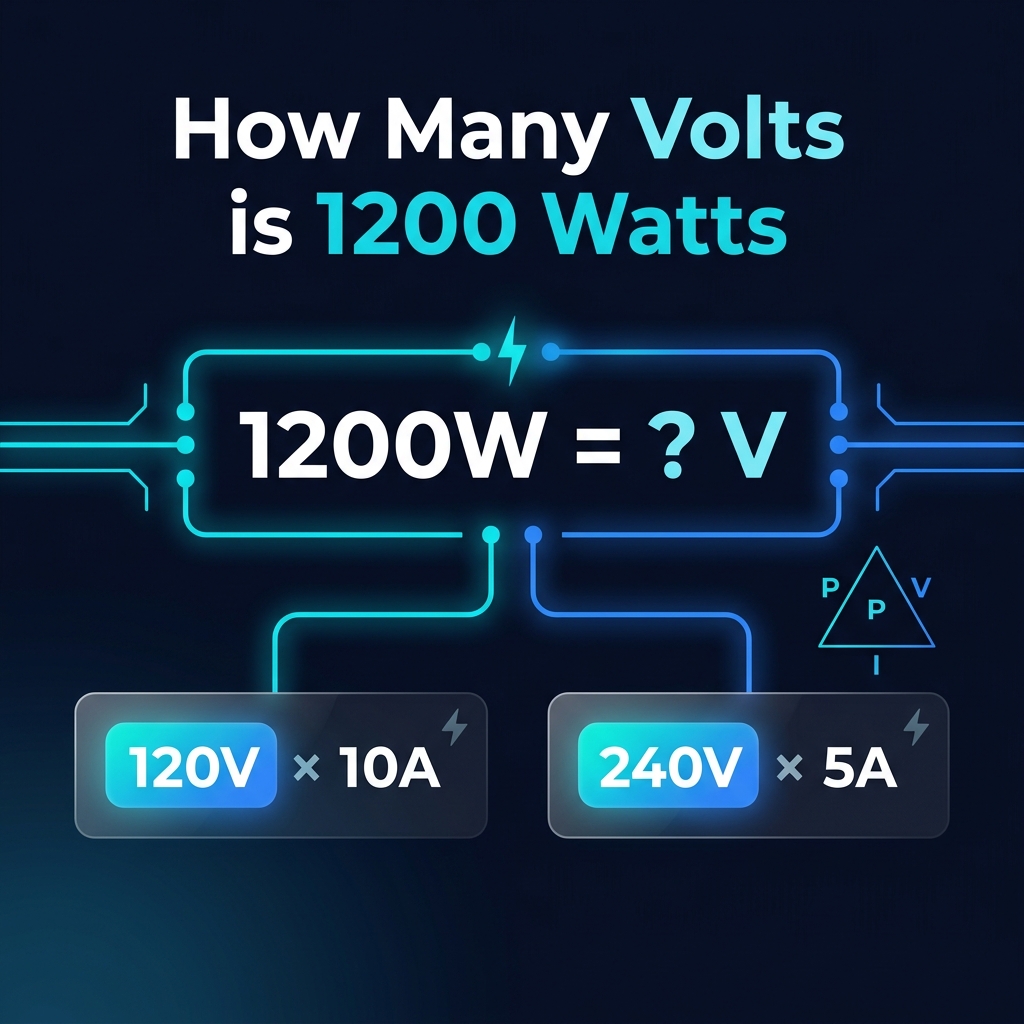
How many volts is 1200 watts? 1200 watts doesn’t equal a single fixed voltage — the voltage depends on how many amps the device draws. Use the formula Volts = Watts ÷ Amps: at 10 amps, 1200 watts equals 120 volts; at 5 amps, it equals 240 volts. Most 1200-watt household appliances — space heaters, microwaves, hair dryers — run on a standard 120-volt outlet and draw 10 amps of current.
1200 watts can equal many different voltages depending on the current (amps). The most common results: 120V at 10A (standard US outlet) or 240V at 5A (heavy-duty circuit). Formula: V = W ÷ A. You always need to know the amps to find the voltage — watts alone aren’t enough.
That’s the short version. But if you’re trying to figure out whether your outlet can handle a 1200-watt appliance, what circuit breaker you need, or how this works in a solar setup — keep reading. Everything below is written to actually help you, not just repeat the formula five different ways.
Why You Can’t Convert Watts to Volts Without Amps
Here’s the thing — watts and volts measure completely different properties of electricity. Trying to convert watts to volts without knowing the amps is like asking “how fast was the car going?” when you only know how much fuel it burned. You need more information.
Watts, Volts, and Amps — What Each One Measures
Watts (W) measure electrical power — the total rate of energy consumption. A 1200-watt space heater burns through 1,200 joules of energy every second.
Volts (V) measure electrical pressure — the force pushing electrons through a wire. Your standard US wall outlet supplies 120 volts. European outlets deliver 230 volts.
Amps (A) measure electrical current — the actual flow of electrons through the conductor. A typical household circuit carries 15 or 20 amps.
These three are locked together by Watt’s Law: P = V × I (Power = Volts × Amps). Change one, and the others shift to compensate.
The Water Pipe Analogy
Think of your electrical circuit like a garden hose. Voltage is the water pressure — how hard the water pushes. Amperage is the flow rate — how much water moves through per second. Wattage is the total output — how much work that water can do hitting a waterwheel.
You can get the same total power (watts) with high pressure and low flow (high volts, low amps) or low pressure and high flow (low volts, high amps). That’s exactly why 1200 watts can be 120V × 10A or 240V × 5A or 12V × 100A. Same power, different combinations.
The Watts to Volts Formula (Step-by-Step)
Three formula paths will get you from 1200 watts to volts. Pick the one that matches the information you have.
Formula for DC Circuits: V = W ÷ A
Direct current circuits — batteries, solar panels, USB chargers — use the simplest version:
Volts = Watts ÷ Amps
Example: A 1200W DC load drawing 10A:
V = 1200 ÷ 10 = 120 volts
No power factor, no extra variables. Just division.
Formula for AC Circuits (Single-Phase): V = W ÷ (A × PF)
Alternating current adds one wrinkle: the power factor (PF). Power factor measures how effectively an AC circuit converts supplied power into useful work.
Volts = Watts ÷ (Amps × Power Factor)
Example: A 1200W AC appliance drawing 10A with PF = 1.0 (a resistive load like a heater):
V = 1200 ÷ (10 × 1.0) = 120 volts
Example: A 1200W AC motor drawing 12.5A with PF = 0.8:
V = 1200 ÷ (12.5 × 0.8) = 120 volts
Notice the motor draws more current for the same wattage because its power factor is below 1.0. That matters for circuit breaker sizing.
Formula Using Resistance: V = √(W × Ω)
When you know the resistance (in ohms) instead of the current, combine Watt’s Law with Ohm’s Law:
Volts = √(Watts × Ohms)
Example: A 1200W heating element with 12 ohms of resistance:
V = √(1200 × 12) = √14,400 = 120 volts
This approach works when you’ve measured resistance with a multimeter but don’t have an amp reading.
1200 Watts at Different Voltages — Quick Reference Chart
| Voltage | Current Draw | Common Use Case |
|---|---|---|
| 12V | 100 amps | Automotive / RV battery systems (very high current — thick cables required) |
| 24V | 50 amps | Solar battery banks, marine systems |
| 48V | 25 amps | Off-grid solar, telecom power systems |
| 120V ★ | 10 amps | Standard US/Canada household outlets — most common for 1200W devices |
| 230V | 5.2 amps | European / UK / Australian household outlets |
| 240V | 5 amps | US heavy-duty outlets (dryers, ranges, water heaters) |
★ Most 1200-watt household appliances in North America operate at 120V. Formula: Amps = 1200W ÷ Voltage.
The pattern is clear: as voltage goes up, current goes down. That inverse relationship is exactly why power grids use high voltage for long-distance transmission — less current means thinner wires and lower energy losses.
Is 1200 Watts 120 Volts or 240 Volts?
This is the real question most people are asking. The answer: it depends on the device, but the overwhelming majority of 1200-watt household appliances in North America run on 120 volts.
1200 Watts on a 120V Circuit (Most Common)
If you’re in the US or Canada and you bought a 1200-watt space heater, microwave, hair dryer, or toaster oven — it runs on 120V. Plug it into any standard wall outlet. At 120 volts, it draws 10 amps (1200 ÷ 120 = 10).
That’s well within the 15-amp or 20-amp rating of a standard household circuit.
1200 Watts on a 240V Circuit
Some industrial or commercial equipment operates at 1200W on a 240V circuit, drawing only 5 amps. You’ll also see this with certain heating elements, workshop tools, and equipment designed for international use (where 230–240V is the standard residential voltage).
How to Check Which Voltage Your Appliance Needs
Flip the device over or look near the power cord. Every appliance has a nameplate label listing its voltage, wattage, and sometimes amperage. You’ll see something like “120V ~ 60Hz 1200W” or “120V 10A.” That label is your definitive answer — don’t guess.
Common 1200-Watt Appliances and Their Voltage
| Appliance | Typical Wattage | Voltage | Amps |
|---|---|---|---|
| 🔥 Space Heater | 1,200–1,500 W | 120V | 10–12.5 A |
| 🍳 Microwave Oven | 1,000–1,200 W | 120V | 8.3–10 A |
| 💇 Hair Dryer | 1,200–1,875 W | 120V | 10–15.6 A |
| 🍞 Toaster Oven | 1,100–1,200 W | 120V | 9.2–10 A |
| ☕ Coffee Maker | 900–1,200 W | 120V | 7.5–10 A |
| 👗 Clothing Iron | 1,000–1,200 W | 120V | 8.3–10 A |
Every single one of these runs on a standard 120V outlet. That’s not a coincidence — 120V × 10A = 1200W is effectively the sweet spot for high-power household devices on a standard circuit. Go much higher and you start pushing the limits of a 15-amp breaker.
How Many Amps Does 1200 Watts Draw?
Flip the formula around: Amps = Watts ÷ Volts. The answer changes dramatically depending on the voltage of your circuit.
At 120 Volts → 10 Amps
This is the most common scenario for household appliances. A 1200-watt device on a standard 120V outlet draws 10 amps — about two-thirds of a 15-amp breaker’s capacity.
At 240 Volts → 5 Amps
On a 240V circuit (the type used for dryers, ranges, and some workshop tools), 1200 watts draws only 5 amps. Half the current, same power.
At 12 Volts → 100 Amps (Battery/Solar Systems)
Here’s where things get serious. A 1200-watt load on a 12V battery system draws a whopping 100 amps. That requires extremely thick cables (2/0 AWG or larger) and puts massive strain on your battery bank. It’s one reason most serious off-grid systems use 24V or 48V architectures instead.
If you’re working with different wattages, our watts to amps calculator handles DC and AC conversions instantly.
What Size Circuit Breaker for 1200 Watts?
A 1200-watt load on a 120V circuit draws 10 amps. So which breaker do you need?
The 80% Rule (NEC Continuous Load Requirement)
The National Electrical Code (NEC) requires that continuous loads — anything running for 3 hours or more — shouldn’t exceed 80% of the circuit breaker’s rated capacity. That’s a safety margin to prevent wire overheating.
For a 15-amp breaker: 15 × 0.80 = 12 amps max continuous. Your 1200-watt device at 10 amps sits comfortably below that limit.
For a 20-amp breaker: 20 × 0.80 = 16 amps max continuous. Even more headroom.
15-Amp vs 20-Amp Breaker for 1200 Watts
A 15-amp breaker works fine for a 1200-watt device — as long as nothing else heavy is running on the same circuit. If your breaker trips when you turn on the space heater, it’s not because 1200W is too much for the breaker. It’s because other devices on that circuit (lights, a TV, a computer) are pushing the total above 15 amps.
When You Need a Dedicated Circuit
If a 1200-watt device runs continuously (like a space heater in winter) and your breaker trips regularly, consider putting it on a dedicated circuit — a circuit that serves only that one outlet. This is standard practice for microwaves and is required by the NEC for certain kitchen and bathroom circuits.
Wire gauge matters too. A 15-amp circuit requires at least 14 AWG copper wire. A 20-amp circuit needs 12 AWG. Never install a 20-amp breaker on 14 AWG wire — the breaker won’t trip fast enough to protect the wire from overheating, creating a fire hazard.
1200 Watts in Solar and Off-Grid Systems
If you’re running a 1200-watt load from a battery bank or solar setup, voltage selection matters enormously.
Battery Voltage and Current Draw at 1200W
| Battery Voltage | Current Draw | Min. Wire Gauge | Practical? |
|---|---|---|---|
| 12V | 100 A | 2/0 AWG | ⚠️ Barely — massive cable, high losses |
| 24V | 50 A | 4 AWG | Workable — common in mid-size solar |
| 48V | 25 A | 8 AWG | ✓ Best — low current, thin wires, minimal loss |
Sizing an Inverter for 1200 Watts
Your inverter converts DC battery power to AC for household devices. A 1200-watt inverter might handle a 1200-watt load — but you’d be running it at 100% capacity with zero headroom.
Buy an inverter rated for at least 1500–2000 watts continuous to comfortably handle a 1200-watt load. Also check the surge rating — microwaves and some motors spike above their rated wattage during startup. A microwave labeled “1200W cooking power” often has an input wattage of 1500–1800W.
Why Higher Battery Voltage = Lower Amps = Thinner Wire
This is the same inverse relationship from the formula. At 12V, 1200 watts demands 100 amps — that’s welding-cable territory. At 48V, the same 1200 watts pulls only 25 amps through reasonably sized wire. Higher voltage systems are cheaper to wire, lose less energy to heat, and put less stress on your batteries.
If you’re building an off-grid system for 1200W+ loads, go 24V minimum. 48V is better.
Does Power Factor Change the Calculation?
For most household 1200-watt devices? No. But if your device has a motor or compressor, yes — and the difference matters.
When Power Factor Equals 1.0 (Resistive Loads)
Space heaters, toaster ovens, incandescent bulbs, and clothing irons are resistive loads. Their power factor is essentially 1.0. Every bit of current they draw does useful work. The simple formula (V = W ÷ A) gives you the exact answer.
When Power Factor Is Less Than 1.0 (Motors, Compressors)
Motors, compressors, fluorescent lighting, and many electronics draw reactive power — current that sloshes back and forth without doing useful work. A 1200-watt motor with a power factor of 0.8 draws 12.5 amps at 120V, not 10 amps. The motor still does 1200 watts of actual work, but the circuit sees more current.
That extra current means the wire heats up more and your circuit breaker is closer to its limit. It’s the reason some 1200-watt devices trip breakers while others don’t.
Power factor can get complex fast — we’ve written a detailed breakdown of what power factor means in AC circuits if you want the full picture.
How Much Does It Cost to Run a 1200-Watt Device?
Quick math: 1200W ÷ 1000 = 1.2 kWh per hour. Multiply by your electricity rate to get the cost.
The kWh Calculation
Cost per hour = (1200W ÷ 1000) × electricity rate Cost per hour = 1.2 kWh × $0.16 = $0.192
Cost Per Hour, Per Day, Per Month
| Electricity Rate | Cost/Hour | Cost/8 Hours | Cost/Month (8 hrs/day) |
|---|---|---|---|
| $0.10/kWh | $0.12 | $0.96 | $28.80 |
| $0.16/kWh (US avg.) | $0.19 | $1.54 | $46.08 |
| $0.20/kWh | $0.24 | $1.92 | $57.60 |
| $0.30/kWh (CA, HI, CT) | $0.36 | $2.88 | $86.40 |
Source: U.S. Energy Information Administration (EIA) average residential electricity rate data, 2025.
Running a 1200-watt space heater 8 hours a day for a full month costs between $29 and $86 depending on where you live. If you’re in California or Hawaii, that heater is noticeably expensive. In Louisiana or Idaho, it’s barely a blip on your bill.
Is 1200 Watts a Lot of Electricity?
Context helps. Here’s where 1200 watts falls on the household power spectrum:
1200 watts is moderate for a single appliance. It’s roughly the upper limit of what a standard 120V outlet handles comfortably. You wouldn’t blink at 1200W on its own — but running two 1200-watt devices on the same circuit pushes past the breaker limit.
Safety Tips for 1200-Watt Devices
A 1200-watt device is perfectly safe on the right circuit. Problems happen when people make a few common mistakes.
Don’t Share Circuits with Other High-Draw Devices
If you’ve ever tripped a breaker while running a space heater and a microwave at the same time, you’ve lived this lesson. Two 1200-watt devices on a 120V circuit draw 20 amps combined — well over the 15-amp breaker’s limit. The breaker trips, and that’s the best outcome. Without a breaker, the wire overheats.
Quick rule: if a device draws 10+ amps, give it its own circuit whenever possible.
Skip the Extension Cord
Extension cords add resistance, which generates heat — especially under a 10-amp load. The National Fire Protection Association (NFPA) consistently lists extension cord misuse as a leading cause of home electrical fires. Space heaters, in particular, should always plug directly into a wall outlet. No extension cords. No power strips. Straight into the wall.
When to Call an Electrician
- Your breaker trips every time you use a specific 1200-watt device
- You smell burning plastic near an outlet under heavy load
- Your outlets feel warm to the touch
- You’re running multiple high-wattage devices and want a dedicated circuit installed
A licensed electrician can add a dedicated 20-amp circuit for under $200–$400 in most areas — cheap insurance against fire risk.
This article provides general educational information about electrical calculations. For any electrical installation, wiring changes, or if you’re unsure whether your circuit can handle a specific load, always consult a licensed electrician. Electrical work is governed by the National Electrical Code (NEC) and local building codes, which vary by jurisdiction.
Frequently Asked Questions
Can I plug a 1200-watt appliance into a regular outlet?
Yes. A standard 120V, 15-amp outlet handles up to 1800 watts total (120V × 15A = 1800W). Your 1200-watt device at 10 amps is well within that limit. Just don’t plug another high-draw device into the same circuit at the same time.
How many amps does a 1200-watt heater draw?
At 120 volts, a 1200-watt heater draws 10 amps (1200 ÷ 120 = 10). At 240 volts, it draws 5 amps (1200 ÷ 240 = 5). Check the label on your heater to confirm which voltage it requires.
Is 1200 watts enough for a microwave?
Yes. 1200 watts of cooking power is standard for a mid-to-large countertop microwave — enough to heat food quickly and evenly. Note that the input wattage (what the microwave draws from the wall) is higher than the cooking wattage, typically 1500–1800W.
Can two 1200-watt devices share one circuit?
Not safely on a 15-amp circuit. Two 1200W devices at 120V draw 20 amps combined — exceeding the 15-amp breaker limit. On a 20-amp circuit, 20 amps hits the breaker’s maximum rating with zero margin. Keep one high-draw device per circuit.
What’s the difference between 1200 watts and 1200 VA?
Watts measure real power — the power that does actual work. VA (volt-amperes) measure apparent power, which includes reactive power in AC circuits. For resistive loads like heaters, watts and VA are equal. For motors and electronics with a power factor below 1.0, VA is higher than watts. A device rated at 1200 VA with a power factor of 0.8 produces only 960 watts of real power.
Can a 1200-watt inverter run a microwave?
It depends on the microwave’s input wattage. A “1200W cooking power” microwave typically draws 1500–1800W from the wall. A 1200-watt inverter can’t handle that. You’d need an inverter rated for at least 1800–2000W continuous, with surge capacity above that for startup spikes.
How do I find the wattage of my appliance?
Check the label on the back, bottom, or near the power cord. Look for a number followed by “W” or “Watts.” If only voltage and amps are listed, multiply them: W = V × A. A label reading “120V 10A” means the device uses 1200 watts.
Does voltage matter if the wattage is the same?
Absolutely. Higher voltage means lower current for the same wattage. Lower current allows thinner wires, smaller breakers, and less energy lost to heat. That’s why industrial facilities use 240V or 480V — it cuts current in half or more, saving money on wiring and reducing losses.
Last updated: June 4, 2026. This article is reviewed and updated periodically to reflect current NEC standards and electricity rate data.
For more electrical calculations, visit WattsToVolts.com — including free calculators for watts-to-volts, volts-to-watts, watts-to-amps, and the complete Watts-Volts-Amps-Ohms calculator.