From Cooling Tower Inspection Findings to a Practical Parts Replacement Plan
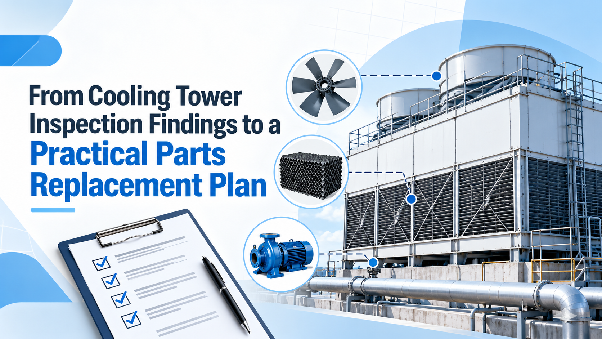
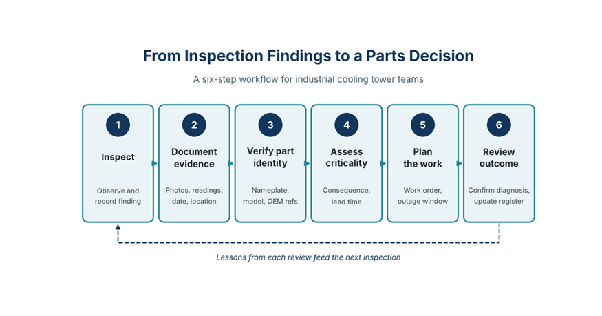
A practical parts replacement plan starts with evidence, not a purchase order. After each inspection, record the tower identity, observed condition, and operating readings. Next, rank each finding by consequence of failure, redundancy, and lead time.
Then confirm compatibility with the OEM or a qualified technical contact before buying. A simple decision register links every finding to an action, an owner, and a review date. This approach turns cooling tower maintenance notes into controlled, traceable decisions.
Why Inspection Findings Should Lead to a Documented Parts Decision
Most inspection reports describe what the crew saw. Few state what the plant will do next, who owns that decision, or when someone will check again.
Some findings then sit in a report until the component fails. Others trigger rushed orders for parts that do not fit or do not fix the real cause.
Many cooling tower maintenance and repair programs lose control at this decision step. A documented decision gives each finding one outcome: repair, replace, monitor, or inspect further.
Capture a Useful Baseline Before Ordering Parts
Before anyone requests a quote, the team needs enough detail to identify the equipment and describe the problem clearly.
Record Tower Model, Manufacturer, Serial/Asset ID and Operating Context
Start with the tower nameplate and the plant asset register. These details let a vendor or OEM identify the exact equipment:
- Manufacturer, model, and serial number
- Plant asset ID and cell number
- Tower type, such as crossflow or counterflow
- Service duty and operating hours
Document Observed Condition, Symptoms, Photos, Operating Readings, and Date
Next, describe the finding itself. Photos with a scale reference help reviewers judge damage. Include:
- The location of the finding within the tower
- Symptoms, such as noise, vibration, leaks, or uneven water flow
- Readings, such as motor current, vibration, or water temperatures
- The inspection date and the inspector’s name
Data availability varies by site and OEM. Older towers may lack nameplates or drawings, so record what the team can confirm and flag the gaps.
Sort Findings by Operational Criticality, Not by Price Alone
A low-cost part can carry a high consequence. A worn drive shaft coupling may cost less than a fill section, yet its failure can stop a cell. Rank each finding with three questions instead of a fixed score.
Consequence of Failure
Ask what happens if the part fails before the next planned outage, including safety risk, lost cooling capacity, and damage to connected equipment.
Redundancy and Lead Time
A multi-cell tower may run with one cell offline, while a single-cell tower may not. Long lead times also raise priority, because the order must go out before the next outage.
Whether the Part Affects Airflow, Water Distribution, Heat Transfer, Structure, or Drive Reliability
Grouping findings by function shows which system each problem threatens:
- Airflow: fans, fan stacks, air inlet louvers, and drift eliminators
- Water distribution: nozzles, headers, and distribution basins
- Heat transfer: fill media
- Structure: structural members, tower hardware, and the fan deck
- Drive reliability: motors, gearboxes, drive shafts, and couplings
Findings that affect structure or rotating equipment usually deserve the closest review, because those failures can create safety hazards.
Match the Component to the Tower Before Procurement
Many replacement errors start when someone copies a part number from memory or from a similar tower. A compatibility check prevents that mistake.
Verify Dimensions, Materials, OEM References, and Compatibility
Compare the proposed part with the original specification, including dimensions, material, connections, and ratings. A gearbox with the wrong ratio, for example, changes fan speed and airflow.
Identify Obsolete Parts and Approved Equivalents
When the OEM discontinues a part, the team needs an approved equivalent with documented specifications. Record who approved the substitute and why.
Confirm Drawings/Manuals With the OEM or Qualified Technical Contact
Use the model-specific manual and drawings. Once the team confirms the equipment identity and required specifications, it can review relevant cooling tower replacement parts and request quotes with accurate details.
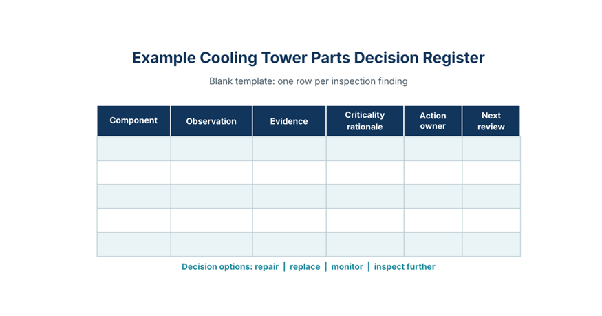
Build a Decision Table for Repair, Replacement, Monitoring or Further Inspection
A decision register keeps every finding visible until someone closes it. The example below shows the format only and does not recommend actions for any specific tower.
| Finding | Evidence Needed | Interim Action | Decision Owner | Parts Needed | Review Date |
|---|---|---|---|---|---|
| Clogged nozzles in one hot water basin | Photos, basin water level | Clean accessible nozzles | Maintenance planner | Nozzles, if damaged | Next routine round |
| Rising gearbox vibration | Vibration trend, oil analysis | Increase monitoring | Reliability engineer | Confirm after OEM review | Before next outage |
| Sagging fill section | Photos, fill condition survey | Monitor water distribution | Maintenance manager | Fill media matched to tower | Next planned outage |
| Corroded fan deck hardware | Close-up photos, extent survey | Restrict access per site rules | Site engineer | Hardware to specification | Inspection follow-up |
Coordinate Maintenance Windows, Spares and Vendor Lead Times
A correct part still causes trouble if it arrives after the outage ends. Good planning connects four steps:
- Work order: The planner links the work order to the register entry.
- Procurement: Purchasing quotes the confirmed specification and asks for lead time.
- Receiving checks: Stores staff check the delivered part against the specification.
- Planned outage: The team confirms labor, access equipment, and permits.
Stock and lead time vary by part and vendor, so confirm availability in writing. Critical spares with long lead times may justify on-site stock, decided case by case.
Review Outcomes and Improve the Register
After each outage, record whether the original diagnosis proved correct. These measures show whether the process works:
- Repeat failures on the same component or cell
- Actual lead time compared with the quoted lead time
- Unplanned work caused by deferred findings
- Diagnoses that the removed part confirmed or contradicted
After major work such as fill replacement, some owners verify thermal performance with a test under CTI ATC-105, the Cooling Technology Institute’s acceptance test code.
Best Practices and Expert Tips
These habits keep the process consistent across shifts and contractors:
- Photograph the nameplate at every inspection, since weather and paint can hide it.
- Keep one register per tower, not separate lists for each contractor.
- Assign a named owner to every open finding.
- Ask vendors for lead times on critical parts before the outage, not during it.
Common Mistakes
The same errors appear in many parts plans, and each one is easy to avoid:
- Ordering by part description alone, without model and serial data
- Replacing a part without confirming the root cause
- Treating every finding as urgent, which hides the truly critical ones
- Closing an entry before anyone confirms the repair worked
Conclusion
A parts replacement plan works when every finding follows the same path. Record the evidence, rank the risk, and confirm compatibility before procurement. Then plan the work around real lead times and review the outcome. This workflow turns cooling tower maintenance findings into decisions the whole team can trace and defend.
Where inspection findings require a broader service review, industrial teams can review ICS’s cooling tower maintenance services.
Frequently Asked Questions
What should a team record before ordering a cooling tower replacement part?
Record the manufacturer, model, serial number, and plant asset ID first. Then add the tower type, finding location, photos, symptoms, and readings such as vibration or motor current. Include the inspection date and inspector’s name. These details help the OEM or a parts supplier identify the correct component and lower the risk of a part that does not fit.
When should a team inspect further instead of replacing a part right away?
Inspect further when the root cause remains unclear or the evidence looks incomplete. The same applies when the part affects structure or rotating equipment and needs a qualified review. An interim action, such as closer monitoring, buys time for an accurate diagnosis. Set a firm review date so the finding does not stay open indefinitely.
How can a plant decide which cooling tower parts to replace first?
Start with the consequence of failure, not the price of the part. Next, weigh redundancy, since a multi-cell tower may run with one cell offline. Then check lead time, because long waits push an order forward. Findings that affect structure, drives, or safety usually rank highest, and a shared register keeps those priorities visible.