Amp Hour Calculator: Find Battery Runtime and Required Capacity
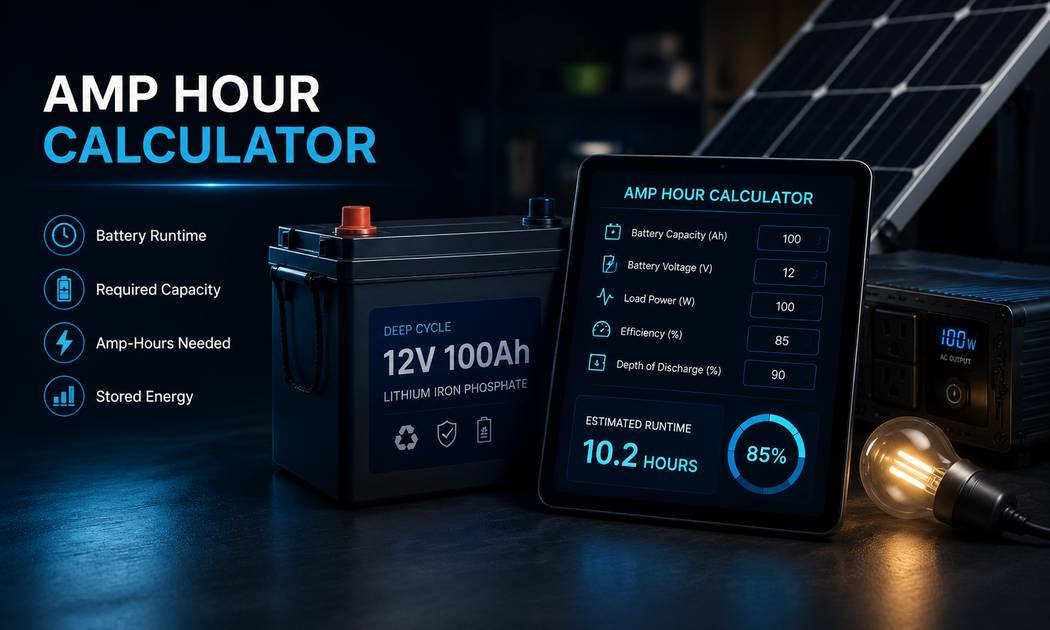
An amp hour (Ah) is a unit that measures how much electric charge a battery can deliver over time. If a battery is rated at 100 Ah, it can theoretically supply 1 amp for 100 hours, 10 amps for 10 hours, or 100 amps for 1 hour. Understanding amp hours helps you size batteries correctly for solar panels, RVs, boats, backup power systems, and off-grid setups.
Amp Hours = Current (Amps) × Time (Hours)
Or inversely: Runtime (Hours) = Battery Capacity (Ah) ÷ Current Draw (Amps)
To find required battery size: Required Ah = Current Draw (A) × Desired Runtime (Hours)
Amp Hour Calculator
🔋 Battery Amp Hour Calculator
Choose a calculation mode and enter your values
What Is an Amp Hour?
An amp hour (Ah) is a unit of electric charge. It represents the amount of charge transferred by a steady current of one ampere flowing for one hour. Amp hours are primarily used to describe battery capacity — a larger Ah rating means the battery can supply power for a longer period.
Key relationships:
- 1 Ah = 1 Amp × 1 Hour = 3,600 coulombs of charge
- A 100 Ah battery can deliver 5A for 20 hours, or 20A for 5 hours
- Watt-hours (Wh) = Ah × Voltage — this converts capacity to energy
How to Calculate Battery Runtime
The most common use of amp hour calculations is determining how long a battery will last under a specific load:
Runtime (Hours) = Usable Capacity (Ah) ÷ Load Current (Amps)
The “usable capacity” accounts for Depth of Discharge (DoD). Most batteries shouldn’t be fully discharged:
| Battery Type | Recommended DoD | Usable Ah (from 100Ah) |
|---|---|---|
| Lead-Acid (FLA) | 50% | 50 Ah |
| AGM | 50–60% | 50–60 Ah |
| Lithium (LiFePO4) | 80–90% | 80–90 Ah |
| Lithium-Ion (Li-Ion) | 80% | 80 Ah |
How to Size a Battery (Required Capacity)
When designing a solar system, RV setup, or backup power system, you need to calculate the required battery capacity:
Required Ah = (Total Daily Load in Watts × Hours of Use) ÷ (System Voltage × DoD)
Example: If you need to run a 60W load for 8 hours on a 12V system with 50% DoD:
- Required Ah = (60W × 8h) ÷ (12V × 0.50) = 480 ÷ 6 = 80 Ah
Always add a 20–25% safety margin to your calculated battery capacity. Real-world efficiency losses from inverters, wiring, and temperature can reduce effective capacity. Also, batteries degrade over time, so oversizing ensures longevity.
Amp Hours vs Watt Hours
Many people confuse amp hours (Ah) and watt hours (Wh). Here’s the difference:
- Amp Hours (Ah) measure charge — how many amps a battery can supply over time
- Watt Hours (Wh) measure energy — the total work a battery can do
The conversion is straightforward:
Wh = Ah × Voltage
A 100 Ah battery at 12V stores 1,200 Wh (1.2 kWh) of energy. The same 100 Ah at 48V stores 4,800 Wh (4.8 kWh). That’s why voltage matters when comparing batteries.
Common Applications
Solar Power Systems
Solar batteries are typically rated in amp hours. A typical off-grid solar setup might use 200–400 Ah of battery storage at 12V or 48V to provide power overnight and during cloudy days.
RV and Marine
RV house batteries commonly range from 100–300 Ah. Deep-cycle batteries are preferred since they can handle repeated discharge and recharge cycles.
UPS and Backup Power
Uninterruptible power supplies use amp hour ratings to determine how long they can keep critical equipment running during a power outage.
Conclusion
Understanding amp hours is essential for anyone working with batteries — whether you’re building a solar system, outfitting an RV, or sizing a backup power supply. Use the calculator above to quickly estimate runtime, required capacity, or maximum current draw. Remember to account for depth of discharge and add a safety margin for real-world conditions.